Gelidium pusillum (Stackhouse) Le Jolis
Classification:
Empire Eukaryota
Kingdom Plantae
Phylum Rhodophyta
Subphylum Eurhodophytina
Class Florideophyceae
Subclass Rhodymeniophycidae
Order Gelidiales
Family Gelidiaceae
Genus Gelidium
- Uses and Compounds
- Taxonomy
- References
- Submit Feedback
- Submit Reference
- Links
- Genbank
- Index Nominum Algarum
- Biodiversity Heritage Library
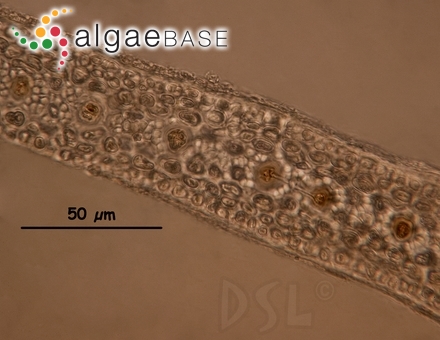
Pictures
click on thumbnail for larger version.

upper intertidal, Ría de Arousa, Galicia, Spain, 2012. Ignacio Bárbara. © Ignacio Bárbara (barbara@udc.es).

Low intertidal at fringing coral reef of Sesoko Island (Okinawa, Japan).. 29 Feb 2012. Eduard and Tamara Titlyanova (etitlyanov@mail.ru). © Eduard and Tamara Titlyanova (etitlyanov@mail.ru).

together Caulacanthus ustullatus, A Coruña, Galicia, Spain, 2008. Ignacio Bárbara. © Ignacio Bárbara (barbara@udc.es).

together Caulacanthus ustullatus, A Coruña, Galicia, Spain, 2008. Ignacio Bárbara. © Ignacio Bárbara (barbara@udc.es).

OLYMPUS DIGITAL CAMERA "
. Ignacio Bárbara. © Ignacio Bárbara (barbara@udc.es).

Lord Howe Island, Australia. 22 Nov 2010. M.D. Guiry. © Michael Guiry (mike.guiry@nuigalway.ie).

Lord Howe Island, Australia. 22 Nov 2010. M.D. Guiry. © Michael Guiry (mike.guiry@nuigalway.ie).

Gelidium pusillum , Lord Howe Island, Australia. 21 Nov 2010. M.D. Guiry. © Michael Guiry (mike.guiry@nuigalway.ie).

Gelidium pusillum (give to Gary for sequencing), Neds Beach , Lord Howe Island, Australia"
. M.D. Guiry. © Michael Guiry (mike.guiry@nuigalway.ie).

Gelidium pusillum (give to Gary for sequencing), Neds Beach , Lord Howe Island, Australia"
. M.D. Guiry. © Michael Guiry (mike.guiry@nuigalway.ie).
20 Found - Displaying 1 through 10
Publication details
Gelidium pusillum (Stackhouse) Le Jolis 1863: 139
Original publication: Le Jolis, A. (1863). Liste des algues marines de Cherbourg. Mémoires de la Société Impériale des Sciences Naturelles de Cherbourg 10: 5-168, pls I-IV.
Download PDF
Type species
The type species (holotype) of the genus Gelidium is Gelidium corneum (Hudson) J.V.Lamouroux.
Status of name
This name is of an entity that is currently accepted taxonomically.
Basionym
Fucus pusillus Stackhouse
Type information
Type locality: Sidmouth, Devon, England (Athanasiadis 1996: 85). Lectotype: BM (Womersley & Guiry 1994: 135). Notes: Womersley & Guiry (1994: 135) note that a "provisional lectotype" was selected by Dixon & Irvine (1977a: 139).
Origin of species name
Adjective (Latin), very small (Stearn 1973).
Homotypic Synonym(s)
Kaliformia pusilla (Stackhouse) Stackhouse
Fucus pusillus Stackhouse 1795
Chondria pusilla (Stackhouse) W.J.Hooker 1821
Acrocarpus pusillus (Stackhouse) Kützing 1849
Heterotypic Synonym(s)
Fucus hetaerophyllus Clemente 1807
Gelidium repens Okamura 1899
General environment
This is a Marine species.
Common names
(as Gelidium pusillum (Stackhouse) Le Jolis)
Japanese: Hai-tengusa (Chapman & Chapman 1980).
Description
Cartilaginous, purplish or blackish red, turf-forming, 2-10 mm high, arising from an extensive creeping base and incorporating shell debris and small molluscs. Erect fronds flattened and leaf-like and 0.5-2 mm broad.
Habitat
On rock in upper intertidal forming extensive mat-like growths below Pelvetia canaliculata, particularly on vertical or near-vertical surfaces. Sometimes associated with Catenella caespitosa and Rhodothamniella purpurea. Widely distributed, common.
Key characteristics
Turf formation in the upper intertidal, blackish-red colour when slightly dry, and extensive rhizoids.
Similar species
Catenella caespitosa also forms turf- or mat-like extensions but is softer has has the appearance of small cocktail sausages.
Distribution by country
Point data for Ireland and Britain
This map may take a minute to load. Please use an up-to-date web browser (Google Chrome 11, Firefox 4, Safari 5, Opera 11, Internet Explorer 9) for best performance.Detailed distribution with sources
(as Fucus hetaerophyllus Clemente)
Europe: Spain (Roxas Clemente y Rubio 1807).
(as Gelidium pusillum (Stackhouse) Le Jolis)
Ireland: Antrim (Morton 1994), Clare (De Valéra et al. 1979), Cork (Cullinane 1971), Derry (Morton 1994), Donegal (Morton 2003), Down (Morton 1994), Leitrim (Cullinane 1970), Mayo (Cotton 1912), Waterford (Guiry 1977), Wexford (Norton 1970).
Wales: Anglesey (Freshwater & Rueness 1994).
Europe: Adriatic (Giaccone 1978, Munda 1979, Ercegovic 1980), Balearic Islands (Navarro & Bellón 1945, Ribera Siguán & Gómez Garreta 1984), Britain (Newton 1931, Dixon & Irvine 1977, Guiry 1997, Hardy & Guiry 2003), Corsica (Boudouresque & Perret 1977), France (Feldmann 1939, Feldmann 1954, Freshwater & Rueness 1994, Verlaque 2001, Dizerbo & Herpe 2007, Loiseaux-de Goër & Noailles 2008, Anon. 2012), Greece (Gerloff & Geissler 1974, Haritonidis & Tsekos 1976, Tsekos & Haritonidis 1977, Athanasiadis 1987, Tsirika & Haritonidis 2005), Ireland (Cotton 1912, Cullinane 1971, Guiry 1977, Guiry 1978, De Valéra et al. 1979, Morton 1994, Guiry 2012), Italy (Giaccone 1969, Feoli & Bressan 1972, Cinelli et al. 1976, Cecere et al. 1996, Furnari, Cormaci & Serio 1999, Rindi, Sartoni & Cinelli 2002, Furnari et al. 2003, Perrone et al 2006), Malta (Cormaci et al. 1997), Netherlands (Stegenga & Mol 1983), Norway (Freshwater & Rueness 1994, Rueness 1997, Rueness & Fredriksen 1998), Portugal (Ardré 1970, Cremades et al., 2002, Araujo, R., I. Bárbara, I. Sousa-Pinto & V. Quintino (2005), Araujo et al. 2009, Araújo, Bárbara & Sousa-Pinto in press), Romania (Caraus 2002, Caraus 2012), Sardinia (Furnari et al. 2003), Scandinavia (Athanasiadis 1996), Slovenia (Rindi & Battelli 2005), Spain (Miranda 1931, Seoane-Camba 1965, Ballesteros 1981, Pérez-Cirera & Maldonado 1982, Ballesteros & Romero 1982, Fernández & Niell 1982, Fernández, Niell & Anadón 1983, Anadón 1983, Boisset & Barceló 1984, Boisset & Barceló 1984, Sierra & Fernández 1984, Pérez-Ruzafa & Honrubia 1984, Gallardo et al. 1985, Anadón & Fernández 1986, Rodriguez Prieto & Polo Alberti 1988, Soto & Conde 1989, Conde, Flores-Moya & Vera 1990, Fernández & Menéndez 1991, Pérez-Ruzafa et al. 1991, Granja, Cremades & Barbara 1992, Flores-Moya et al. 1994, Bárbara, Cremades & Pérez-Cirera 1995, Conde et al. 1996, Bárbara & Cremades 1996, Rodríguez-Prieto & Polo, L. 1996, Rodriguez-Prieto et al. 1997, Veiga, Cremades & Bárbara 1998, Rodriguez-Prieto & Polo Albertí 1998, Peña & Bárbara 2002, Gorostiaga et al., 2004, Bárbara et al. 2005, Peña & Bárbara 2006, Martínez-Gil et al. 2007, Pérez-Ruzafa et al. 2008, Peña & Bárbara 2008, Peña & Bárbara 2010, Cires Rodriguez & Cuesta Moliner 2010, Hernández et al. 2010), Turkey (Europe) (Taskin et al. 2008).
Atlantic Islands: Ascension (Price & John 1980, John et al. 2004), Azores (Tittley & Neto 1994, Neto 1994), Bermuda (Taylor 1960, Schneider & Searles 1991), Canary Islands (Børgesen 1927, Gil-Rodríguez & Afonso-Carrillo 1980, Viera-Rodriguez et al. 1987, Guadalupe et al. 1995, Haroun et al. 2002, Aldanondo-Aristizábal, Domínguez-Alvarez & Gil-Rodríguez 2003, Gil-Rodríguez et al. 2003, John et al. 2004, Anon 2011), Cape Verde Islands (John et al. 2004, Prud'homme van Reine, Haroun & Kostermans 2005), Madeira (Levring 1974, Neto, Cravo & Haroun 2001, Haroun et al. 2002, John et al. 2004), Salvage Islands (Audiffred & Weisscher 1984, Parente et al. 2000, John et al. 2004).
North America: California (Abbott & Hollenberg 1976, Santelices & Stewart 1985, Rodríguez & Santelices 1988, Stewart 1991, Miller 2012), Florida (Taylor 1960, Schneider & Searles 1991), Georgia (Schneider & Searles 1991), Gulf of California (Dawson 1944), Mexico (Taylor 1945, Dawson 1953), North Carolina (Schneider & Searles 1991), Oregon (Hansen 1997), South Carolina (Schneider & Searles 1991), Texas (Taylor 1960, Wynne 2009).
Central America: Costa Rica (Taylor 1945, Taylor 1960, Fernández-García et al. 2011), El Salvador (Fernández-García et al. 2011), Islas Revillagigedo (Taylor 1945), Panama (Taylor 1945, Fernández-García et al. 2011).
Caribbean Islands: Barbados (Taylor 1960), Caribbean (Littler & Littler 2000), Cuba (Taylor 1960, Cabrera, Moreira & Suárez 2004, Suárez 2005), Hispaniola (Betancourt & Herrera-Moreno, 2001), Lesser Antilles (Taylor 1960), Martinique (Rodríguez-Prieto, Michanek & Ivon 1999), Trinidad (Taylor 1960, Richardson 1975), Trinidad & Tobago (Duncan & Lee Lum 2006).
Western Atlantic: Trop. & Subtrop. W. Atlantic (Wynne 2011).
South America: Brazil (Taylor 1930, Joly 1957, Taylor 1960, Joly 1965, Villaca et al. 2010, Creed et al. 2010), Chile (Rodríguez & Santelices 1988, Ramírez & Santelices 1991), Colombia (Taylor 1960, Díaz-Pulido & Díaz-Ruíz 2003), Galápagos Islands (Ruiz & Ziemmeck 2011), Uruguay (Coll & Oliveira 1999), Venezuela (Ganesan 1990).
Africa: Angola (John et al. 2004), Benin (John et al. 2004), Cameroon (John et al. 2004), Côte d'Ivoire (John et al. 2004), Egypt (Papenfuss 1968, Aleem 1993), Equatorial Guinea (John et al. 2004), Eritrea (Lipkin & Silva 2002), Gabon (John et al. 2004), Gambia (John et al. 2004), Ghana (John et al. 2004), Kenya (Silva, Basson & Moe 1996, Bolton, Oyieke & Gwanda 2007), Liberia (John et al. 2004), Mauritania (John et al. 2004), Mauritius (Børgesen 1943, Silva, Basson & Moe 1996), Morocco (Dangeard 1949), Namibia (Rull Lluch 2002, John et al. 2004), São Tomé & Príncipe (John et al. 2004), Senegal (John et al. 2004), Sierra Leone (John et al. 2004), Somalia (Silva, Basson & Moe 1996), Tanzania (Silva, Basson & Moe 1996, Oliveira, Österlund & Mtolera 2005), Togo (John et al. 2004), Tunisia (Meñez & Mathieson 1981, Ben Maiz, Boudouresque & Quahchi 1987), Western Sahara (John et al. 2004).
Indian Ocean Islands: Aldabra Islands (Silva, Basson & Moe 1996), Andaman Islands (Silva, Basson & Moe 1996), Diego Garcia Atoll (Silva, Basson & Moe 1996), Laccadive Islands (Silva, Basson & Moe 1996), Maldives (Silva, Basson & Moe 1996), Nicobar Islands (Silva, Basson & Moe 1996), Réunion (Silva, Basson & Moe 1996), Seychelles (Silva, Basson & Moe 1996).
South-west Asia: Bangladesh (Silva, Basson & Moe 1996), India (Silva, Basson & Moe 1996, Sahoo et al. 2001), Iran (Sohrabipour & Rabii 1999), Israel (Papenfuss 1968, Einav 2007), Kuwait (Silva, Basson & Moe 1996), Oman (Silva, Basson & Moe 1996), Pakistan (Silva, Basson & Moe 1996), Saudi Arabia (Silva, Basson & Moe 1996), Sri Lanka (Silva, Basson & Moe 1996), Turkey (Asia) (Taskin et al. 2008), Yemen (Silva, Basson & Moe 1996).
Asia: China (Tseng 1984, Chang & Xia 1988, Xia, Tseng & Wang 2002, Zeng 2009), Hong Kong (Chang & Xia 1988), Japan (Okamura 1936, Segawa 1981, Yoshida, Nakajima & Nakata 1990, Yoshida 1998, Titlyanov et al 2006, Titlyanov & Titlyanov 2012), Korea (Lee 1994, Lee & Kang 2001, Lee 2008), Taiwan (Chang & Xia 1988, Huang 2000, Anon. 2012).
South-east Asia: Indonesia (Verheij & Prud'homme van Reine 1993, Silva, Basson & Moe 1996, Atmadja & Prud'homme van Reine 2012), Malaysia (Silva, Basson & Moe 1996), Myanmar (Burma) (Silva, Basson & Moe 1996), Philippines (Silva, Meñez & Moe 1987), Singapore (Silva, Basson & Moe 1996, Pham et al. 2011), Vietnam (Pham-Hoàng 1969).
Australia and New Zealand: Lord Howe Island (Millar & Kraft 1993), New South Wales (Millar & Kraft 1993, Womersley & Guiry 1994), New Zealand (Adams 1994), Northern Territory (Womersley 1958), Papua New Guinea (Coppejans & Millar 2000), Queensland (Lewis 1984, Phillips 1997, Phillips 2002, Bostock & Holland 2010), South Australia (Womersley & Guiry 1994, Copertino et al. 2005), Tasmania (Womersley & Guiry 1994), Victoria (Womersley & Guiry 1994, Shepherd et al. 2009), Western Australia (Womersley & Guiry 1994).
Pacific Islands: Easter Island (Børgesen 1924, Santelices & Abbott 1987), Federated States of Micronesia (Lobban & Tsuda 2003, Tsuda 2006), Fiji (N'Yeurt, South & Keats 1996, South & Skelton 2003), French Polynesia (Payri, N'Yeurt & Orempuller 2000), Hawaiian Islands (Rodríguez & Santelices 1988, Abbott 1999, Huisman, Abbott & Smith 2007), Mariana Islands (Tsuda 2003), Solomon Islands (Womersley & Bailey 1970).
Taxonomic notes
South & Skelton (2003) note that confusion probably occurs between G. pusillum and G. samoense (Santelices et al . 2003). John et al. (2004) cite Gelidium pusillum var. pulvinatum (C. Agardh) Feldmann, G. pulchellum (Turner) Kützing, G. pulvinatum (Kützing) Thuret ex Bornet and G. reptans (Suhr) Kylin as synonyms of this species, but see Fredriksen, Guiry & Rueness (1994) in relation to the separateness of G. pulchellum.
The occurrence of this upper intertidal species world-wide needs investigation. The name may only be applicable to upper-intertidal plants in damp crevices and under fucoids in the north-eastern Atlantic, and even then species limits are not clear. - (17 Aug 2006) - Wendy Guiry
Lipkin & Silva (2002: 9, 10) note that Gelidium crinale and G. pusillum are traditionally recognized as two distinct species (Feldmann & Hamel 1936: 107). They were merged by Dixon & Irvine (1977: 126), based on sequential field observations of marked plants in Britain and more detailed understanding of growth and behaviour. Lipkin & Silva (2002), while having no reason to doubt the validity of this conclusion, note that specimens of 'G. crinale' from the Red Sea and many other parts of the world (Indian Ocean, see Silva et al. 1996: 137) are not conspecific with G. pusillum and they follow traditional, albeit faulty, species concepts in dealing with Red Sea specimens. Womersley & Guiry(1994: 133) note that the type of G. crinale and Australian specimens appear to be distinct from the type of G. pusillum - (31 May 2010) - Wendy Guiry
Key references
Dawes, C.J. & Mathieson, A.C. (2008). The seaweeds of Florida. pp. [i]- viii, [1]-591, [592], pls I-LI. Gainesville, Florida: University Press of Florida.
Dixon, P.S. & Irvine, L.M. (1977). Seaweeds of the British Isles. Volume 1. Rhodophyta. Part 1. Introduction, Nemaliales, Gigartinales. pp. [i]v-xi, [1]4-252, 90 figs. London: British Museum (Natural History).
Huisman, J.M., Abbott, I.A., Smith, C.M. (2007). Hawaiian reef plants. pp. [1]-264, numerous colour photographs. Honolulu: A publication of the University of Hawai'i Sea Grant College Program.
Lee, H.-B. & Kim, J.-I. (1995). Notes on gelidiales species from Korea. In: Taxonomy of Economic Seaweeds. (Abbott, I.A. Eds) Vol.5, pp. 161-174. La Jolla, California: California Sea Grant College System.
Lee, H.B. (1994). Some species of Gelidium (Gelidiales, Rhodophyta) from Korea. In: Taxonomy of Economic Seaweeds. (Abbott, I. Eds) Vol.4, pp. 67-79.
Lipkin, Y. & Silva, P.C. (2002). Marine algae and seagrasses of the Dahlak Archipelago, southern Red Sea. Nova Hedwigia 75: 1-90, 7 figs.
Loiseaux-de Goër, S. & Noailles, M.-C. (2008). Algues de Roscoff. pp. [1]-215, col. figs. Roscoff: Editions de la Station Biologique de Roscoff.
Okamura, K. (1909). Icones of Japanese algae. Vol. II pp. 1-20, pls LI-LV. Tokyo: The Author.
Rodríguez, D. & Santelices, B. (1988). Separation of Gelidium and Pterocladia on vegetative characters. In: Taxonomy of Economic Seaweeds With reference to some Pacific and Caribbean Species Vol. II. (Abbott, I.A. Eds), pp. 115-125. La Jolla: Sea Grant College Program, University of California.
Rodríguez-Prieto, C., Ballesteros, E., Boisset, F. & Afonso-Carrillo, J. (2013). Guía de las macroalgas y fanerógamas marinas del Mediterráneo occidental. pp. [1]-656. Barcelona: Ediciones Omega, S.A..
Santelices, B. & Stewart, J.G. (1985). Pacific species of Gelidium Lamouroux and other Gelidiales (Rhodophyta), with keys and descriptions to the common or economically important species. In: Taxonomy of Economic Seaweds With Refernce to some Paicific and Caribbean Species. (Abbott, I.A. & Norris, J.N. Eds), pp. 17-31. La Jolla: California Sea Grant College Program.
Santelices, B. (1988). Taxonomic studies on Chinese Gelidiales (Rhodophyta). In: Taxonomy of Economic Seaweeds. (Abbott, I.A. Eds) Vol.2, pp. 91-107.
Silva, P.C., Basson, P.W. & Moe, R.L. (1996). Catalogue of the benthic marine algae of the Indian Ocean. University of California Publications in Botany 79: 1-1259.
Smith, G.M. (1944). Marine algae of the Monterey Peninsula. pp. i-ix, 1-622, 98 pls. Stanford: Stanford University Press.
Titlyanov, E.A. & Titlyanov, T.V. (2012). Marine plants of the Asian Pacific Region countries, their use and cultivation. pp. [1]-376, many col. photographs. Vladivostok: Dalnauka & A.V. Zhirmunsky Institute of Marine Biology Far East Branch of the Russian Academy of Sciences.
Womersley, H.B.S. & Guiry, M.D. (1994). Order Gelidiales Kylin 1923: 132. In: The marine benthic flora of southern Australia. Part IIIA. Bangiophyceae and Florideophyceae (Acrochaetiales, Nemaliales, Gelidiales, Hildenbrandiales and Gigartinales sensu lato). (Womersley, H.B.S. Eds), pp. 118-142. Canberra: Australian Biological Resources Study.
Xia, B.M. (2004). Flora algarum marinarum sinicarum Tomus II Rhodophyta No. III Gelidiales Cryptonemiales Hildenbrandiales. pp. [i]-xxi, 1-203, pls I-XIII. Beijing: Science Press.
Xia, B.M., Tseng, C.K. & Wang, Y.Q. (2002). Synopsis of the Chinese species of Gelidium (Gelidiales, Rhodophyta). In: Taxonomy of Economic Seaweeds with reference to some Pacific species. Vol. VIII. (Abbott, I.A. & Mcdermid, K.J. Eds) Vol.8, pp. 183-205. La Jolla: California Sea Grant College.
Zhang, J.F. & Xia, E. (1988). Chinese species of Gelidium Lamouroux and other Gelidiales (Rhodophyta) with key, list and distribution of common species.. In: Taxonomy of economic seaweeds with reference to some Pacific and Caribbean species. (Abbott, I.A. Eds) Vol.2, pp. 109-113. California Sea Grant College Program.
SAG Cultures
SAG Cultures may be viewed at http://sagdb.uni-goettingen.de/showstrains.php?genus=Gelidium&species=pusillum
SCCAP Cultures
Cultures from the Scandinavian Culture Collection of Algae at the University of Copenhagen (SCCAP) and Protozoa may be viewed at http://www.sccap.dk/search/algaebase.asp?Genus=Gelidium&Species=pusillum
KU-MACC Cultures
Strain Number: KU-1524, Gelidium pusillum
Go to KU-MACC Site
Created: 30 March 1996 by M.D. Guiry
Verified by: 07 May 2013 by M.D. Guiry
Accesses: This record has been accessed by users 6656 times since it was created.
References
(Please note: only references with the binomials in the title are included. The information is from the Literature database.)
Akatsuka, I. (1970). Male organs of Gelidium amansii Lmx., G. pacificum Okam., and G. pusillum (Stackh.) Le Jol.. Bulletin of the Japanese Society for Phycology 18: 112-115.
Fredriksen, S., Guiry, M.D. & Rueness, J. (1994). Morphological and biosystematic studies of Gelidium pusillum and G. pulchellum (Gelidiaceae, Rhodophyta) from Europe. Phycologia 33: 462-470.
Kaliaperumal, N. & Umamaheswara Rao, M. (1981). Studies on the standing crop and phycocolloid of Gelidium pusillum and Pterocladia heteroplatos. Indian Journal of Botany 4(2): 91-95, 1 fig, 3 tables.
Kaliaperumal, N. & Umamaheswara Rao, M. (1986). Growth, reproduction & sporulation of marine alga Gelidium pusillum (Stackhouse) Le Jolis. Indian Journal of Marine Sciences 15: 29-32, 2 figs, 1 table.
Kapraun, D.F. & Bailey, J.C. (1989). Karyology and nuclear DNA content of Gelidium pusillum (Gelidiales, Rhodophyta) from North Carolina, USA. Japanese Journal of Phycology 37: 201-207.
Mairh, O.P. & Rao, P.S. (1978). Culture studies on Gelidium pusillum (Stackh.) Le Jolis. Botanica Marina 21: 169-174.
Rico, J.M., Horgan, C. & Guiry, M.D. (1996). Latitudinal ecotypes in north-eastern Atlantic populations of Gelidium pusillum (Gelidiaceae; Rhodophyta). In: Irish Marine Science 1995. (Keegan, B.F. & O'connor, R. Eds), pp. 105-116. Galway: Galway University Press.
Rueness, J. & Fredriksen, S. (1998). Intraspecific reproductive variation in Gelidium pusillum (Stackh.) Le Jol. (Gelidiales, Rhodophyta) fom Europe. Journal of Applied Phycology 10: 253-260, 17 figs.
Linking to this page: http://www.algaebase.org/search/species/detail/?species_id=17
Citing AlgaeBase
Cite this record as:
M.D. Guiry in Guiry, M.D. & Guiry, G.M. 2013.
AlgaeBase. World-wide electronic publication, National University of Ireland, Galway. http://www.algaebase.org; searched on 19 June 2013.
Algaebase taxon LSID: urn:lsid:algaebase.org:taxname:77496