125,865 species and infraspecific names are in the database, 8,150 images, 44,630 bibliographic items, 162,797 distributional records.

Plocamium cartilagineum (Linnaeus) P.S.Dixon

Classification:
Empire Eukaryota
Kingdom Plantae
Subkingdom Biliphyta
Phylum Rhodophycophyta
Subphylum Eurhodophytina
Class Florideophyceae
Subclass Rhodymeniophycidae
Order Plocamiales
Family Plocamiaceae
Genus Plocamium

Pictures:

click on thumbnail for larger version.


Spain, Galicia, A Coruña, Ártabra, 2005, intertidal. Ignacio Bárbara. © Ignacio Bárbara.


Finavarra, Co. Clare, Ireland; apex of plant with secund branching. 08 Aug 2004. Michael Guiry. © Michael Guiry.


Buffels Bay, Cape Peninsula Reserve, Western Cape, South Africa; on rocks at low water; identification tentitative. 07 Oct 2005. Michael Guiry. © Michael Guiry.


Finavarra, Co. Clare, Ireland; lower-shore rocks epiphytic on corallines; a smaller entity that may be new. 11 Aug 2002. Michael Guiry. © Michael Guiry.


Finavarra, Co. Clare, Ireland; lower-shore rocks. 11 Aug 2002. Michael Guiry. © Michael Guiry.


Finavarra, Co. Clare, Ireland; lower-shore rocks; apices, some with tetrasporangia. 11 Aug 2002. Michael Guiry. © Michael Guiry.


New Quay, Co. Clare, Ireland; plants at MLWS. 29 Mar 2002. Michael Guiry. © Michael Guiry.


Spiddal, Co. Galway, Ireland; fronds at low water. 22 Mar 2002. Michael Guiry. © Michael Guiry.


Inishbofin, Co. Galway, Ireland; shallow subtidal on Laminaria hyperborea stipes with Ptilota gunneri. 25 Jul 2006. Aoife Guiry. © Michael Guiry.


Cape Griz Nez France; Saunders GWS000254. 21 Aug 1997. Gary Saunders. © Gary Saunders.

1  2  Next

12 Found - Displaying 1 through 10


DSC_1617

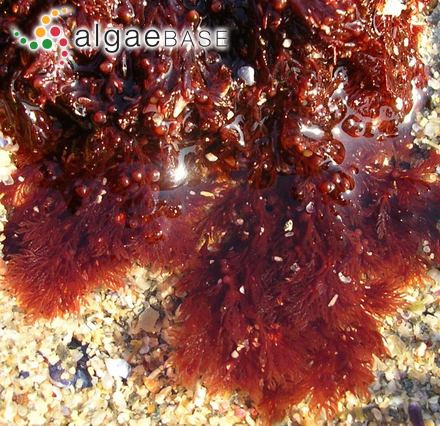
Plocamium cartilagineum (Linnaeus) P.S.Dixon Finavarra, Co. Clare, Ireland; lower-shore rocks epiphytic on corallines; a smaller entity that may be new

Publication details
Plocamium cartilagineum (Linnaeus) P.S.Dixon 1967: 58; pl. 14, 26

Original publication: Dixon, P.S. (1967). The typification of Fucus cartilagineus L. and F. corneus Huds. Blumea 15: 55-62.

Type species
The type species (holotype) of the genus Plocamium is Plocamium vulgare J.V.Lamouroux.

Status of name
This name is of an entity that is currently accepted taxonomically.

Basionym
Fucus cartilagineus Linnaeus

Type information
Type locality: "In Oceano australiore" (but probably northern Europe) (Silva, Basson & Moe 1996: 340). Lectotype: L 910, 184...14 (Womersley 1994: 389). Notes: This type locality was first recorded by Dixon (1967: 55-57). Northern Europe (Womersley 1994: 389).

Origin of species name
Adjective (Latin), cartilaginous, flexible but firm and tough (Stearn 1973).

Homotypic Synonym(s)
Fucus cartilagineus Linnaeus 1753
Gelidium cartilagineum (Linnaeus) Gaillon 1828

Heterotypic Synonym(s)
Fucus plocamium S.G.Gmelin 1768
Fucus coccineus Hudson 1778
Nereidea coccinea (Hudson) Stackhouse 1809
Plocamium vulgare J.V.Lamouroux 1813
Delesseria coccinea (Hudson) C.Agardh 1817
Plocamium coccineum Lyngbye 1819
Plocamium coccineum var. ß subtile 1819
Delesseria plocamium C.Agardh 1822
Plocamium lyngbyanum Kützing 1843
Plocamium binderianum Kützing 1843
Plocamium pusillum Sonder 1845
Plocamium angustum var. pusillum (Sonder) Harvey 1863
Plocamium coccineum f. binderianum (Kützing) Hauck 1883

General environment
This is a Marine species.

Common names

(as Plocamium coccineum Lyngbye)
English: Cockscomb (Dickinson 1963).

Description
Narrow, compressed, cartilaginous, bright scarlet fronds, to 300 mm long, tufted, much divided. Branching irregularly alternate, pinnules alternately secund in twos to fives, with acute apices, lowest of each set a simple spur, others increasingly strongly pectinate.

Habitat
Temperate seas throughout the world; found on coasts of strong to moderate wave action and known from depths of 2-26 m (Womersley 1994: 389). Growing on Laminaria hyperborea stipes and on other larger algae; mainly subtidal, abundant, widely distributed, often washed ashore in quantity.

Detailed distribution with sources
(as Fucus coccineus Hudson)
Ireland: Wexford (Tighe 1803).

Europe: Ireland (Tighe 1803), Spain (Roxas Clemente y Rubio 1807).

(as Plocamium vulgare J.V.Lamouroux)
Ireland: Wexford (Parkes & Scannell 1969).

Europe: France (Augier, Boudouresque & Laborel 1971), Ireland (Parkes & Scannell 1969), Italy (Giaccone 1969, Cinelli 1971, Feoli & Bressan 1972, Cinelli et al. 1976).

(as Plocamium coccineum Lyngbye)
Ireland: Antrim (Drummond 1837), Donegal (McMillan & Morton 1979), Dublin (Sanders 1860), Mayo (Cotton 1912), Wexford (Cotton 1913).

Europe: Balearic Islands (Rodríguez y Femenías 1889, Bellón 1921, Navarro & Bellón 1945), Britain (Newton 1931), France (Feldmann 1954), Ireland (Cotton 1912, Cotton 1913), Portugal (Ardré 1970), Spain (Lázaro Ibiza 1889, Sauvageau 1897, Bellón 1921, Hamel 1928, Miranda 1931, Bellón 1940, Bellón 1942, Seoane-Camba 1957, Fischer-Piette, C. & Seoane Camba, J. (1962), Seoane-Camba 1965), Sweden (Kylin 1907, Kylin 1944), Turkey (Europe) (Güven & Öztig 1971).

Atlantic Islands: Canary Islands (Børgesen 1929).

South America: Brazil (Taylor 1930), Tierra del Fuego (Kylin & Skottsberg 1919).

Africa: Morocco (Dangeard 1949).

Antarctic and the subantarctic islands: Antarctic Peninsula (Lamb & Zimmermann 1977), Antarctica (Papenfuss 1964), Graham Land (Dawson 1941).

(as Gelidium cartilagineum (Linnaeus) Gaillon)
Africa: Mauritius (Børgesen 1943).

(as Plocamium cartilagineum (Linnaeus) P.S.Dixon)
Ireland: Antrim (Morton 1994), Clare (De Valéra et al. 1979, Maggs 1983), Cork (Cullinane 1971, Cullinane, McCarthy & Fletcher 1975, Guiry 1978, Cullinane & Whelan 1983), Derry (Morton 1994), Donegal (McMillan & Morton 1979, Morton 2003), Down (Morton 1974, Guiry 1978, Morton 1994), Dublin (Fletcher & Maggs 1985), Galway (Maggs 1983), Kerry (Guiry 1978, Cullinane & Whelan 1983, Cullinane & Whelan 1984, Whelan & Cullinane 1985), Leitrim (Cullinane 1970, Guiry 1978), Waterford (Guiry 1978), Wexford (Norton 1970, Guiry 1978).

Europe: Adriatic (Giaccone 1978), Balearic Islands (Seoane-Camba 1969, Ribera Siguán 1983, Ribera Siguán & Gómez Garreta 1984), Baltic Sea (Nielsen et al. 1995), Britain (Dixon & Irvine 1977, Hardy & Guiry 2003, Saunders & Lehmkuhl 2005, Saunders & Lehmkuhl 2005), Corsica (Boudouresque & Perret 1977, Demoulin, Janssen & Licot 1980, Verlaque 1984), Denmark (Saunders & Lehmkuhl 2005), Faroes (Irvine 1982, Nielsen & Gunnarsson 2001, Saunders & Lehmkuhl 2005, Saunders & Lehmkuhl 2005), France (Ben Maiz, Boudouresque, Lauret & Riouall 1988, Coppejans 1995, Verlaque 2001, Saunders & Lehmkuhl 2005, Saunders & Lehmkuhl 2005, Dizerbo & Herpe 2007, Loiseaux-de Goër & Noailles 2008, Zubia et al. 2009), Greece (Gerloff & Geissler 1974, Haritonidis & Tsekos 1976, Athanasiadis 1987), Helgoland (Bartsch & Kuhlenkamp 2000), Iceland (Caram & Jónsson 1972), Ireland (Cullinane 1971, Guiry 1978, De Valéra et al. 1979, Maggs 1983, Whelan & Cullinane 1985, Morton 1994, Saunders & Lehmkuhl 2005, Saunders & Lehmkuhl 2005), Isla de Alborán (Conde & Flores Moya 2000), Italy (Edwards et al. 1975, Furnari, Cormaci & Serio 1999, Rindi, Sartoni & Cinelli 2002, Furnari et al. 2003, Furnari et al. 2003, Furnari et al. 2003, Furnari et al. 2003, Serio et al 2006), Malta (Cormaci et al. 1997), Netherlands (Stegenga & Mol 1983), Norway (Rueness 1997, Saunders & Lehmkuhl 2005, Saunders & Lehmkuhl 2005), Portugal (Araújo, Bárbara & Sousa-Pinto in press), Sardinia (Furnari et al. 2003), Spain (Ballesteros 1981, Barcelo & Seoane 1982, Pérez-Cirera & Maldonado 1982, Ballesteros & Romero 1982, Gallardo & Pérez-Cirera 1982, Fernández & Niell 1982, Fernández, Niell & Anadón 1983, Boisset & Barceló 1984, Pérez-Ruzafa & Honrubia 1984, Gallardo et al. 1985, Anadón & Fernández 1986, Rodriguez Prieto & Polo Alberti 1988, Soto & Conde 1989, Flores-Moya et al. 1994, Conde et al. 1996, Bárbara & Cremades 1996, Rodríguez-Prieto & Polo, L. 1996, Rodriguez-Prieto et al. 1997, Veiga, Cremades & Bárbara 1998, Rodriguez-Prieto & Polo Albertí 1998, No Couto 2001, Peña & Bárbara 2002, Valenzuela Miranda 2002, Gorostiaga et al., 2004, Bárbara et al. 2004, Bárbara et al. 2005, Diaz-Tapia & Bárbara 2005, Pena & Bárbara 2008, de los Santos, Pérez-Lloréns & Vergara 2009, Mercado et al. 2009, Esteban et al. 2009), Turkey (Europe) (Cirik, Zeybeck, Aysel & Cirik 1990, Taskin et al. 2008 ).

Atlantic Islands: Ascension (John et al. 2004), Azores (Tittley & Neto 1994, Neto 1994), Canary Islands (Gil-Rodríguez & Afonso-Carrillo 1980, Viera-Rodriguez et al. 1987, Gil-Rodriguez, Afonso-Carrillo & Wildpret de la Torre 1987, Ballesteros, Sansón, Reyes, Afonso-Carrillo & Gil-Rodríguez 1992, Lawson et al. 1995, Guadalupe et al. 1995, Haroun et al. 2002, Gil-Rodríguez et al. 2003, John et al. 2004), Cape Verde Islands (John et al. 2004, Prud'homme van Reine, Haroun & Kostermans 2005), Madeira (Levring 1974, Neto, Cravo & Haroun 2001, John et al. 2004), Salvage Islands (Audiffred & Weisscher 1984, John et al. 2004).

North America: Alaska (Scagel et al. 1989, Mondragon & Mondragon 2003 ), Baja California (Mondragon & Mondragon 2003), British Columbia (Scagel et al. 1989, Saunders & Lehmkuhl 2005), California (Abbott & Hollenberg 1976, Scagel et al. 1989, Stewart 1991, Spalding, Foster & Heine, 2003), Mexico (Castaneda-Fernández de Lara et al. 2010 ), Oregon (Hansen 1997, Saunders & Lehmkuhl 2005), Washington (Scagel et al. 1989, Murru & Sandgren 2004).

South America: Chile (Santelices 1989, Ramírez & Santelices 1991, Hoffmann & Santelices 1997), Peru (Ramírez & Santelices 1991), Venezuela (Ganesan 1990).

Africa: Egypt (Aleem 1993), Mauritania (John et al. 2004), Mauritius (Silva, Basson & Moe 1996), Morocco (Gil-Rodriguez & Socorro Hernández 1986), Namibia (Rull Lluch 2002, John et al. 2004), Senegal (John et al. 2004), Tunisia (Meñez & Mathieson 1981, Ben Maiz, Boudouresque & Quahchi 1987), Western Sahara (John et al. 2004).

South-west Asia: Oman (Wynne & Jupp 1998), Pakistan (Silva, Basson & Moe 1996), Turkey (Asia) (Taskin et al. 2008 ).

Asia: Japan (Yoshida 1998, , Saunders & Lehmkuhl 2005, Yano et al. 2006), Korea (Lee 2008).

Australia and New Zealand: Chatham Islands (Chapman 1979), Lord Howe Island (Lewis 1984, Millar & Kraft 1993), New South Wales (Millar & Kraft 1993, Womersley 1994, Huisman 2000), New Zealand (Chapman 1979, Adams 1994), Queensland (Lewis 1984), South Australia (Womersley 1994, Huisman 2000), Tasmania (Womersley 1994, Huisman 2000), Victoria (Womersley 1994, Huisman 2000, Saunders & Lehmkuhl 2005, Shepherd et al. 2009), Western Australia (Huisman & Walker 1990, Womersley 1994, Huisman 2000).

Pacific Islands: Fiji (N'Yeurt, South & Keats 1996, South & Skelton 2003), French Polynesia (Payri, N'Yeurt & Orempuller 2000).

Antarctic and the subantarctic islands: Antarctic Peninsula (Peters et al 2005, Amsler et al. 2005, Hommersand et al. 2009 ), Antarctica (Wiencke & Clayton 2002), Anvers Island (Amsler, Rowley, Laur, Quetin & Ross 1995, Aumack et al. 2010), King George Island (Al-Handal & Wulff 2008), South Shetland Islands (Gallardo, Pérez-Ruzafa, Flores-Moya & Conde 1999, Quartino et al. 2005).

Taxonomic notes
The concept of Plocamium cartilagineum world-wide has been altered considerably by Saunders & Lehmkuhl (2005). It is clear from sequence data that reports of this essentially north-eastern Atlantic species, which occurs mainly in the subtidal and grows epiphytically on other species, are likely to represent other species of the genus. Even in the north-eastern Atlantic, the authors have shown that four species, namely P. cartilagineum sensu stricto, P. subtile (q.v.), P. nanum (q.v.) and P. maggsiae were passing under the name Plocamium cartilagineum. Many of the species called P. cartilagineum in the Pacific and Australasia represent different entities, some of which may be undescribed.

Key references
Braune, W. (2008). Meeresalgen. Ein Farbbildführer zu den verbreiteten benthischen Grün- Braun- und Rotalgen der Weltmeere. pp. [1]-596, 266 pls. Ruggell: A.R.G. Gantner Verlag.

Loiseaux-de Goër, S. & Noailles, M.-C. (2008). Algues de Roscoff. pp. [1]-215, col. figs. Roscoff: Editions de la Station Biologique de Roscoff.

Saunders, G.W. & Lehmkuhl, K.V. (2005). Molecular divergence and morphological diversity among four cryptic species of Plocamium (Plocamiales, Florideophyceae) in northern Europe. European Journal of Phycology 40: 293-312.

Silva, P.C., Basson, P.W. & Moe, R.L. (1996). Catalogue of the benthic marine algae of the Indian Ocean. University of California Publications in Botany 79: 1-1259.

Womersley, H.B.S. (1994). The marine benthic flora of southern Australia - Part IIIA - Bangiophyceae and Florideophyceae (Acrochaetiales, Nemaliales, Gelidiales, Hildenbrandiales and Gigartinales sensu lato). pp. 1-508, 167 figs, 4 pls, 4 maps. Canberra: Australian Biological Resources Study.

Yano, T., Kamiya, M., Arai, S. & Kawai, H. (2004). Morphological homoplasy in Japanese Plocamium species (Plocamiales, Rhodophyta) inferred from the Rubisco spacer sequence and intracellular acidity. Phycologia 43: 383-393, 11 figs, 2 tables.

Yano, T., Kamiya, M., Murikami, A., Sasaki, H. & Kawai, H. (2006). Biochemical phenotypes corresponding to molecular phylogeny of the red alga Plocamium (Plocamiales, Rhodophyta): implications of incongruence with the conventional taxonomy . Journal of Phycology 42: 155-169.

SAG Cultures
No records have been found on the SAG site.

NCBI Nucleotide Sequences
As of 2 June 2009, nucleotide sequence data are available at http://www.ncbi.nlm.nih.gov/Genbank for 23 samples identified as Plocamium cartilagineum.

Created: 30 March 1996 by M.D. Guiry

Verified by: 23 July 2009 by Wendy Guiry

Accesses: This record has been accessed by users 6021 times since it was created.

References
(Please note: only references with the binomials in the title are included. The information is from the Literature database.)

Barrow, K.D. & Temple, C.A. (1985). Biosynthesis of halogenated monoterpenes in Plocamium cartilagineum. Phytochemistry 24: 1697-1704.
Cremades, J., Maneiro, I. & Barreiro, R. (2009). Consecuencias de la nueva interpretación taxonómica del tipo de Plocamium cartilagineum (Plocamiales, Florideophyceae). Algas, Bol. Soc. Esp. Ficología 42: 5-6.
Kain (Jones), J.M. (1984). Plocamium cartilagineum in the Isle of Man: why are there so many tetrasporophytes?. British Phycological Journal 19: 195.
Kain (Jones), J.M. (1986). Seasonal growth of Plocamium cartilagineum and inhibition by high light. British Phycological Journal 21: 331.
Kain (Jones), J.M. (1987). Seasonal growth and photoinhibition in Plocamium cartilagineum (Rhodophyta) off the Isle of Man. Phycologia 26: 88-99.
Konig, G.M., Wright, A.D. & Sticher, O. (1990). A new polyhalogenated monoterpene from the red alga Plocamium cartilagineum. J Nat Prod-Lloydia 53(6): 1615-1618.
König, G.M., Wright, A.D. & Sticher, O. (1990). A new polyhalogenated monoterpene from the red alga Plocamium cartilagineum. Journal of Natural Products 53: 1615-1618.
Rovirosa, J., Moena, J. & San-Martín, A. (1988). Two chemical types of the red alga Plocamium cartilagineum. Biochem. Syst. Ecol. 16: 593-595.
San-Martín, A. & Rovirosa, J. (1986). Variations in the halogenated monoterpene metabolites of Plocamium cartilagineum of the Chilean coast. Biochem. Syst. Ecol. 14: 459-461.
Sanmartin, A., Negrete, R. & Rovirosa, J. (1991). Insecticide and acaricide activities of polyhalogenated monoterpenes from Chilean Plocamium cartilagineum. Phytochemistry 30(7): 2165-2169.

SITE © 1996 - 2010 M.D. Guiry. All rights reserved.

Website Design : 249 Design Studio