Polyides rotundus (Hudson) Gaillon
Classification:
Empire Eukaryota
Kingdom Plantae
Subkingdom Biliphyta
Phylum Rhodophycophyta
Subphylum Eurhodophytina
Class Florideophyceae
Subclass Rhodymeniophycidae
Order Gigartinales
Family Polyidaceae
Genus Polyides
Pictures:
click on thumbnail for larger version.

Black Hd., Co. Clare, Ireland; lower-shore rock pools in sand. 16 Mar 2006. Michael Guiry. © Michael Guiry.

Finavarra, Co. Clare, Ireland; MLWN lagoon. 08 Aug 2002. Michael Guiry. © Michael Guiry.

Finavarra, Co. Clare, Ireland; plants in sandy MLWN pools. 29 Mar 2002. Michael Guiry. © Michael Guiry.

Finavarra, Co. Clare, Ireland; plants in sandy MLWN pools. 29 Mar 2002. Michael Guiry. © Michael Guiry.

Groton, Connecticut, USA; open coast.. 13 Sep 2007. Courtnay Hermann. © Courtnay Hermann.

Bay of Fundy, New Brunswick, Canada. Colin Bates. © Coastal Imageworks.

Spain, Galicia, A Coruña, Muxía, 2008, cystocarps. Ignacio Bárbara. © Ignacio Bárbara.

Spain, Galicia, A Coruña, Muxía, 2008. Ignacio Bárbara. © Ignacio Bárbara.

Spain, Galicia, A Coruña, Muxía, 2008. Ignacio Bárbara. © Ignacio Bárbara.

Spain, Galicia, A Coruña, Muxía, 2008. Ignacio Bárbara. © Ignacio Bárbara.
22 Found - Displaying 1 through 10
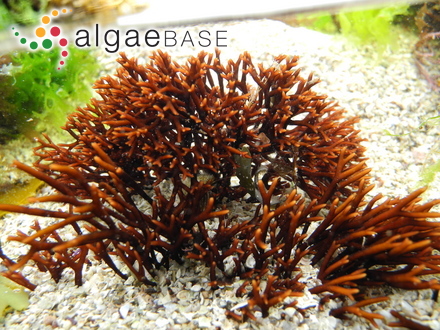
Polyides rotundus (Hudson) Gaillon Finavarra, Co. Clare, Ireland; plants in sandy MLWN pools
Publication details
Polyides rotundus (Hudson) Gaillon 1828: 365
Original publication: Gaillon, B. (1828). Résumé méthodique des classifications des Thalassiophytes. Dictionnaire des Sciences Naturelles [Levrault] 53: 350-406, Tables 1-3.
Download PDF
Type species
The type species (holotype) of the genus Polyides is Polyides lumbricalis C.Agardh.
Status of name
This name is of an entity that is currently accepted taxonomically.
Basionym
Fucus rotundus Hudson
Type information
Type locality: St Ives, Cornwall, England (Dixon & Irvine 1977: 179). Lectotype: Hudson’s description based on herb. Sherard 1906, OXF (Dixon & Irvine 1977: 179). Notes: See also Drew (1958, pl. 61).
Origin of species name
Adjective (Latin), almost circular, with length breadth ration of about 6 to 5 (Stearn 1973).
Homotypic Synonym(s)
Fucus rotundus Hudson 1762
Chordaria rotunda (Hudson) C.Agardh 1817
Furcellaria rotunda (Hudson) Lyngbye 1819
Bifurcaria rotunda (Hudson) Papenfuss 1950
Heterotypic Synonym(s)
Fucus caprinus Gunnerus 1766
Fucus furcellatus Mohr 1786
Fucus radiatus Goodenough & Woodward 1797
Polyides lumbricalis C.Agardh 1822
Polyides caprinus (Gunnerus) Papenfuss 1950
General environment
This is a marine species.
Common names
(as Polyides caprinus (Gunnerus) Papenfuss)
English: Goat Tang (Dickinson 1963).
Description
Cartilaginous, cylindrical, brownish red (drying black) fronds, to 200 mm high, in tufts from basal disc to 10 mm diam. Fronds 1-2 mm thick, undivided for some distance, then regularly and repeatedly dichotomously branched, axils rounded, apices pointed.
Habitat
On rocks and stones in open sandy pools and runnels, lower intertidal and shallow subtidal, widely disrtibuted, common.
Similar species
Furcellaria lumbricalis from which it many be distinguished by the absence of a rhizoidal base, wider branching angles (i.e. more fan-shaped), and that the fronds are red when held up to the light.
Detailed distribution with sources
(as Polyides rotundus (Hudson) Gaillon)
Ireland: Antrim (Morton 1994), Clare (De Valéra et al. 1979, Maggs 1983), Cork (Cullinane 1971, Guiry 1978), Derry (McMillan & Morton 1979, Morton 1994), Donegal (Guiry 1978, Morton 2003), Down (Morton 1974, Guiry 1978, Morton 1994), Dublin (Guiry 1978), Galway (Guiry 1978, Maggs 1983), Kerry (Guiry 1978, Whelan & Cullinane 1985), Mayo (Cotton 1912, Guiry 1978), Sligo (Cullinane 1970), Waterford (Guiry 1978), Wexford (Parkes & Scannell 1969, Norton 1970, Guiry 1978).
Europe: Baltic Sea (Nielsen et al. 1995), Britain (Newton 1931, Dixon & Irvine 1977, Hardy & Guiry 2003), Faroes (Irvine 1982, Nielsen & Gunnarsson 2001), France (Coppejans 1995, Dizerbo & Herpe 2007, Loiseaux-de Goër & Noailles 2008), Helgoland (Bartsch & Kuhlenkamp 2000), Ireland (Cotton 1912, Cullinane 1971, Guiry 1978, De Valéra et al. 1979, Maggs 1983, Whelan & Cullinane 1985, Morton 1994), Italy (Giaccone 1969), Netherlands (Stegenga & Mol 1983), Norway (Rueness 1997), Scandinavia (Athanasiadis 1996), Spain (Miranda 1931, Conde & Seoane 1982, Fernández, Niell & Anadón 1983, Gallardo et al. 1985, Conde et al. 1996), Sweden (Kylin 1907, Kylin 1944, Tolstoy & Österlund 2003).
North America: Maine (Mathieson et al. 2001), New Brunswick (Bates et al. 2005), New Hampshire (Mathieson & Hehre 1986, Mathieson & Dawes 2002), Nova Scotia (Tai, Lindstrom & Saunders 2001, Pueschel & Saunders 2009).
Asia: Russia (Perestenko 1980).
(as Bifurcaria rotunda (Hudson) Papenfuss)
Europe: France (Feldmann 1954).
Africa: Morocco (Dangeard 1949).
(as Polyides caprinus (Gunnerus) Papenfuss)
Arctic: Canada (Arctic) (Taylor 1957).
Europe: France (Feldmann 1954).
Key references
Bates, C.R., Saunders, G.W. & Chopin, T. (2005). An assessment of two taxonomic distinctness indices for detecting seaweed assemblage responses to environmental stress. Botanica Marina 48: 231-243.
Braune, W. (2008). Meeresalgen. Ein Farbbildführer zu den verbreiteten benthischen Grün- Braun- und Rotalgen der Weltmeere. pp. [1]-596, 266 pls. Ruggell: A.R.G. Gantner Verlag.
Dixon, P.S. & Irvine, L.M. (1977). Seaweeds of the British Isles. Volume 1. Rhodophyta. Part 1. Introduction, Nemaliales, Gigartinales. pp. xi + 252, 90 figs. London: British Museum (Natural History).
Greville, R.K. (1830). Algae britannicae, or descriptions of the marine and other inarticulated plants of the British islands, belonging to the order Algae; with plates illustrative of the genera. pp. [i*-iii*], [i]-lxxxviii, [1]-218, pl. 1-19. Edinburgh & London: McLachlan & Stewart; Baldwin & Cradock.
Loiseaux-de Goër, S. & Noailles, M.-C. (2008). Algues de Roscoff. pp. [1]-215, col. figs. Roscoff: Editions de la Station Biologique de Roscoff.
Rao, C.S.P. (1956). The life-history and reproduction of Polyides caprinus (Gunn. ) Papenf.. Ann Bot 20: 211-230.
SAG Cultures
No records have been found on the SAG site.
NCBI Nucleotide Sequences
Created: 30 March 1996 by M.D. Guiry
Verified by: 20 November 2008 by M.D. Guiry
Accesses: This record has been accessed by users 2034 times since it was created.
References
(Please note: only references with the binomials in the title are included. The information is from the Literature database.)
MacFarlane, C.I. (1965). Ecological observations on two marine algae in Nova Scotia-Furcelaria fastigiata and Polyides rotundus. Botanica Gothoburgensia 3: 151-154.
Novaczek, I. & Breeman, A.M. (1990). Thermal ecotypes of amphi-Atlantic algae. II. Cold-temperate species (Furcellaria lumbricalis and Polyides rotundus). Helgoländer Meeresuntersuchungen 44: 475-485.