Akashiwo sanguinea (K.Hirasaka) G.Hansen & Ø.Moestrup
Classification:
Empire Eukaryota
Kingdom Protozoa
Subkingdom Biciliata
Infrakingdom Alveolata
Phylum Myzozoa
Class Dinophyceae
Order Gymnodiniales
Family Gymnodiniaceae
Genus Akashiwo
Pictures:
click on thumbnail for larger version.

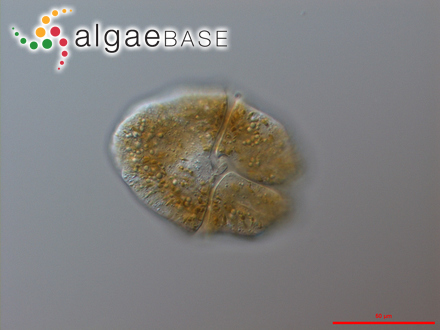
Bainbridge Island, Washington, USA; Eagle Harbor marina, 400x, DIC. 18 Oct 2008. Karl Bruun. © Karl Bruun.

Poulsbo, Washington, USA; Liberty Bay Marina, 400x, DIC. 22 Aug 2009. Karl Bruun. © Karl Bruun.

Poulsbo, Washington, USA; Liberty Bay Marina, 400x, DIC. 22 Aug 2009. Karl Bruun. © Karl Bruun.
Akashiwo sanguinea (K.Hirasaka) G.Hansen & Ø.Moestrup Poulsbo, Washington, USA; Liberty Bay Marina, 400x, DIC
Publication details
Akashiwo sanguinea (K.Hirasaka) G.Hansen & Ø.Moestrup in N. Daugbjerg, G. Hansen, J. Larsen, & Ø. Moestrup 2000: 308
Original publication: Daugbjerg, N., Hansen, G., Larsen, J. & Moestrup, Ø. (2000). Phylogeny of some of the major genera of dinoflagellates based on ultrastructure and partial LSU rDNA sequence data, including the erection of three new genera of unarmoured dinoflagellates. Phycologia 39: 302-317.
Type species
This is the type species (holotype) of the genus Akashiwo.
Status of name
This name is of an entity that is currently accepted taxonomically.
Basionym
Gymnodinium sanguineum K.Hirasaka
Type information
Type locality: NW Pacific Ocean: Kozusa-ura, Gokasho Bay, Japan (Faust & Gulledge 2002: 43). Holotype: (Faust & Gulledge 2002: 43).
Origin of species name
Adjective (Latin), blood-red (Stearn 1973).
Homotypic Synonym(s)
Gymnodinium sanguineum K.Hirasaka 1922
General environment
This is a Marine species.
Detailed distribution with sources
(as Gymnodinium sanguineum K.Hirasaka)
Asia: Japan (Faust & Gulledge 2002).
Australia and New Zealand: Australia (Faust & Gulledge 2002), New Zealand (Faust & Gulledge 2002).
(as Akashiwo sanguinea (K.Hirasaka) G.Hansen & Ø.Moestrup)
North America: Maryland (Eissler et al. 2009).
Central America: Belize (Faust, 2003).
Asia: Japan (de Salas et al 2005).
Source of synonymy
Gómez, F. (2005). A list of free-living dinoflagellate species in the world's oceans. Acta Botanica Croatica 64: 129-212.
Key references
Jeong, H.J., Kim, H.R., Kim, K.L., Kim, K.Y., Park, K.H., Kim, S.T., Yoo, Y.D., Song, J.Y., Kim, J.S., Seong, K.A., Yih, W.H., Pae, S.J., Lee, C.H., Huh, M.D. & Lee, S.H. (2002). NaOCl produced by electrolysis of natural seawater as a potential method to control marine red-tide dinoflagellates. Phycologia 41: 643-656.
Leaw, C.P., Lim, P.T., Ng, B.K., Cheah, M.Y., Ahmad, A. & Usup, G. (2005). Phylogenetic analysis of Alexandrium species and Pyrodinium bahamense (Dinophyceae) based on theca morphology and nuclear ribosomal gene sequence. Phycologia 44: 550-565.
Lindberg, K., Moestrup, Ø & Daugbjerg, N. (2005). Studies on woloszynskioid dinoflagellates I: Woloszynskia coronata re-examined using light and electron microscopy and partial LSU rDNA sequences, with description of Tovellia gen. nov. and Jadwigia gen. nov. (Tovelliaceae fam. nov.). Phycologia 44: 416-440.
Takano, Y. & Horiguchi, T. (2006). Acquiring scanning electron microscopical, light microscopical and multiple gene sequence data from a single dinoflagellate cell. Journal of Phycology 42: 251-256.
NCBI Nucleotide Sequences
Created: 26 April 2002 by M.D. Guiry
Verified by: 07 January 2010 by M.D. Guiry
Accesses: This record has been accessed by users 1258 times since it was created.