125,528 species and infraspecific names are in the database, 8,150 images, 44,360 bibliographic items, 162,479 distributional records.

Alexandrium tamarense (Lebour) E.Balech

Classification:
Empire Eukaryota
Kingdom Protozoa
Subkingdom Biciliata
Infrakingdom Alveolata
Phylum Myzozoa
Class Dinophyceae
Subclass Peridiniphycidae
Order Gonyaulacales
Family Gonyaulacaceae
Genus Alexandrium

Pictures:

click on thumbnail for larger version.


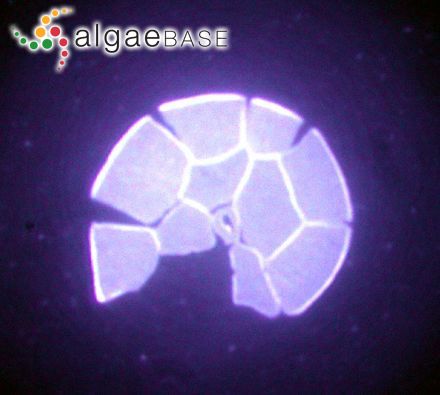
Thecal plate structure of the epitheca. The epitheca has been flattened and broken apart at the joint between the first apical plate and the fourth apical and sixth precingular plates. One can see a pore along the join between the first and fourth apical . © Robin Raine.


© Georgina Mc Dermott.


35aCalco_epi_1631

Alexandrium tamarense (Lebour) E.Balech Thecal plate structure of the epitheca. The epitheca has been flattened and broken apart at the joint between the first apical plate and the fourth apical and sixth precingular plates. One can see a pore along the join between the first and fourth apical

Publication details
Alexandrium tamarense (Lebour) E.Balech 1995: 38, pl. 6, figs 1-40; pl. 7, figs 1-9

Original publication: Balech, E. (1995). The genus Alexandrium Halim (Dinoflagellata). pp. 1-151. Sherkin Island: Sherkin Island Marine Station.

Type species
The type species (holotype) of the genus Alexandrium is Alexandrium minutum Halim.

Status of name
This name is of an entity that is currently accepted taxonomically.

Basionym
Gonyaulax tamarensis Lebour

Type information
Type locality: English Channel: River Tamar Estuary, near Plymouth, United Kingdom (Faust & Gulledge 2002: 18). Holotype: (Faust & Gulledge 2002: 18).

Homotypic Synonym(s)
Gonyaulax tamarensis Lebour 1925
Protogonyaulax tamarensis (Lebour) F.J.R.Taylor 1979

Heterotypic Synonym(s)
Gonyaulax tamarensis var. excavata T.Braarud 1945
Gonyaulax excavata (Braarud) Balech 1971
Gessnerium tamarensis (Lebour) Loeblich III & L.Loeblich 1979
Protogonyaulax excavata (Braarud) F.J.R.Taylor 1979
Alexandrium excavatum (Braarud) Balech & Tangen 1985

Usage notes
Faust & Gulledge (2002: 19) notes this species produces very potent paralytic shellfish poison (PSP) neurotoxins; gonyautoxins, neosaxitoxin and saxitoxin. Resting cysts can harbour PSP toxins, it was been demonstrated that cysts were more toxic than their motile stage. Humans, other mammals, fish and birds can be affected. Please consult original reference for further details. Harmful species

Detailed distribution with sources
(as Gonyaulax tamarensis Lebour)
Europe: Britain (Parke & Dixon 1976).

(as Gonyaulax excavata (Braarud) Balech)
Europe: Britain (Parke & Dixon 1976).

(as Alexandrium tamarense (Lebour) E.Balech)
Europe: Britain (Hansen, Daugbjerg & Franco 2003, Leaw et al 2005, Alpermann et al. 2010), Faroes (Hansen, Daugbjerg & Franco 2003), Ireland (Stokes, O'Neill & McDonald 2004).

North America: Nova Scotia (, Lewis et al 2006), Quebec (Fauchot et al 2005, Gagnon et al 2005).

Africa: South Africa (Sebastián et al. 2005).

Asia: Hong Kong (Harlow et al 2007), Japan (Hansen, Daugbjerg & Franco 2003, Leaw et al 2005, Nagai et al 2007, Kobiyama et al 2007), Korea (Kim et al.), Russia (Orlova et al 2007), South Korea (Leaw et al 2005).

South-east Asia: Malaysia (Leaw et al 2005), Thailand (Leaw et al 2005).

Australia and New Zealand: Australia (Leaw et al 2005), New Zealand (Leaw et al 2005), Tasmania (Hansen, Daugbjerg & Franco 2003, Harlow et al 2007).

Antarctic and the subantarctic islands: Antarctica (McMinn & Scott 2005).

Taxonomic notes
According to Lilly et al. (2007: 1336), the three morphospecies of the A. tamarense complex do not conform to the phylogenetic, biological, or morphological species definition and thus ought not to be considered valid species. Instead, five phylogenetic groups have been identified that are likely cryptic species, and they strongly recommend that these groups be evaluated for species-level status. They argue that geographically based names are no longer indicative of the range occupied by members of each group. They recommend a simple group-numbering scheme for use until the taxonomy of this group is reevaluated and species names proposed. - (11 Mar 2008) - Diane Littler

Source of synonymy
Zhang, H., Bhattacharya, D. & Lin, S. (2005). Phylogeny of dinoflagellates based on mitochondrial cytochrome b and nuclear small subunit rDNA sequence comparisons. Journal of Phycology 41: 411-420.

Key references
Alpermann, T.J., Tillmann, U., Beszteri, B., Cembella, A.D. & John, U. (2010). Phenotypic variation and genotypic diversity in a planktonic population of the toxigenic marine dinoflagellate Alexandrium tamarense (Dinophyceae). Journal of Phycology 46(1): 18-32.

Bérard-Therriault, L., Poulin, M. & Bossé, L. (1999). Guide d'identification du phytoplancton marin de l'estuaire et du Golfe du Saint-Laurent incluant également certains protozoaires. Publication Spéciale Canadienne des Sciences Halieutiques et Aquatiques 128: 1-387.

Collins, C., Graham, J., Brown, L., Bresnan, E., Lacaze, J.-P. & Turrell, E.A. (2009). Identification and toxicity of Alexandrium tamarense (Dinophyceae) in Scottish waters. Journal of Phycology 45(3): 692-703, 7 figs, 1 table.

Fauchot, J., Levasseur, M., Roy, S., Gagnon, R. & Weise, A.M. (2005). Environmental factors controlling Alexandrium tamarense (Dinophyceae) growth rate during a red tide event in the St. Lawrence Estuary (Canada). Journal of Phycology 41: 263-272.

Faust, M.A. & Gulledge, R.A. (2002). Identifying harmful marine dinoflagellates. Contributions from the United States National Herbarium 42: 1-144.

Gagnon, R., Levasseur, M., Weise, A.M., Fauchot, Campbell, P.G.C., Weissenboeck, B.J., Merzouk, A., Gosselin, M. & Vigneault, B. (2005). Growth stimulation of Alexandrium tamarense (Dinophyceae) by humic substances from the Manicouagan River (Eastern Canada). Journal of Phycology 41: 489-497.

Hallegraeff, G.M., Anderson, D.M. & Cembella, A.D., Eds (2003). Manual on harmful marine microalgae. Paris: UNESCO.

Harlow, L.D., Koutoulis, A. & Hallegraeff, G.M. (2007). S-adenosylmethionine synthetase genes from eleven marine dinoflagellates. Phycologia 46: 46-53.

Kennaway, G.M. & Lewis, J.M. (2004). An ultrastructural study of hypnozygotes of Alexandrium species (Dinophyceae). Phycologia 43: 353-363, 22 figs, 1 table.

Kim, K.-Y., Yoshida, M. & Kim, C.-H. (2005). Molecular phylogeny of three hitherto unreported Alexandrium species: Alexandrium hiranoi, Alexandrium leei and Alexandrium satoanum (Gonyaulacales, Dinophyceae) inferred from the 18S and 26S rDNA sequence data. Phycologia 44: 361-368.

Kim, S. (2006). Patterns in host range for two strains of Amoebophyra (Dinophyta) infecting thecate dinoflagellates: Amoebophyra spp. ex ,i>Alexandrium affine and ex Gonyaulax polygramma (Note). Journal of Phycology 42: 1170-1173.

Kobiyama, A., Ikeda, Y., Koike, K & Ogaka, T. (2007). Isolation of a differentially expressed gene in separate mating types of the dinoflagellate Alexandrium tamarense. European Journal of Phycology 42(2): 183-190, 5 figs.

Leaw, C.P., Lim, P.T., Ng, B.K., Cheah, M.Y., Ahmad, A. & Usup, G. (2005). Phylogenetic analysis of Alexandrium species and Pyrodinium bahamense (Dinophyceae) based on theca morphology and nuclear ribosomal gene sequence. Phycologia 44: 550-565.

Lewis, N.L., Xu, W., Jericho, S.K., Kreuzer, H.J., Jericho, M.H. & Cembella, A.D. (2006). Swimming speed of three species of Alexandrium (Dinophyceae) as determined by digital in-line holography. Phycologia 45: 61-70.

Lilly, E.L., Halanych, K.M. & Anderson, D.M. (2007). Species boundaries and global biogeography of the Alexandrium tamarense complex (Dinophyceae). Journal of Phycology 43: 1329-1338.

Liu, L. & Hastings, J.W. (2006). Novel and rapidly diverging intergenic sequences between tandem repeats of the luciferase genes in seven dinoflagellate species. Journal of Phycology 42: 96-103.

McMinn, A. & Scott, F.J. (2005). Dinoflagellates. In: Antarctic marine protists. (Scott, F.J. & Marchant, H.J. Eds), pp. 202-250. Canberra & Hobart: Australian Biological Resources Study; Australian Antarctic Division.

Nagai, S., Lian, C., Yamaguchi, S., Hamaguchi, M., Matsuyama, Y., Itakura, S., Shimada, H., Kaga, S., Yamauchi, H., Sonda, Y., Nishikawa, T., Kim, C.-H. & Hogetsu, T. (2007). Microsatellite markers reveal population genetic structure of the toxic dinoflagellate Alexandrium tamarense (Dinophyceae) in Japanese coastal waters. Journal of Phycology 43: 43-54.

Penna, A., Fraga, S., Masó, M., Giacobbe, M.G., Bravo, I., Garcés, E., Vila, M., Bertozzini, E., Adreoni, F., Lugliè, A. & Vernesi, C. (2008). Phylogenetic relationships among the Mediterranean Alexandrium (Dinophyceae) species based on sequences of 5.8S gene and Internal Transcript Spacers of the rRNA operon. European Journal of Phycology 43(2): 163-178, 25 figs, 3 tables.

Sebastián, C.R., Etheridge, S.M., Cook, P.A., O'Ryan, C. & Pitcher, G.C. (2005). Phylogenetic analysis of toxic Alexandrium (Dinophyceae) isolates from South Africa: implications for the global phylogeography of the Alexandrium tamarense species complex . Phycologia 44: 49-60.

Steidinger, K.A. & Tangen, K. (1996). Dinoflagellates. In: Identifying Marine Phytoplankton. (Tomas, C.R. Eds), pp. 387-584. San Diego: Academic Press.

CCAP Cultures
CCAP Strain Number 1119/1 Alexandrium tamarense (Lebour) E. Balech
Go to CCAP Site

NCBI Nucleotide Sequences
As of 2 June 2009, nucleotide sequence data are available at http://www.ncbi.nlm.nih.gov/Genbank for 11,283 samples identified as Alexandrium tamarense.

Created: 26 April 2002 by M.D. Guiry

Verified by: 07 April 2010 by Wendy Guiry

Accesses: This record has been accessed by users 2450 times since it was created.

References
(Please note: only references with the binomials in the title are included. The information is from the Literature database.)

Adachi, M., Sako, Y. & Ishida, Y. (1996). Note: Identification of the toxic dinoflagellates Alexandrium catenella and A. tamarense (Dinophyceae) using DNA probes and whole-cell hybridization. Journal of Phycology 32: 1049-1052, 1 fig, 1 table.
Alpermann, T.J., Tillmann, U., Beszteri, B., Cembella, A.D. & John, U. (2010). Phenotypic variation and genotypic diversity in a planktonic population of the toxigenic marine dinoflagellate Alexandrium tamarense (Dinophyceae). Journal of Phycology 46(1): 18-32.
Cho, E.S. & Lee, H.J. (2001). Thecal plates, toxin content and growth of five clones of Alexandrium tamarense (Dinophyceae) isolated from Jinhae Bay, Korea. Phycologia 40: 435-439.
Collins, C., Graham, J., Brown, L., Bresnan, E., Lacaze, J.-P. & Turrell, E.A. (2009). Identification and toxicity of Alexandrium tamarense (Dinophyceae) in Scottish waters. Journal of Phycology 45(3): 692-703, 7 figs, 1 table.
Destombe, C., Cembella, A.D., Murphy, C.A. & Ragan, M.A. (1992). Nucleotide seguence of the 18S ribosomal RNA genes from the marine dinoflagellate Alexandrium tamarense (Gonyaulacales, Dinophyta). Phycologia 31: 121-124, 1 fig.
Doucette, G.J., Cembella, A.D. & Boyer, G.L. (1989). Cyst formation in the red tide dinoflagellate Alexandrium tamarense (Dinophyceae): effects of iron stress. Journal of Phycology 25: 721-731, 23 figs.
Fauchot, J., Levasseur, M., Roy, S., Gagnon, R. & Weise, A.M. (2005). Environmental factors controlling Alexandrium tamarense (Dinophyceae) growth rate during a red tide event in the St. Lawrence Estuary (Canada). Journal of Phycology 41: 263-272.
Gagnon, R., Levasseur, M., Weise, A.M., Fauchot, Campbell, P.G.C., Weissenboeck, B.J., Merzouk, A., Gosselin, M. & Vigneault, B. (2005). Growth stimulation of Alexandrium tamarense (Dinophyceae) by humic substances from the Manicouagan River (Eastern Canada). Journal of Phycology 41: 489-497.
Higman, W.A., Stone, D.M. & Lewis, J.M. (2001). Sequence comparisons of toxic and non-toxic Alexandrium tamarense (Dinophyceae) isolates from UK waters. Phycologia 40: 256-262.
Itakura, S. & Yamaguchi, M. (2001). Germination characteristics of naturally occurring cysts of Alexandrium tamarense (Dinophyceae) in Hiroshima Bay, Inland Sea of Japan. Phycologia 40: 263-267.
Kobiyama, A., Ikeda, Y., Koike, K & Ogaka, T. (2007). Isolation of a differentially expressed gene in separate mating types of the dinoflagellate Alexandrium tamarense. European Journal of Phycology 42(2): 183-190, 5 figs.
Laurion, I. & Roy, S. (2009). Growth and photoprotection in three dinoflagellates (including two strains of Alexandrium tamarense) and one diatom exposed to four weeks of natural and enhanced ultraviolet-B radiation. Journal of Phycology 45: 16-33.
Lilly, E.L., Halanych, K.M. & Anderson, D.M. (2007). Species boundaries and global biogeography of the Alexandrium tamarense complex (Dinophyceae). Journal of Phycology 43: 1329-1338.
Nagai, S., Lian, C., Yamaguchi, S., Hamaguchi, M., Matsuyama, Y., Itakura, S., Shimada, H., Kaga, S., Yamauchi, H., Sonda, Y., Nishikawa, T., Kim, C.-H. & Hogetsu, T. (2007). Microsatellite markers reveal population genetic structure of the toxic dinoflagellate Alexandrium tamarense (Dinophyceae) in Japanese coastal waters. Journal of Phycology 43: 43-54.
Orlova, T.Y., Selina, M.S., Lilly, E.L. Kulis, D.M. & Anderson, D.M. (2007). Morphogenetic and toxin composition variability of Alexandrium tamarense (Dinophyceae) from the east coast of Russia. Phycologia 46: 534-548.
Sako, Y., Hosoi-Tanabe, S. & Uchida, A. (2004). Fluorescence in situ hybridization using rRNA-targeted probes for simple and rapid identification of the toxic dinoflagellates Alexandrium tamarense and Alexandrium catanella. Journal of Phycology 40: 598-605.
Scholin, C.A., Hallegraeff, G.M. & Anderson, D.M. (1995). Molecular evolution of the Alexandrium tamarense 'species complex' (Dinophyceae): dispersal in the North American and West Pacific regions. Phycologia 34: 472-485, 4 figs, 1 table.
Sebastián, C.R., Etheridge, S.M., Cook, P.A., O'Ryan, C. & Pitcher, G.C. (2005). Phylogenetic analysis of toxic Alexandrium (Dinophyceae) isolates from South Africa: implications for the global phylogeography of the Alexandrium tamarense species complex . Phycologia 44: 49-60.
Shi, Y., Hu, H. & Cong, W. (2005). Positive effects of continuous low nitrate levels on growth and photosynthesis of Alexandrium tamarense (Gonyaulacales, Dinophyceae). Phycological Research 53(1): 43-48.
Yamamoto, T. & Tarutani, K. (1999). Growth and phosphate uptake kinetics of the toxic dinoflagellate Alexandrium tamarense from Hiroshima Bay in the Seto Inland Sea, Japan. Phycological Research 47: 27-32.
Yoshida, T., Sako, Y. & Uchida, A. (2001). Geographic differences in paralytic shellfish poisoning toxin profiles among Japanese populations of Alexandrium tamarense and A/ catenella (Dinophyceae). Phycological Research 49: 13-22.

SITE © 1996 - 2010 M.D. Guiry. All rights reserved.

Website Design : 249 Design Studio