133,462 species and infraspecific names are in the database, 16,455 images, 49,226 bibliographic items, 220,042 distributional records.

Ascophyllum nodosum (Linnaeus) Le Jolis

Classification:
Empire Eukaryota
Kingdom Chromista
Phylum Ochrophyta
Class Phaeophyceae
Order Fucales
Family Fucaceae
Genus Ascophyllum

Pictures

click on thumbnail for larger version.

Ascophyllum nodosum (Linnaeus) Le Jolis
Spain. Ignacio Bárbara. © Ignacio Bárbara (barbara@udc.es).

Ascophyllum nodosum (Linnaeus) Le Jolis
Spain. Ignacio Bárbara. © Ignacio Bárbara (barbara@udc.es).

Ascophyllum nodosum (Linnaeus) Le Jolis
Spain. Ignacio Bárbara. © Ignacio Bárbara (barbara@udc.es).

Ascophyllum nodosum (Linnaeus) Le Jolis
Spain. Ignacio Bárbara. © Ignacio Bárbara (barbara@udc.es).

Ascophyllum nodosum (Linnaeus) Le Jolis
Spain. Ignacio Bárbara. © Ignacio Bárbara (barbara@udc.es).

Ascophyllum nodosum (Linnaeus) Le Jolis
Spain. Ignacio Bárbara. © Ignacio Bárbara (barbara@udc.es).

Ascophyllum nodosum (Linnaeus) Le Jolis
Spain. Ignacio Bárbara. © Ignacio Bárbara (barbara@udc.es).

Ascophyllum nodosum (Linnaeus) Le Jolis
Spain. Ignacio Bárbara. © Ignacio Bárbara (barbara@udc.es).

Ascophyllum nodosum (Linnaeus) Le Jolis
Spain. Ignacio Bárbara. © Ignacio Bárbara (barbara@udc.es).

Ascophyllum nodosum (Linnaeus) Le Jolis
France, Brittany, 2011. 24 Oct 2011. Ignacio Bárbara. © Ignacio Bárbara (barbara@udc.es).

1  2  3  4  5  6  7  Next

69 Found - Displaying 1 through 10


Gigartina laingii Lindauer ex V.J.Chapman

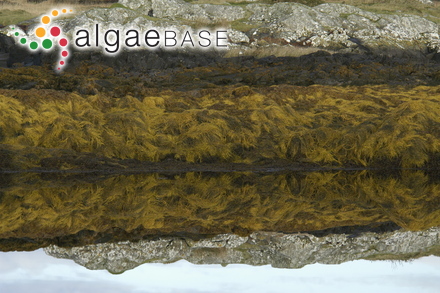
Ascophyllum nodosum (Linnaeus) Le Jolis Cuan na Beirtrí Bhuí, Conamara, Ireland; zone of yellow plants in the intertidal with other fucoids

Publication details
Ascophyllum nodosum (Linnaeus) Le Jolis 1863: 96

Original publication: Le Jolis, A. (1863). Liste des algues marines de Cherbourg. Mémoires de la Société Impériale des Sciences Naturelles de Cherbourg 10: 5-168, pls I-IV.
 Download PDF

Original description:  Download PDF

Type species
The type species (holotype) of the genus Ascophyllum is Ascophylla laevigata Stackhouse.

Status of name
This name is of an entity that is currently accepted taxonomically.

Basionym
Fucus nodosus Linnaeus

Type information
Type locality: Habitat in Mari Atlantico [Atlantic Ocean] (Linnaeus 1753: 1159). Notes: On-line view of an unlocalised specimen LINN 1274.58 in the Linnean Herbarium labelled "9" as in the protologue. Athanasiadis (1996: 217) indicated that no type has been designated.

Origin of species name
Adjective (Latin), knotted, knobbly (Stearn 1973).

Homotypic Synonym(s)
Fucus nodosus Linnaeus 1753
Fistularia nodosa (Linnaeus) Stackhouse 1816
Halicoccus nodosus (Linnaeus) Lyngbye 1819
Physocaulon nodosum (Linnaeus) Kützing 1843
Ozothallia nodosa (Linnaeus) Decaisne & Thuret 1845
Fucodium nodosum (Linnaeus) J.Agardh 1848
Ascophylla nodosa (Linnaeus) Kuntze 1894

Heterotypic Synonym(s)
Ascophyllum nodosum f. mackayi (Turner)
Fucus nodosus var. siliquatus Turner 1802
Fucus mackayi Turner 1808
Ascophylla laevigata Stackhouse 1809
Fucus scorpioides Hornemann 1813
Fistularia mackayi (Turner) Stackhouse 1816
Chordaria scorpioides (Hornemann) Lyngbye 1819
Halidrys siliquosa var. minor Lyngbye 1819
Fucus nodosus var. denudatus C.Agardh 1820
Fucus nodosus var. evesiculosus J.Agardh 1836
Physocaulon mackayi (Turner) Kützing 1843
Ozothallia vulgaris Decaisne & Thuret 1845
Halicoccus nodosus var. furcatus Areschoug 1847
Fucodium nodosum var. scorpioides (Hornemann) J.Agardh 1848
Ozothallia nodosa f. furcata (Areschoug) Kjellman 1880
Ascophyllum nodosum f. scorpioides Hauck 1883
Ascophyllum nodosum var. scorpioides (Hauck) Reinke 1889
Ascophyllum mackayi (Turner) Holmes & Batters 1892
Ascophyllum mackayi f. robertsonii Batters 1892
Ascophyllum robertsonii (Batters) Batters 1892
Ascophyllum nodosum var. furcatum (Areschoug) Reinke 1892
Ascophyllum nodosum var. typicum Reinke 1892
Ascophyllum nodosum var. minor Batters 1902
Ascophyllum nodosum var. siliquatum (Turner) Batters 1902
Ascophyllum nodosum var. mackayi (Turner) Cotton 1912
Ascophyllum nodosum var. lusitanicum Lami 1939
Ascophyllum nodosum f. denudatum (C.Agardh) Athanasiadis 1996

General environment
This is a Marine species.

Common names

(as Ascophyllum nodosum (Linnaeus) Le Jolis)
English: Yellow Tang (Duddington 1966), Knotted wrack, Knobbed Wrack (Arasaki & Arasaki 1983), Asco, Sea Whistle (Anon. 2000), Egg Wrack (Bunker et al. 2010).

Gaeilge: Feamainn bhuí (Anonymous 1978), Feamainn bhuidhe bhoilgíneach (Anon. 2000).

German: Knotentang, Sägetang (Braune 2008).

(as Ascophyllum mackayi (Turner) Holmes & Batters)
English: Wrack (Madlener 1977).

Description
Ascophyllum nodosum is a brown seaweed closely related to Fucus. It forms a single bladders centrally in long, strap-like fronds. The fronds hang downwards, gently draping sheltered intertidal rocks. A number of fronds grow from each basal holfast, and the plant generally regenerates new fronds from the base when one of the larger fronds are damaged, so that the stands you see on the shore may be very persistant . Reproduction takes place in beautiful yellow receptacles in spring (below). These develop in reponse to short days in the autumn, mature during the winter, and are at their most prolific in spring. Eggs and sperm are released into the water, and the eggs release a low molecular weight sperm attractant known as Finnavarene, named for the village of Finavarra ("wood by the sea") in north Co. Clare in Ireland.

Distribution by country

Point data for Ireland and Britain

This map may take a minute to load. Please use an up-to-date web browser (Google Chrome 11, Firefox 4, Safari 5, Opera 11, Internet Explorer 9) for best performance.

Detailed distribution with sources
(as Fucus nodosus Linnaeus)
Ireland: Antrim (Drummond 1837), Wexford (Tighe 1803).

Europe: Ireland (Tighe 1803, Drummond 1837).

Atlantic Islands: Canary Islands (Price, John & Lawson 1978).

(as Ascophyllum nodosum (Linnaeus) Le Jolis)
Arctic: Canada (Arctic) (Taylor 1957, Lee 1980).

Ireland: Antrim (Adams 1907, Guiry 1978, Morton 1994), Clare (Guiry 1978, De Valéra & Cooke 1979), Cork (Renouf 1931, Cullinane 1971, Cullinane, McCarthy & Fletcher 1975, Guiry 1978), Derry (Guiry 1978, Morton 1994), Donegal (Guiry 1978, Morton 2003), Down (Morton 1974, Guiry 1978, Morton 1994), Dublin (Guiry 1978), Galway (Guiry 1978), Kerry (Guiry 1978), Leitrim (Cullinane 1970, Guiry 1978), Limerick (Cullinane 1969, Guiry 1978), Louth (Synnott 1969, Guiry 1978), Mayo (Cotton 1912, Guiry 1978), Sligo (Cullinane 1970), Waterford (Guiry 1978), Wexford (Cotton 1913, Parkes & Scannell 1969, Norton 1970, Guiry 1978), Wicklow (Guiry 1978).

Scotland: Scotland (Marconi et al. 2011).

Europe: Baltic Sea (Nielsen et al. 1995), Britain (Newton 1931, Hardy & Guiry 2003, Pavia et al 2003), Faroe Islands (Irvine 1982, Nielsen & Gunnarsson 2001), France (Feldmann 1954, Connan et al 2006, Dizerbo & Herpe 2007, Loiseaux-de Goër & Noailles 2008, Toxopeus et al. 2011, Silberfeld et al. 2011, Anon. 2012), Helgoland (Bartsch & Kuhlenkamp 2000), Ireland (Adams 1907, Cotton 1912, Cotton 1913, Cullinane 1969, Cullinane 1971, Guiry 1978, De Valéra et al. 1979, Morton 1994, Guiry 2012), Netherlands (Stegenga & Mol 1983, Cho, Lee & Boo 2004), Norway (Rueness 1997), Portugal (De Mesquita Rodrigues 1963, Ardré 1970, Araújo et al. 2006, Araujo et al. 2009, Araújo, Bárbara & Sousa-Pinto in press), Russia (Europe) (Toxopeus et al. 2011 ), Scandinavia (Athanasiadis 1996), Scotland (Toxopeus et al. 2011), Spain (Miranda 1931, Anadón 1983, Pérez-Cirera 1989, Granja, Cremades & Barbara 1992, Bárbara, Cremades & Pérez-Cirera 1995, Bárbara & Cremades 1996, Veiga, Cremades & Bárbara 1998, Veiga Villar 1999, Calvo & Bárbara 2002, Valenzuela Miranda 2002, Gorostiaga et al., 2004, Martínez-Gil et al. 2007, Cires Rodriguez & Cuesta Moliner 2010, Lamela-Silvarrey et al. 2012), Spitsbergen (Vinogradova 1995), Sweden (Kylin 1907, Kylin 1947, Pavia et al 2003, Toxopeus et al. 2011).

Atlantic Islands: Azores (Neto 1994, Tittley & Neto 1994, Tittley, Neto & Parente 2009 ), Bermuda (Taylor 1957), Canary Islands (Price, John & Lawson 1978, John et al. 2004), E. Greenland (Pedersen 1976), Greenland (Pedersen 2011), Iceland (Caram & Jónsson 1972), Madeira (Neto, Cravo & Haroun 2001 , John et al. 2004).

North America: California (Miller et al. 2004 , Miller et al. 2004), Canada (Toxopeus et al. 2011 ), Connecticut (Van Patten 2009), Labrador (Taylor 1957), Maine (Mathieson et al. 2001), New Hampshire (Mathieson & Hehre 1986, Mathieson & Dawes 2002, Hofman et al. 2010), New Jersey (Taylor 1957), Newfoundland (Taylor 1957), North Carolina (Schneider & Searles 1991), Nova Scotia (Kim et al 2006, Garbary et al 2006, Longtin et al. 2009), Virginia (Humm 1979).

Western Atlantic: Trop. & Subtrop. W. Atlantic (Wynne 2011).

South America: Brazil (Taylor 1930 , Taylor 1960).

(as Ascophyllum nodosum f. scorpioides Hauck)
Europe: Sweden (Kylin 1947).

North America: Maine (Taylor 1957, Mathieson et al. 2001), Maritime Provinces (Taylor 1957), Massachusetts (Taylor 1957), New Hampshire (Taylor 1957, Mathieson & Hehre 1986), New Jersey (Taylor 1957), Virginia (Taylor 1957).

Western Atlantic: Trop. & Subtrop. W. Atlantic (Wynne 2011).

(as Ascophyllum nodosum var. scorpioides (Hauck) Reinke)
Europe: Britain (Newton 1931), Ireland (Newton 1931), Spain (Bárbara et al. 2012).

(as Ascophyllum mackayi (Turner) Holmes & Batters)
Ireland: Galway (Batters 1892).

Europe: Britain (Newton 1931).

North America: Connecticut (Taylor 1957), Massachusetts (Taylor 1957).

(as Ascophyllum mackayi f. robertsonii Batters)
Europe: Britain (Newton 1931).

(as Ascophyllum nodosum var. minor Batters)
Ireland: Antrim (Morton 1994).

Europe: Britain (Newton 1931), Ireland (Morton 1994).

(as Ascophyllum nodosum var. siliquatum (Turner) Batters)
Europe: Britain (Newton 1931).

(as Ascophyllum nodosum var. mackayi (Turner) Cotton)
Ireland: Galway (Cotton 1912).

Europe: Ireland (Cotton 1912, Guiry 2012).

Western Atlantic: Trop. & Subtrop. W. Atlantic (Wynne 2011).

(as Ascophyllum nodosum var. lusitanicum Lami)
Europe: Portugal (De Mesquita Rodrigues 1963).

Key references
Baardseth, E. (1970). Synopsis of biological data on knobbed wrack Ascophyllum nodosum (Linnaeus) Le Jolis. Rev. 1. FAO Fisheries Synopsis 38: [1-48], 9 pls., 7 drawings, 1 graph, 1 map.

Braune, W. (2008). Meeresalgen. Ein Farbbildführer zu den verbreiteten benthischen Grün- Braun- und Rotalgen der Weltmeere. pp. [1]-596, pls 1-266 (colour photographs). Ruggell: A.R.G. Gantner Verlag.

Cho, G.Y, Rousseau, F., Reviers, B. de & Boo, S.M. (2006). Phylogenetic relationships within the Fucales (Phaeophyceae) assessed by the photosystem I coding psaA sequences. Phycologia 45: 512-519.

De Toni, G.B. (1895). Sylloge algarum omnium hucusque cognitarum. Vol. III. Fucoideae. Vol. 3 pp. [i]-xvi, [1]-638. Patavii [Padua]: Sumptibus auctoris.

Loiseaux-de Goër, S. & Noailles, M.-C. (2008). Algues de Roscoff. pp. [1]-215, col. figs. Roscoff: Editions de la Station Biologique de Roscoff.

McHugh, D.J. (2003). A guide to the seaweed industry. FAO Fisheries Technical Paper 441: x + 105, 64 figs.

Pedersen, P.M. (2011). Grønlands havalger. pp. [1] 7-208. Copenhagen: Forlaget Epsilon.DK.

SAG Cultures
SAG Cultures may be viewed at http://sagdb.uni-goettingen.de/showstrains.php?genus=Ascophyllum&species=nodosum

SCCAP Cultures
Cultures from the Scandinavian Culture Collection of Algae at the University of Copenhagen (SCCAP) and Protozoa may be viewed at http://www.sccap.dk/search/algaebase.asp?Genus=Ascophyllum&Species=nodosum

NCBI Nucleotide Sequences

Created: 30 March 1996 by M.D. Guiry

Verified by: 25 February 2013 by M.D. Guiry

Accesses: This record has been accessed by users 61628 times since it was created.

References
(Please note: only references with the binomials in the title are included. The information is from the Literature database.)


Aberg, P. (1990). Measuring size and choosing category size for a transition matrix study of the seaweed Ascophyllum nodosum. MAR ECOL-PR 63(2-3): 281-287.
Abetz, P. & Young, C.L. (1983). The effect of seaweed sprays derived from Ascophyllum nodosum on lettuce and cauliflower crops. Botanica Marina 26: 487-492.
Almeida, G., Almeida, M., Humanes, M., Lino, A.R., Melo, R., Moura, I., Armando Silva, J. & Fraústo da Silva, J.J.R. (1993). Haloperoxidases from the algae Ascophyllum nodosum. In: Latin-American Inorganic Chemistry Meeting. ( Eds), pp. 156.
Ang, P. O., Sharp, G. J. & Semple, R. E. (1993). Changes in the population structure of Ascophyllum nodosum (L.) Le Jolis due to mechanical harvesting. Proceedings of the International Seaweed Symposium 14: 321-326.
Ang, P. O., Sharp, G. J. & Semple, R. E. (1996). Comparison of the structure of populations of Ascophyllum nodosum (Fucales, Phaeophyta) at sites with different harvesting histories. Proceedings of the International Seaweed Symposium 15: 179-184.
Araujo, R., Vaselli, S., Almeida, M., Serrão, E. & Sousa-Pinto, I. (2009). Effects of disturbance on marginal populations: human trampling on Ascophyllum nodosum assemblages at its southern distribution limit. Marine Ecology Progress Series 378: 81-92.
Baardseth, E. (1955). Regrowth of Ascophyllum Nodosum after harvesting. pp. [i]-iv, 1-67, 3 fold-outs. Dublin: Institute for Industrial Research and Standards.
Baardseth, E. (1968). Synopsis of biological data on knobbed wrack Ascophyllum nodosum (Linnaeus) Le Jolis. FAO Fisheries Synopsis 38: 1-40 , 9 pls., 27 drawings, 3 graphs, 1 Map.
Baardseth, E. (1970). Synopsis of biological data on knobbed wrack Ascophyllum nodosum (Linnaeus) Le Jolis. Rev. 1. FAO Fisheries Synopsis 38: [1-48], 9 pls., 7 drawings, 1 graph, 1 map.
Baardseth, E.. (1949). Regrowth of Ascophyllum nodosum after harvesting. Report to Institute for Industrial Research and Standards. Typewritten manuscript.. pp. 1-47.
Bacon, L.C. & Vadas, R.L. (1991). A model for gamete release in Ascophyllum nodosum (Phaeophyta). Journal of Phycology 27: 166-173.
Barry, C. & Flood, D. T. (1958). The seasonal variation in the alginic acid content of Ascophyllum nodosum growing in Dublin Bay. Proceedings of the International Seaweed Symposium 3: 71-72.
Blunden, G. & Jones, R.T. (1972). Toxic effects of Ascophyllum nodosum as a rabbit food additive. Proc Mar Tech Soc Food - Drugs from the Sea : 267-273.
Brackenbury, A.M., Kang, E.J. & Garbary, D.J. (2006). Air pressure regulation in air bladers of Ascophyllum nodosum (Fucales, Phaeophyceae). Algae 21(2): 245-251, 7 figs, 2 tables.
Cassan, L., Jeannin, I., Lamaze, T. & Morot-Gaudry, J.-F. (1992). the effect of the Ascophyllum nodosum extract Goëmar GA14 on the growth of spinach. Botanica Marina 35: 437-439, 2 tables.
Chock, J.S. & Mathieson, A.C. (1976). Ecological studies of the salt marsh ecad scorpioides (Hornemann) Hauck of Ascophyllum nodosum (L.) Le Jolis. Journal of Experimental Marine Biology and Ecology 23: 171-190.
Chock, J.S. & Mathieson, A.C. (1978). Physiological ecology of Ascophyllum nodosum (L.) Le Jolis and its detached ecad scorpioides (Hornemann) Hauck (Fucales, Phaeophyta). Botanica Marina 22: 21-26.
Chopin, T., Marquis, P.A. & Belyea, E.P. (1996). Seasonal dynamics of phosphorus and nitrogen contents in the brown alga Ascophyllum nodosum (L) Le Jolis, and its associated species Polysiphonia lanosa (L.) Tandy and Pilayella littoralis (L.) Kjellman, from the Bay of Fundy, Canada. Botanica Marina 39: 543-552.
Cousens, R. (1981). Variation in annual production by Ascophyllum nodosum (L.) Le Jolis with degree of exposure to wave action. Proceedings of the International Seaweed Symposium 10: 253-258.
Cousens, R. (1982). Popular misconceptions about Ascophyllum nodosum and their effect on the interpretation of its population dynamics from existing data. British Phycological Journal 17: 231.
Cousens, R. (1982). The effect of exposure to wave action on the morphology and pigmentation of Ascophyllum nodosum (L.) Le Jolis in south-eastern Canada. Botanica Marina 25: 191-195.
Cousens, R. (1984). Estimation of annual production by the intertidal brown alga Ascophyllum nodosum (L.) Le Jolis. Botanica Marina 27: 217-227.
Cousens, R. (1985). Frond size distributions and the effects of the algal canopy on the behaviour of Ascophyllum nodosum (L.) Le Jolis. Journal of Experimental Marine Biology and Ecology 92: 231-249.
Damant, G.C.C. (1936). Storage of oxygen in the bladders of the seaweed Ascophyllum nodosum and their adaptation to hydrostatic pressure.. : 198-209.
Davison, I.R. (1987). Partial purification and preliminary characterization of pyruvate kinase from the brown alga Ascophyllum nodosum. British Phycological Journal 22: 401-409.
Deckert, R.J. & Garbary D.J. (2005). Ascophyllum and its symbionts. VI. Microscopic characterization of the Ascopyllum nodosum (Phaeophyceae), Mycophycias ascophylli (Ascomycetes) symbiotum. Algae 20(3): 225-232, 17 figs.
Deckert, R.J. & Garbary, D.J. (2005). Ascophyllum and its symbionts. VIII. Interactions among Ascophyllum nodosum (Phaeophyceae), Mycophycias ascophylli (Ascopmycetes) and Elachista fucicola (Phaeophyceae). Algae 20: 363-368.
Eckersley, L.K. & Garbary, D.J. (2007). Developmental and environmental sources of variation on annual growth increments of Ascophyllum nodosum (Phaeophyceae). Algae 22(2): 107-116, 10 figs, 3 tables.
Filion-Myklebust, C. & Norton, T.A. (1981). Epidermis shedding in the brown seaweed Ascophyllum nodosum (L.) Le Jolis and its ecological significance. Marine Biology Letters 2: 45-51.
Filion-Myklebust, C. & Norton, T.A. (1981). An anti-fouling mechanism in Ascophyllum nodosum. British Phycological Journal 16: 135.
Filion-Myklebust, C. & Norton, T.A. (1981). Epidermis shedding in the brown seaweed Ascophyllum nodosum (L.) Le Jolis, and its ecological significance. Marine Biology Letters 2: 45-51.
Fries, L. (1988). Ascophyllum nodosum (Phaeophyta) in axenic culture and its response to the endophytic fungus Mycosphaerella ascophylli and epiphytic bacteria. Journal of Phycology 24: 333-337.
Fries, L. (1991). Formation of filaments and single cells by the activity of the meristoderm of axenic Ascophyllum nodosum (Fucaceae, Phaeophyta) (Research Note). Phycologia 30: 310-313.
Fries, L. (1991). Formation of filaments and single cells by the activity of the meristoderm of axenic Ascophyllum nodosum (Fucaceae, Phaeophyta). Phycologia 30: 310-313.
Fries, L. (1993). Vitamin B12 heterotrophy in Fucus spiralis and Ascophyllum nodosum (fucales, Phaeophyta) in axenic cultures. Botanica Marina 36: 5-7, 2 tables.
Fries, N. (1979). Physiological characteristics of Mycosphaerella ascophylli, a fungal endophyte of the marine brown alga Ascophyllum nodosum. Physiol. Plant. 45: 117-121.
Garbary, D.J. & London, J.F. (1995). The Ascophyllum/Polysiphonia/Mycosphaerella symbiosis. V. Fungal infection protect A. nodosum from desiccation. Botanica Marina 38: 529-533.
Garbary, D.J., Deckert, R.J. & Hubbard, C.B. (2005). Ascophyllum and its symbionts. VII. Three-way interactions among Ascophyllum nodosum (Phaeophyceae), Mycophycias ascophylli (Ascopmycetes) and Vertebrata lanosa (Rhodophyta). Algae 20(4): 353-361, 17 figs.
Garbary, D.J., Lawson, G. Clement, K. & E. Galway, M.E. (2009). Cell division in the absence of mitosis: the unusual case of the fucoid Ascophyllum nodosum (L.) Le Jolis (Phaeophyceae). Algae. An International Journal of Algal Research 24: 239-248.
Gibb, D.C. (1957). The free living forms of Ascophyllum nodosum (L.) Le Jol. Journal of Ecology 45: 49-83, 3 figs., 11 photographs, 2 tables.
Gordon, S.M. & Simpson, B.L. (1987). The use of composted Ascophyllum nodosum in land reclamation and soil stabilization. British Phycological Journal 22: 304-305.
Guillaumont, B., Callens, L. & Dion, P. (1993). Spatial distribution and quantification of Fucus species and Ascophyllum nodosum beds in intertidal zones using spot imagery. Proceedings of the International Seaweed Symposium 14: 297.
Hankins, S. D. & Hockey, H. P. (1990). The effect of a liquid seaweed extract from Ascophyllum nodosum (Fucales, Phaeophyta) on the two-spotted red spider mite Tetranychus urticae. Proceedings of the International Seaweed Symposium 13: 555-559.
Harlin, M. M. & Craigie, J. S. (1981). The export of organic carbon from Ascophyllum nodosum as it relates to epiphytic Polsiphonia lanosa. Proceedings of the International Seaweed Symposium 8: 193.
Harlin, M.M. & Craigie, J.S. (1975). The distribution of photosynthate in Ascophyllum nodosum as it relates to epiphytic Polysiphonia lanosa. Journal of Phycology 11: 109-113.
Hession, C.C., Guiry, M.D., McGarvey, S. & Joyce, D. (1998). Mapping and assessment of the seaweed resources (Ascophyllum nodosum, Laminaria spp.) off the west coast of Ireland. Marine Resource Series [Ireland] 5: 1-74, 32 figs, 13 tables.
Jensen, A. (1964). Ascorbic acid in Ascophyllum nodosum, Fucus serratus and Fucus vesiculosus. Proceedings of the International Seaweed Symposium 4: 319-325.
Jensen, A. (1969). Seasonal variations in the content of individual tocopherols in Ascophyllum nodosum, Pelvetia canaliculata and Fucus serratus (Phaeophyceae). Proceedings of the International Seaweed Symposium 6: 493-500.
John, D.M. (1974). New records of Ascophyllum nodosum (L.) Le Jol. from the warmer parts of the Atlantic Ocean. Journal of Phycology 10: 243-244.
Johnson, S.C. & Scheibling, R.E. (1987). Reproductive patterns of harpacticoid copepods on intertidal macroalgae (Ascophyllum nodosum and Fucus vesiculosus) in Nova Scotia, Canada. Can. J. Zool. 65: 129-141.
Johnson, S.C. & Scheibling, R.E. (1987). Structure and dynamics of epifaunal assemblages on intertidal macroalgae Ascophyllum nodosum and Fucus vesiculosus in Nova Scotia, Canada. Marine Ecology Progress Series 37: 209-227.
Johnston, A.M. & Raven, J.A. (1983). The diurnal variation in the titratable acidity of Ascophyllum nodosum. British Phycological Journal 18: 205.
Johnston, A.M. & Raven, J.A. (1986). Dark carbon fixation studies on the intertidal macroalga Ascophyllum nodosum (Phaeophyta). Journal of Phycology 22: 78-83.
Johnston, A.M. & Raven, J.A. (1986). The analysis of photosynthesis in air and water of Ascophyllum nodosum (L.) Le Jol.. Oecologia 69: 288-295.
Johnston, A.M. & Raven, J.A. (1987). The C4-like characteristics of the intertidal macroalga Ascophyllum nodosum (L.) Le Jolis (Fucales, Phaeophyta). Phycologia 26: 159-166.
Johnston, A.M. & Raven, J.A. (1989). Extraction, partial purification and characterization of phosphoenolpyruvate carboxykinase from Ascophyllum nodosum (Phaeophyta). Journal of Phycology 25: 568-576, 7 figs, 2 tables.
Johnston, A.M. & Raven, J.A. (1989). Seasonal dark fixation studies of Ascophyllum nodosum. British Phycological Journal 24: 307.
Johnston, A.M. & Raven, J.A. (1990). The assimilation of inorganic carbon by Ascophyllum nodosum: is a biophysical concentrating mechanism involved?. British Phycological Journal 25: 91.
Jones, R. T. & Blunden, G. (1981). Effects of dietary Ascophyllum nodosum on blood parameters of rabbits, rats and pigs. Proceedings of the International Seaweed Symposium 8: 718-723.
Josselyn, M.N. & Mathieson, A.C. (1978). Contribution of receptacles from the fucoid Ascophyllum nodosum to the detrital pool of a North temperate estuary. Estuaries 1(4): 258-261.
Kelly, L., Collier, L., Costello, M.J., Diver, M., McGarvey, S., Kraan, S., Morrissey, J. & Guiry, M.D. (2001). Impact assessment of hand and mechanical harvesting of Ascophyllum nodosum on regeneration and biodiversity. Marine Resource Series [Ireland] 19: [i]-vi, 1-51.
Kerby, N.W. & Evans, L.V. (1983). Phosphoenolpyruvate carboxykinase activity in Ascophyllum nodosum (Phaeophyceae). Journal of Phycology 19: 1-3.
Kerby, N.W. & Evans, L.V. (1983). Properties of phosphoenolpyruvate carboxykinase from Ascophyllum nodosum (Phaeophyceae). Journal of Phycology 19: 421-424, 6 figs.
Keser, M. & Larson, B.R. (1984). Colonization and growth of Ascophyllum nodosum (Phaeophyta) in Maine. Journal of Phycology 20: 83-87.
Keser, M., Vadas, R.L. & Larson, B.R. (1981). Regrowth of Ascophyllum nodosum and Fucus vesiculosus under various harvesting regimes in Maine, U. S. A.. Botanica Marina 24: 29-38, 2 figs, 6 tables.
Kim, C. S. (1972). The effects of dietary Sargassum natans and Ascophyllum nodosum on Salmonella gallinarum infection in chicks. Proceedings of the International Seaweed Symposium 7: 573-574.
Kim, K.Y. & Garbary, D.J. (2009). Form, function and longevity in fucoid thalli: chlorophyll a fluorescence differentiation pf Ascophyllum nodosum, Fucus vesiculosus and F. distichus (Phaeophyceae. Algae 24(2): 93-104, 15 figs.
Kim, K.Y., Jeong, H.J., Main, H.P. & Garbary, D.J. (2006). Fluorescence and photosynthetic competency in single eggs and embryos of Ascophyllum nodosum (Phaeophyceae). Phycologia 45: 331-336.
Kim, K.Y., O'Leary, S.J. & Garbary, D.J. (1997). Artificial hybridization between Ascophyllum nodosum and Fucus vesiculosus (Phaeophyceae) from Nova Sotia, Canada. Canadian Journal of Botany 75: 1133-1136.
Kingman, A.R. & Moore, J. (1982). Isolation, purification, and quantitation of several growth-regulating substances in Ascophyllum nodosum (Phaeophyta). Botanica Marina 25: 149-153.
Kohlmeyer, J. & Kohlmeyer, E. (1972). Is Ascophyllum nodosum lichenized?. Botanica Marina 15: 109-112.
Kraberg, A.C. & Norton, T.A. (2007). Effect of epiphytism on reproductive and vegetative lateral formation in the brown, intertidal seaweed Ascophyllum nodosum (Phaeophyceae). Phycological Research 55(1): 17-24.
Larsen, B. & Haug, A. (1958). The influence of habitat on the chemical composition of Ascophyllum nodosum. Proceedings of the International Seaweed Symposium 3: 73.
Larsen, B. & Haug, A. (1964). Polysaccharides occuring in the sodium carbonate extract of Ascophyllum nodosum. Proceedings of the International Seaweed Symposium 4: 338-343.
Larsen, B. & Haug, A. (1969). Fucose-containing Polysaccharides in Ascophyllum nodosum. Proceedings of the International Seaweed Symposium 6: 521-528.
Lining, T. & Garbary, D.J. (1992). The Ascophyllum / Polysiphonia / Mycosphaerella symbiosis. III. Experimental studies on the interactions between P. lanosa and A. nodosum. Botanica Marina 35: 341-349, 17 figs, 3 tables.
Lobban, C.S. & Baxter, D.M. (1983). Distribution of the red algal epiphyte Polysiphonia lanosa on its brown algal host Ascophyllum nodosum in the Bay of Fundy, Canada. Botanica Marina 26: 533-538.
Longtin, C.M. & Scrosati, R.A. (2009). Role of surface wounds and brown algal epiphytes in the colonization of Ascophyllum nodosum (Phaeophyceae) fronds by Veretebrata lanosa (Rhodophyta)(Note). Journal of Phycology 45(3): 535-539, 1 fig.
Loureiro, R.R., Reis, R.P. & Critchley, A.T. (2010). In vitro cultivation of three Kappaphycus alvarezii (Rhodophyta, Areschougiaceae) variants (green, red and brown) exposed to a commercial extract of the brown alga Ascophyllum nodosum (Fucaceae, Ochrophyta). Journal of Applied Phycology 22: 101-104.
MacDonald, M.A., Fensom, D.S. & Taylor, A.R.A. (1974). Electrical impedance in Ascophyllum nodosum and Fucus vesiculosus in relation to cooling, freezing, and desiccation. Journal of Phycology 10: 462-469.
MacFarlane, C. (1932). Observations on the annual growth of Ascophyllum nodosum. Proceedings of the Nova Scotian Institute of Science : 27-33.
Margalet, J.L. & Navarro, M.J. (1992). Mapas de distribución de algas marinas de la Península Ibérica. II. Ascophyllum nodosum (L.) Le Jolis, Pelvetia canaliculata (L.) Decne. et Thur e Himanthalia elongata (L.) S.F.Gray. Botanica Complutensis 17: 117-132.
Mathieson, A.C., Penniman, C.A., Busse, P.K. & Tveter-Gallagher, E. (1982). Effects of ice on Ascophyllum nodosum within the Great Bay estuary system of New Hampshire-Maine. Journal of Phycology 18: 331-336.
Miller, A.W., Chang, A.L., Consentino-Manning, N. & Ruiz, G.M. (2004). A new record and eradication of the Northern Atlantic alga Ascophyllum nodosum (Phaeophyceae) from San Francisco Bay, California, USA. Journal of Phycology 40: 1028-1031.
Miller, S.L. & Vadas, R.L. (1984). The population biology of Ascophyllum nodosum: biological and physical factors affecting survivorship of germlings. British Phycological Journal 19: 198.
Moen, E., Larsen, B., Østgaard, K. & Jensen, A. (1999). Alginate stability during high salt preservation of Ascophyllum nodosum. Proceedings of the International Seaweed Symposium 16: 535-539.
Molloy, F. J. & Hills, J. M. (1996). Long-term changes in heavy metal loadings of Ascophyllum nodosum from the Firth of Clyde, UK. Proceedings of the International Seaweed Symposium 15: 305-310.
Morrison, L., Baumann, H.A. & Stengel, D.B. (2008). An assessment of metal contamination along the Irish coast using the seaweed Ascophyllum nodosum (Fucales, Phaeophyceae). Environmental Pollution 152: 293-303.
Moss, B. (1970). Meristems and growth control in Ascophyllum nodosum (L.) Le Jol.. New Phytologist 69: 253-260.
Moss, B. (1971). Meristems and morphogenesis in Ascophyllum nodosum ecad mackaii (Cotton). British Phycological Journal 6: 187-193.
Moss, B. (1975). Attachment of zygotes and germlings of Ascophyllum nodosum (L.) Le. Jol. (Phaeophyceae, Fucales). Phycologia 14: 75-80.
Munda, I. (1964). The quantity and chemical composition of Ascophyllum nodosum. Botanica Marina : .
Munda, I. (1964). Water and electrolyte exchange in the brown algae Ascophyllum nodosum (L.) Le Jol., Fucus ceranoides L.. Botanica Marina 6: 158-188.
Myklestad, S. & Haug, A. (1966). Studies on the solubility of Alginic acid from Ascophyllum nodosum at low pH. Proceedings of the International Seaweed Symposium 5: 297-303.
Myklestad, S. & Melsom, S. (1979). Heavy metal exchange by Ascophyllum nodosum (Phaeophyceae) plants in situ. Proceedings of the International Seaweed Symposium 9: 143-151.
Müller, D.G., Gassmann, G., Marner, F.-J., Boland, W. & Jaenicke, L. (1982). The sperm attractant of the marine brown alga Ascophyllum nodosum (Phaeophyceae). Science 218: 1119-1120.
Niell, F.X. & Soneira, A. (1976). On the biology of Ascophyllum nodosum (L.) in Galicia. Standing crop in the Vigo Bay. Inv Pesq 40: 105-110.
Parys, S., Kehraus, S., Pete, R., Küpper, F.C., Glombitza, K.-W. & König, G.M. (2009). Seasonal variation of polyphenolics in Ascophyllum nodosum (Phaeophyceae). European Journal of Phycology 44(3): 331-338.
Patier, P, Yvin, J., Kloareg, B., Lienart, Y. & Rochas, C. (1993). Seaweed liquid fertilizer from Ascophyllum nodosum contains elicitors of plant D-glycanases. J. Appl. Phycol. 5: 343-349.
Pavia, H. & Åberg, P. (1996). Spatial variation in polyphenolic content of Ascophyllum nodosum (Fucales, Phaeophyta). Proceedings of the International Seaweed Symposium 15: 199-203.
Pavia, H., Toth, G.B., Lindgren, A. & Aberg, P. (2003). Intraspecific variation in the phlorotannin content of the brown alga Ascophyllum nodosum. Phycologia 42: 378-383.
Pearson, G.A. & Evans, L.V. (1990). Settlement and survival of Polysiphonia lanosa (Ceramiales) spores on Ascophyllum nodosum and Fucus vesiculosus (Fucales).. Journal of Phycology 26: 597-603.
Peckol, P., Harlin, M.M. & Krumscheid, P. (1988). Physiological and population ecology of intertidal and subtidal Ascophyllum nodosum (Phaeophyta). Journal of Phycology 24: 192-198.
Pellegrini, M., Pellegrini, L., Chabot, R., Percehais, S. & Yvin, J.C. (1987). Effects of a liquid extract derived from Ascophyllum nodosum on the ultrastructure of Vitis vinifera leaf tissue. Botanica Marina 30: 437-446.
Penot, M. & Penot, M. (1976). Nouvel aspect des relations physiologiques entre l'Ascophyllum nodosum (L.) Le Jolis. (Fucacées) et ses épiphytes. Bulletin de la Société Phycologique de France 21: 1-7.
Penot, M. & Penot, M. (1977). Quelques aspects originaux des transports à longue distance dans le thalle de Ascophyllum nodosum (L.) Le Jolis (Phaeophyceae, Fucales). Phycologia 16: 339-347, 8 figs, 1 table.
Penot, M. & Penot, M. (1981). Ions transport and exchange between Ascophyllum nodosum (L.) Le Jolis and some epiphytes. Proceedings of the International Seaweed Symposium 8: 217-223.
Penot, M. (1974). Ionic exchange between tissue of Ascophyllum nodosum (L.) Le Jolis and Polysiphonia lanosa (L.) Tandy. Zeits. Pflanzenphysiol. 73: 125-131.
Printz, H. (1950). Seasonal growth and production of dry matter in Ascophyllum nodosum (L.) Le Jol.. Det Norske Vid.-Akad. Oslo I. Mat.-Naturv. Klasse 4: 3-15.
Printz, H. (1956). Phenology of Ascophyllum nodosum. Proceedings of the International Seaweed Symposium 2: 198-202.
Printz, H. (1959). Phenological studies of marine algae along the Norwegian Coast. I. Ascophyllum nodosum (L.) Le Jol. II. Fucus vesiculosus L.. Det Norske Vid.-Akad. Oslo I. Mat.-Naturv. Klasse 4: 3-28.
Ragan, M.A. & Jensen, A. (1978). Quantitative studies in brown algal phenols. II. Seasonal variation in polyphenol content of Ascophyllum nodosum (L.) Le Jol. and Fucus vesiculosus (L.). Journal of Experimental Marine Biology and Ecology 34: 245-258.
Rawlence, D.J. (1972). An ultrastructural study of the relationship between rhizoids of Polysiphonia lanosa (L.) Tandy (Rhodophyceae) and tissue of Ascophyllum nodosum (L.) Le Jolis (Phaeophyceae). Phycologia 11: 279-290.
Rawlence, D.L. (1973). Some aspects of the ultrastructure of Ascophyllum nodosum (L.) Le Jolis (Phaeophyceae, Fucales), including observations on cell plate formation. Phycologia 12: 17-28, 20 figs.
Rheault, R.B. & Ryther, J.H. (1983). Note: Growth, yield and morphology of Ascophyllum nodosum (Phaeophyta) under continuous and intermittent seawater spray culture regimens. Journal of Phycology 19: 252-254, 1 fig, 1 table.
Rintz, H. (1959). Phenological studies of marine algae along the Norwegian coast. I. Ascophyllum nodosum (L.) Le Jol. II. Fucus vesiculosus L.. Det Norske Vid.-Akad. Oslo, I, Mat.-Naturv. Klasse 1959(4): 1-28.
Rueness, J. (1973). Pollution effects on littoral algal communities in the inner Oslofjord, with species reference to Ascophyllum nodosum. Helgoländer Wissenschaftliche Meeresuntersuchungen 24: 446-454.
Seeley, R.H. & Schlesinger, W.H. (2012). Sustainable seaweed cutting? The rockweed (Ascophyllum nodosum) industry of Maine and the Maritime Provinces. Annals of the New York Academy of Sciences 1249: 84-103.
Senn, T.L., Martin, J.A., Crawford, J.H. & Derting, C.W. (1961). The effect of Norwegian seaweed (Ascophyllum nodosum) on the development and composition of certain horticultural and special crops. South Carolina Agric. Exp. Stn. Res. Ser. 23: .
Sharp, G. & Bodiguel, C. (2003). Introducing integrated management, ecosystem and precautionary approaches in seaweed management: the Ascophyllum nodosum (rockweed) harvest in New Bruswick, Canada and implications for industry. Proceedings of the International Seaweed Symposium 17: 107-114.
Sharp, G. (1981). An assessment of Ascophyllum nodosum harvesting methods in southwestern Nova Scotia. Can. Tech. Rep. Fish. Aquat. Sci. 1012: 28.
Sharp, G. (1987). Ascophyllum nodosum and its harvesting in Eastern Canada. FAO Fish. Tech. Paper 281: 3-44.
Sharp, G.J., Ang, P.O., Jr & MacKinnon, D. (1994). Rockweed (Ascophyllum nodosum (L.) Le Jolis) harvesting in Nova Scotia: its socioeconomic and biological implications for coastal zone management. Proc. Coastal Zone Canada '92: 1632-1644.
Sheader, A. & Moss, B.L. (1975). Effects of light and temperature on germination and growth of Ascophyllum nodosum (L.) Le Jol. Estuarine and Coastal Marine Science 3: 125-132.
Sieburth, J.M. & Tootle, J.L. (1981). Seasonality of microbial fouling on Ascophyllum nodosum (L.) Lejol., Fucus vesiculosus L., Polysiphonia lanosa (L.) Tandy and Chondrus crispus Stackh. Journal of Phycology 17: 57-64.
Smart, J.D., Smith, B.E., Barnes, M.S., Blunden, G., Smith, A.L. & Simpson, B.L. (1992). Evaluation of soil conditioning agents based on Ascophyllum nodosum. British Phycological Journal 27: 100-101.
Soneira, A. & Niell, F.X. (1975). On the biology of Ascophyllum nodosum in the coasts of Galicia. Inv Pesq 39: 43-59.
South, G.R. & Hill, R.D. (1970). Studies on marine algae of Newfoundland. I. Occurrence and distribution of free-living Ascophyllum nodosum in Newfoundland. Canadian Journal of Botany 48(10): 1697-1701.
Stengel, D.B. & Dring, M.J. (1992). Ascophyllum nodosum as an indicator of copper and iron levels in Strangford Lough and Co. Sligo. British Phycological Journal 27: 101.
Stengel, D.B. & Dring, M.J. (1997). Morphology and in situ growth rates of plants of Ascophyllum nodosum (Phaeophyta) from different shore levels and responses of plants to vertical transplantation. European Journal of Phycology 32: 193-202, 7 figs, 1 table.
Stengel, D.B. & Dring, M.J. (1998). Seasonal variation in the pigment content and photosynthesis of different thallus regions of Ascophyllum nodosum (Fucales, Phaeophyta) in relation to position in the canopy. Phycologia 37: 259-268, 7 figs, 1 table.
Stengel, D.B. & Dring, M.J. (2000). Copper and iron concentrations in Ascophyllum nodosum (Fucales, Phaeophyta) from different sites in Ireland and after culture experiments in relation to thallus age and epiphytism. Journal of Experimental Marine Biology and Ecology 246: 145-161, 7 figs, 1 table.
Strömgren, T. (1986). Comparative growth ecology of Ascophyllum nodosum from Norway (lat. 63ºN and Wales (Lat. 53ºN). Aquatic Botany 24: 311-319.
Sundene, O. (1973). Growth and reproduction in Ascophyllum nodosum (Phaeophyceae). Norwegian Journal of Botany 20: 249-255.
Tammes, P.M.L. (1954). Gas-exchange in the vesicles (air bladders) of Ascophyllum nodosum. Acta Botanica Neerlandica 3: 114-123.
Terry, L.A. & Moss, B.L. (1980). The effect of photoperiod on receptacle initiation in Ascophyllum nodosum (L.) Le Jol.. British Phycological Journal 15: 291-301.
Toth, G.B. & Pavia, H. (2003). Fertilization and germination tolerance to copper in Ascophyllum nodosum (Phaeophyceae) . Proceedings of the International Seaweed Symposium 17: 411-416.
Ugarte, R.A. (2011). An evaluation of the mortality of the brown seaweed Ascophyllum nodosum (L.) Le Jol. produced by cutter rake harvests in southern New Brunswick, Canada. Journal of Applied Phycology 23: 401-407.
Ugarte, R.A. (2011). Management and production of the brown algae [sic] Ascophyllum nodosum in the Canadian maritimes. Journal of Applied Phycology 24: 409-416.
Ugarte, R.A., Sharp, G. & Moore, B. (2007). Changes in the brown seaweed Ascophyllum nodosum (L.) Le Jol. plant morphology and biomass produced by cutter rake harvests in southern New Brunswick, Canada. Proceedings of the International Seaweed Symposium 18: 125-133.
Vacca, D.D. & Walsh, R.A. (1954). The antibacterial activity of an extract obtained from Ascophyllum nodosum. J. Am. Pharm. Ass. 43: 24-26.
Vadas, R.L. & Wright, W.A. (1986). Recruitment, growth and management of Ascophyllum nodosum. Actas Congr. Algas Mar. Chilenas 2: 101-113.
Vadas, R.L., Wright, W.A. & Miller, S.L. (1990). Recruitment of Ascophyllum nodosum: wave action as a source of mortality. Marine Ecology Progress Series 61: 263-272.
Vilter, H. (1983). Peroxidases from Phaeophyceae. III. Catalysis of halogenation by peroxidases from Ascophyllum nodosum (L.) Le Jol.. Botanica Marina 26: 429-435.
Wever, R., Tromp, M.G.M., Krenn, B.E., Marjani, A. & Vantol, M. (1991). Brominating activity of the seaweed Ascophyllum nodosum: impact on the biosphere. Environ Sci Technol 25(3): 446-449.
White, K.L., Kim, J.K. & Garbary, D.J. (2011). Effects of land-based fish farm effluent on the morphology and growth of Ascophyllum nodosum (Fucales, Phaeophyceae) in southwestern Nova Scotia. Algae 26: 253-263.
Wu, X.F., Jenkins, T., Blunden, G., von Mende, N. & Hankins, S.D. (1998). Suppression of fecundity of the root-knot nematode, Meloidogyne javanica, in monoxenic cultures of Arabidopsis thaliana treated with an alkaline extract of Ascophyllum nodosum. Journal of Applied Phycology 10: 91-94, 1 table.
Xu, H., Deckert, R.J. & Garbary D.J. (2008). Ascophyllum and its symbionts. X. Ultrastructure of the interaction between A. nodosum (Phaeophyceae) and Mycophycias ascophylli (Ascomycetes). Canadian Journal of Botany 86: 185-193.
Åberg, P. (1989). Distinguishing between genetic individuals in Ascophyllum nodosum populations on the Swedish west coast. British Phycological Journal 24: 183-190.
Åberg, P. (1992). A demographic study of two populations of the seaweed Ascophyllum nodosum. Ecology 73: 1473-1487.
Åberg, P. (1992). Size-based demography of the seaweed Ascophyllum nodosum in stochastic environments. Ecology 73: 1488-1501.

Linking to this page: http://www.algaebase.org/search/species/detail/?species_id=5

Citing AlgaeBase
Cite this record as:
M.D. Guiry in Guiry, M.D. & Guiry, G.M. 2013. AlgaeBase. World-wide electronic publication, National University of Ireland, Galway. http://www.algaebase.org; searched on 23 May 2013.

Algaebase taxon LSID: urn:lsid:algaebase.org:taxname:77508

Back to search results or Search again

SITE © 1996 - 2013 M.D. Guiry. All rights reserved.

Website Design : 249 Design Studio