Ceratium tripos (O.F.Müller) Nitzsch 1817
Current name:
Tripos muelleri Bory
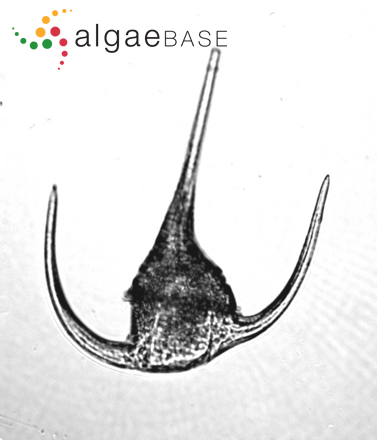
A cosmopolitan species. Dorsal view.Robin Raine (Robin.Raine@nuigalway.ie)
Publication Details
Ceratium tripos (O.F.Müller) Nitzsch 1817: 4 (as 'tripus')
Published in: Nitzsch, C.L. (1817). Beitrag zur Infusorienkunde oder Naturbeschreibung der Zerkarien und Bazillarien. Neue Schriften der Naturforschenden Gesellschaft zu Halle 3(1): 1-128, 6 pls.
 Request PDF
Type Species
The type species (lectotype) of the genus Ceratium is Ceratium tetraceras Schrank.
Status of Name
This name is currently regarded as a synonym of Tripos muelleri Bory.
Source of Synonymy
Gómez, F. (2013). Reinstatement of the dinoflagellate genus Tripos to replace Neoceratium, marine species of Ceratium (Dinophyceae, Alveolata). CICIMAR Oceánides 28(1): 1-22.
Basionym
Cercaria tripos O.F.Müller
Type Information
Type locality: ""2489. C. Tripos subtriangularis, brachiis deflexis. Tre-Fod-Haleren. ln aqua marina."; (Müller 1776: 206)
Origin of Species Name
Noun (Greek), A three-legged structure; a tripod.
General Environment
This is a marine species.
Created: 11 April 2002 by M.D. Guiry.
Last updated: 29 October 2021
Verification of Data
Users are responsible for verifying the accuracy of information before use, as noted on the website Content page.
Nomenclatural note
Index Nominum Algarum cites Ceratium tripos ('tripus') (O.F. Müller) Nitzsch in Ersch & Gruber 1827: 63. - (18 October 2011) - G.M. Guiry
Taxonomic note
According to Dodge (1982: 223) this species is of the sub-genus Orthoceratium. - (11 May 2006) - G.M. Guiry
Linking to this page: https://www.algaebase.org/search/species/detail/?species_id=30386
Citing AlgaeBase
Cite this record as:
M.D. Guiry in Guiry, M.D. & Guiry, G.M. 29 October 2021. AlgaeBase. World-wide electronic publication, National University of Ireland, Galway. https://www.algaebase.org; searched on 04 July 2025