133,478 species and infraspecific names are in the database, 16,455 images, 49,226 bibliographic items, 220,042 distributional records.

Acrosorium venulosum (Zanardini) Kylin

Publication details
Acrosorium venulosum (Zanardini) Kylin 1924: 77, fig. 60

Original publication: Kylin, H. (1924). Studien über die Delesseriaceen. Acta Universitatis Lundensis 20(6): 1-111, 80 figs.

Type species
The type species (holotype) of the genus Acrosorium is Acrosorium aglaophylloides Zanardini ex Kützing.

Status of name
This name is currently regarded as a taxonomic synonym of Acrosorium ciliolatum (Harvey) Kylin

Basionym
Nitophyllum venulosum Zanardini

Type information
Type locality: Zadar, Croatia (Silva, Basson & Moe 1996: 446). Notes: Although Zanardini’'s types should be in the Museo Civico, Venice, De Toni & Levi (1988) did not list any relevant specimen in this collection. Other possibilities are W, HBG and L. (Maggs & Hommersand, 1993).

Origin of species name
Adjective (Latin), finely-veined or profusely veined.

Homotypic Synonym(s)
Acrosorium uncinatum var. venulosum (Zanardini) Boudouresque, Perret-Boudouresque & Knoepffler-Péguy

Heterotypic Synonym(s)
Acrosorium aglaophylloides Zanardini ex Kützing 1869

General environment
This is a marine species.

Common names

(as Acrosorium venulosum (Zanardini) Kylin)
English: Red Hook Weed (Bunker et al. 2010).

Description
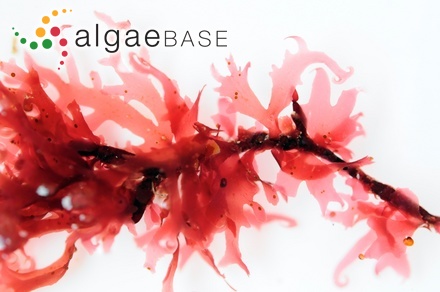
Flattened, membranous, deep red fronds, 30-150(-200) mm long. Frond deeply divided into linear-lanceolate, irregularly branched segments, often terminating in hooks. Margins toothed, often ± proliferous. Frond traversed by network of microscopic veins, macroscopic veins absent.

Distribution by country

Point data for Ireland and Britain

This map may take a minute to load. Please use an up-to-date web browser (Google Chrome 11, Firefox 4, Safari 5, Opera 11, Internet Explorer 9) for best performance.

Detailed distribution with sources
(as Acrosorium uncinatum var. venulosum (Zanardini) Boudouresque, Perret-Boudouresque & Knoepffler-Péguy)
Europe: Spain (Gallardo et al. 1985, Rodriguez Prieto & Polo Alberti 1988, Soto & Conde 1989, Rodriguez-Prieto & Polo Albertí 1998).

Africa: Tunisia (Ben Maiz, Boudouresque & Quahchi 1987).

(as Acrosorium venulosum (Zanardini) Kylin)
Ireland: Antrim (Maggs & Hommersand 1993, Morton 1994), Clare (Maggs & Hommersand 1993), Donegal (Maggs & Hommersand 1993, Morton 2003).

Europe: Adriatic (Giaccone 1978, Gómez Garreta et al. 2001), Balearic Islands (Ribera Siguán 1983, Ribera Siguán & Gómez Garreta 1984, Gómez Garreta et al. 2001), Britain (Maggs & Hommersand 1993, Hardy & Guiry 2003), Corsica (Boudouresque & Perret 1977, Coppejans 1979, Rodríguez Prieto, Boudouresque & Marcot-Coqueugniot 1993), France (Feldmann 1943, Augier, Boudouresque & Laborel 1971, Gómez Garreta et al. 2001, Verlaque 2001, Anon. 2012), Greece (Gómez Garreta et al. 2001), Ireland (Maggs & Hommersand 1993, Morton 1994, Guiry 2012), Italy (Funk 1961, Giaccone 1969, Edwards et al. 1975, Cinelli et al. 1976, Cecere et al. 1996, Furnari, Cormaci & Serio 1999, Gómez Garreta et al. 2001, Gómez Garreta et al. 2001, Rindi, Sartoni & Cinelli 2002, Furnari et al. 2003, Furnari et al. 2003, Furnari et al. 2003, Furnari et al. 2003), Malta (Cormaci et al. 1997), Portugal (Araújo et al., 2003), Sardinia (Gómez Garreta et al. 2001, Furnari et al. 2003), Spain (Ballesteros & Romero 1982, Gómez-Menor Robles & Fuertes Lasala 1982, Ballesteros 1983, Boisset & Barceló 1984, Granja, Cremades & Barbara 1992, Barbara, Cremades & López Rodriguez 1992, Bárbara, Cremades & Pérez-Cirera 1995, Bárbara & Cremades 1996, Conde et al. 1996, Rodríguez-Prieto & Polo, L. 1996, Veiga, Cremades & Bárbara 1998, Gómez Garreta et al. 2001), Turkey (Europe) (Gómez Garreta et al. 2001, Taskin et al. 2008 ).

Atlantic Islands: Canary Islands (Price, John & Lawson 1986, Ballesteros, Sansón, Reyes, Afonso-Carrillo & Gil-Rodríguez 1992, Haroun et al. 2002, Gil-Rodríguez et al. 2003, John et al. 2004, Anon 2011), Cape Verde Islands (John et al. 2004, Prud'homme van Reine, Haroun & Kostermans 2005), Madeira (Neto, Cravo & Haroun 2001, John et al. 2004).

North America: California (Stewart 1991), North Carolina (Schneider & Searles 1991), South Carolina (Schneider & Searles 1991).

Africa: Algeria (Gómez Garreta et al. 2001), Egypt (Aleem 1993, Gómez Garreta et al. 2001), Kenya (Silva, Basson & Moe 1996), Libya (Gómez Garreta et al. 2001), Mauritania (John et al. 2004), Morocco (Gómez Garreta et al. 2001), Senegal (John et al. 2004), South Africa (Silva, Basson & Moe 1996, Stegenga, Bolton & Anderson 1997), Tunisia (Gómez Garreta et al. 2001), Western Sahara (John et al. 2004).

Indian Ocean Islands: St. Paul Island (Silva, Basson & Moe 1996).

South-west Asia: India (Silva, Basson & Moe 1996, Sahoo et al. 2001), Levant states (Gómez Garreta et al. 2001), Oman (Wynne & Jupp 1998), Sri Lanka (Silva, Basson & Moe 1996).

Asia: China (Zheng, Liu & Chen 2001, Zeng 2009), Japan (Yoshida, Nakajima & Nakata 1990, Yoshida 1998), Korea (Lee & Kang 2001, Lee 2008).

South-east Asia: Indonesia (Silva, Basson & Moe 1996).

Australia and New Zealand: Lord Howe Island (Millar & Kraft 1993), New South Wales (Millar 1990, Millar & Kraft 1993), New Zealand (Adams 1994, Lin, Fredericq & Hommersand 2001), Norfolk Island (Millar 1999), Queensland (Phillips 1997, Phillips 2002).

Taxonomic notes
As to type, the names Acrosorium reptans (P.L. Crouan & H.M. Crouan) Kylin and A. uncinatum (Turner) Kylin are based on forms of Cryptopleura ramosa (Wynne 1989; Maggs & Hommersand 1993, p. 254-55); however, some reports of A. reptans are based on specimens of A. venulosum and some on Cryptopleura ramosa. Individual examination of specimens is therefore necessary to establish validity of many records. John et al. (2004) cite Acrosorium uncinatum (Turner) Kylin, Nitophyllum uncinatum (Turner) J. Agardh and Aglaophyllum laceratum Mont. as synonyms of this species.

Womersley (2003: 133) notes: "The type of Acrosorium ciliolatum has numerous short, slender, "cilia" on the margins and surface.... As Kylin (1929: 13) considered, A. ciliolatum is not specifically distinct from A. venulosum, and is the earliest name for this Acrosorium. Most descriptions under Acrosorium vunulosum or A. uncinatum state "gametophyes unknown". However, a few southern Australian collections (e.g. AD, A31152) with typical uncinate branches and agreeing well with this species, do bear cystocarps, and the description" (given by Womersley 2003) "of female stages is based on these." - (26 Jan 2009) - Wendy Guiry

According to Maggs & Hommersand (1993: 255), Acrosorium uncinatum sensu Kylin (1924: 77) [non Fucus laceratus var. uncinatus Turner (1808: 68) is a synonym of Acrosorium venulosum (Zanardini) Kylin (1924: 77). - (26 Jan 2009) - Wendy Guiry

Key references
Agardh, C.A. (1811). Dispositio algarum Sueciae, quam publico examini subjiciunt Carl Adolph Agardh... & Johannes Bruzelius, Scanus. Die xi decembris mdcccxi. p. ii. h. & l.s. pp. Pars 2: [i], 17-26. Lundae: Litteris Berlingianis.

Maggs, C.A. & Hommersand, M.H. (1993). Seaweeds of the British Isles. Volume 1. Rhodophyta. Part 3A. Ceramiales. pp. [i]-xv, 1-444, 129 figs, map. London: HMSO.

Womersley, H.B.S. (2003). The marine benthic flora of southern Australia - Part IIID Ceramiales - Delesseriaceae, Sarcomeniaceae, Rhodomelaceae. pp. 533. Canberra & Adelaide: Australian Biological Resources Study & State Herbarium of South Australia.

Wynne, M.J. (1989). Towards the resolution of taxonomic and nomenclatural problems concerning the typification of Acrosorium uncinatum (Delesseriaceae: Rhodophyta). British Phycological Journal 24: 245-252, 18 figs.

SAG Cultures
SAG Cultures may be viewed at http://sagdb.uni-goettingen.de/showstrains.php?genus=Acrosorium&species=venulosum

SCCAP Cultures
Cultures from the Scandinavian Culture Collection of Algae at the University of Copenhagen (SCCAP) and Protozoa may be viewed at http://www.sccap.dk/search/algaebase.asp?Genus=Acrosorium&Species=venulosum

NCBI Nucleotide Sequences

Created: 17 May 1996 by M.D. Guiry

Verified by: 03 December 2012 by M.D. Guiry

Accesses: This record has been accessed by users 2318 times since it was created.

Linking to this page: http://www.algaebase.org/search/species/detail/?species_id=488

Citing AlgaeBase
Cite this record as:
M.D. Guiry in Guiry, M.D. & Guiry, G.M. 2013. AlgaeBase. World-wide electronic publication, National University of Ireland, Galway. http://www.algaebase.org; searched on 24 May 2013.

Algaebase taxon LSID: urn:lsid:algaebase.org:taxname:114284

SITE © 1996 - 2013 M.D. Guiry. All rights reserved.

Website Design : 249 Design Studio