125,865 species and infraspecific names are in the database, 8,150 images, 44,630 bibliographic items, 162,797 distributional records.

Furcellaria lumbricalis (Hudson) J.V.Lamouroux

Classification:
Empire Eukaryota
Kingdom Plantae
Subkingdom Biliphyta
Phylum Rhodophycophyta
Subphylum Eurhodophytina
Class Florideophyceae
Subclass Rhodymeniophycidae
Order Gigartinales
Family Furcellariaceae
Genus Furcellaria

Pictures:

click on thumbnail for larger version.


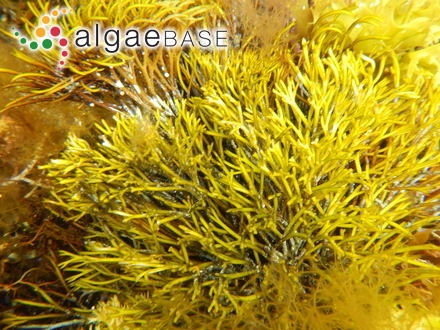
Kleinwaabs, Eckernförder Bight, Germany, Baltic Sea, 3m depth. 03 Oct 2005. Dirk Schories. © Dirk Schories.


Dog's Bay, Roundstone, Co. Galway, Ireland; plants at low water. 27 Apr 2006. Michael Guiry. © Michael Guiry.


Spiddal, Co. Galway, Ireland; sandy lagoons at MLWN. 18 Apr 2002. Michael Guiry. © Michael Guiry.


Dog's Bay, Roundstone, Co. Galway, Ireland; plants at low water. 27 Apr 2006. Michael Guiry. © Michael Guiry.


Cooliva Quay, Co. Clare, Ireland; plants growing on sandy rocks at MLWN. 28 Apr 2006. Michael Guiry. © Michael Guiry.


Trá an Dóilín, An Cheathrú Rua, Co. na Gaillimhe. 05 May 2008. Michael Guiry. © Michael Guiry.


Spain, Asturias, Candás, 2007. Ignacio Bárbara. © Ignacio Bárbara.


Spain, Asturias, Candás, 2007. Ignacio Bárbara. © Ignacio Bárbara.


Spain, Asturias, Candás, 2007. Ignacio Bárbara. © Ignacio Bárbara.


Spain, Asturias, Candás, 2007. Ignacio Bárbara. © Ignacio Bárbara.

1  2  Next

16 Found - Displaying 1 through 10


_MG38755

Furcellaria lumbricalis (Hudson) J.V.Lamouroux Furcellaria lumbricalis Cuan, Ventry Harbour, Co. Kerry, Ireland

Publication details
Furcellaria lumbricalis (Hudson) J.V.Lamouroux 1813: 46

Original publication: Lamouroux, J.V.F. (1813). Essai sur les genres de la famille des thalassiophytes non articulées. Annales du Muséum d'Histoire Naturelle, Paris 20: 21-47, 115-139, 267-293, Plates 7-13.
 Download PDF

Type species
The type species (holotype) of the genus Furcellaria is Furcellaria fastigiata (Turner) J.V.Lamouroux.

Status of name
This name is of an entity that is currently accepted taxonomically.

Basionym
Fucus lumbricalis Hudson

Type information
Type locality: [unlocalised; certainly England] (Hudson 1762: 471). Lectotype: BM (Dixon & Irvine 1977: 181). Notes: An unlocalised, undated Hudson specimen accepted provisionally as of lectotype status by Dixon & Irvine (1977: 181).

Origin of species name
Adjective (Latin), worm-shaped (Stearn 1973).

Homotypic Synonym(s)
Fucus lumbricalis Hudson 1762

Heterotypic Synonym(s)
Fucus fastigiatus Linnaeus 1753
Fucus furcellatus Linnaeus 1763
Fucus lumbricalis var. fastigiatus Turner 1807
Fastigiaria furcellata (Linnaeus) Stackhouse 1809
Furcellaria fastigiata (Turner) J.V.Lamouroux 1813
Furcellaria fastigiata var. minor C.Agardh 1817
Furcellaria lumbricalis var. fastigiata (Turner) Lyngbye 1819
Polyides lumbricalis var. fastigiatus C.Agardh 1822
Sphaerococcus fastigiatus (Linnaeus) Wahlenberg 1826
Polyides rotundus f. fastigiatus (C.Agardh) Duby 1830
Furcellaria fastigiata f. aegagropila Reinke 1889
Furcellaria fastigiata f. minor (C.Agardh) Svedelius 1901

General environment
This is a marine species.

Description
Cartilaginous, cylindrical, brownish-black fronds, repeatedly dichotomously branched, fastigiate, to 2 mm diam. and 300 mm long, with acute apices. Attached by much-branched rhizoids. Multiaxial, medulla of cylindrical cells interspersed with rhizoids, cortex of irregular filaments, inner cells elliptical, outer cells narrow, elongated, in radial rows.

Habitat
On rocks, lower intertidal and shallow subtidal, in pools and runnels, in open situations, often on sandy and muddy shores, tolerating lowered salinities. Generally distributed, common.

Detailed distribution with sources
(as Fucus fastigiatus Linnaeus)
Ireland: Wexford (Tighe 1803).

Europe: Ireland (Tighe 1803).

(as Fucus lumbricalis Hudson)
Ireland: Wexford (Tighe 1803).

Europe: Ireland (Tighe 1803).

(as Furcellaria lumbricalis (Hudson) J.V.Lamouroux)
Ireland: Antrim (Morton & Chamberlain 1985, Morton & Chamberlain 1985, Morton 1994), Clare (De Valéra et al. 1979, Maggs 1983), Derry (Morton 1994), Donegal (Morton 2003), Down (Morton & Chamberlain 1985, Morton & Chamberlain 1985, Morton 1994), Galway (Maggs 1983), Kerry (Whelan & Cullinane 1985).

Europe: Baltic Sea (Nielsen et al. 1995), Britain (Dixon & Irvine 1977), Denmark (Larsen & Sand-Jensen 2006, Wernberg 2006), Faroes (Irvine 1982, Nielsen & Gunnarsson 2001), Finland (Kostano & Makinen 2006), France (Coppejans 1995, Dizerbo & Herpe 2007), Helgoland (Bartsch & Kuhlenkamp 2000), Ireland (Guiry 1978, De Valéra et al. 1979, Maggs 1983, Whelan & Cullinane 1985, Morton 1994), Italy (Furnari et al. 2003), Norway (Rueness 1997), Portugal (Araujo et al. 2009), Sardinia (Furnari et al. 2003), Scandinavia (Athanasiadis 1996), Spain (Gallardo et al. 1985, Granja, Cremades & Bárbara 1993, Conde et al. 1996, Casado & Gallardo 2000, Pérez-Cirera 2004, Bárbara et al. 2005), Spitsbergen (Vinogradova 1995), Sweden (Tolstoy & Österlund 2003).

South-west Asia: India (Silva, Basson & Moe 1996, Sahoo et al. 2001), Pakistan (Silva, Basson & Moe 1996), Turkey (Asia) (Taskin et al. 2008).

(as Furcellaria fastigiata (Turner) J.V.Lamouroux)
Ireland: Antrim (Adams 1907), Cork (Cullinane 1971, Cullinane, McCarthy & Fletcher 1975), Down (Morton 1974), Louth (Synnott 1969), Mayo (Cotton 1912), Wexford (Cotton 1913, Parkes & Scannell 1969, Norton 1970).

Europe: Britain (Newton 1931, Hardy & Guiry 2003), Bulgaria (Dimitrova-Konaklieva 1981), France (Feldmann 1954, Zubia et al. 2009), Greece (Haritonidis & Tsekos 1976), Ireland (Adams 1907, Cotton 1912, Cotton 1913, Cullinane 1971), Italy (Giaccone 1969), Spain (Miranda 1931), Sweden (Kylin 1907, Kylin 1944).

Key references
Austin, A.P. (1960). Life history and reproduction of Furcellaria fastigata (L.) Lam. 2. The tetrasporophyte and reduction division in the tetrasporangium. Annals of Botany, New Series 24: 296-310.

Austin, A.P. (1960). Life history and reproduction of Furcellaria fastigiata (L.) Lam. 1. The haploid plants and the development of the carposporophyte. Annals of Botany, New Series 24: 257-274.

Austin, A.P. (1960). Observations on the growth, fruiting and longevity of Furcellaria fastigiata (L.) Lam.. Hydrobiologia 5: 193-207.

Braune, W. (2008). Meeresalgen. Ein Farbbildführer zu den verbreiteten benthischen Grün- Braun- und Rotalgen der Weltmeere. pp. [1]-596, 266 pls. Ruggell: A.R.G. Gantner Verlag.

Kostamo, K. & Mäkinen, A. (2006). Observations on the mode and seasonality of reproduction in Furcellaria lumbricalis (Gigartinales, Rhodophyta) populations in the northern Baltic Sea.. Botanica Marina 49(4): 304-309, 4 figs, 4 tables .

Larsen, A. & Sand-Jensen, K. (2005). Salt tolerance and distribution of estuarine benthic macroalgae in the Kattegat-Baltic Sea area. Phycologia 45: 13-23.

Wernberg, T. (2006). Scale of impact determines early post-disturbance assemblage structure in subtidal Fucus beds in the Baltic Sea (Bornholm, Denmark). European Journal of Phycology 41: 105-113.

SAG Cultures
No records have been found on the SAG site.

NCBI Nucleotide Sequences

Created: 30 March 1996 by M.D. Guiry

Verified by: 24 August 2008 by M.D. Guiry

Accesses: This record has been accessed by users 3864 times since it was created.

References
(Please note: only references with the binomials in the title are included. The information is from the Literature database.)

Barwell, C.J. (1983). The distribution of histamine in Furcellaria lumbricalis. British Phycological Journal 18: 200.
Barwell, C.J. (1989). Distribution of histamine in the thallus of Furcellaria lumbricalis. J Appl Phycol 1: 341-344.
Bird, C.J., Saunders, G.W. & Mclachlan, J. (1991). Biology of Furcellaria lumbricalis (Hudson) Lamouroux (Rhodophyta, Gigartinales), a commercial carrageenophyte. Journal of Applied Phycology 3: 61-82.
Bird, N.L., Chen, L.C.-M. & McLachlan, J. (1979). Effects of temperature, light and salinity on growth in culture of Chondrus crispus, Furcellaria lumbricalis, Gracilaria tikvahiae (Gigartinales, Rhodophyta) and Fucus serratus (Fucales, Phaeophyta). Botanica Marina 22: 521-527.
Blunden, G., Smith, B.E. & Cary, P.D. (1989). Trans-4-hydroxy-ß-prolinebetaine, a new betaine from Furcellaria lumbricalis. J Appl Phycol 1(1): 1-4.
Holmsgaard, J. E., Greenwell, M. & McLachlan, J. (1981). Biomass and vertical distribution of Furcellaria lumbricalis and associated algae. Proceedings of the International Seaweed Symposium 10: 309-314.
Indergaard, M. & Knutsen, S.H. (1990). Seasonal differences in ash, carbon, fibre and nitrogen components of Furcellaria lumbricalis (Gigartinales, Rhodophyceae), Norway. Botanica Marina 33: 327-334.
Knutsen, S.H. & Grasdalen, H. (1987). Characterization of water-extractable polysaccarides from Norwegian Furcellaria lumbricalis (Huds.) Lamour. (Gigartinales, Rhodophyceae) by IR and NMR spectroscopy. Botanica Marina 30: 497-505.
Knutsen, S.H., Myslabodski, D.E. & Grasdalen, H. (1990). Characterization of carrageenan fractions from Norwegian Furcellaria lumbricalis (Huds.) Lamour. by 1H-n.m.r. spectroscopy. Carbohydrate Research 206: 367-372.
Korolev, A., Kuznetzova, T.A. & Drozdetsky, V.G. (1993). Investigations of the Furcellaria lumbricalis distribution and abundance at the eastern coast of the Baltic sea. Proc. 13th Baltic Mar. Biol. Symp. : 9.
Kostamo, K. & Mäkinen, A. (2006). Observations on the mode and seasonality of reproduction in Furcellaria lumbricalis (Gigartinales, Rhodophyta) populations in the northern Baltic Sea.. Botanica Marina 49(4): 304-309, 4 figs, 4 tables .
Maekinen, A., Kaeaeriae, J. & Rajasilta, M. (1988). Factors controlling the occurrence of Furcellaria lumbricalis (Huds.) Lamour. and Phyllophora truncata (Pallas) Zinova in the upper littoral of the archipelago of S.W. Finland. In: The Baltic Sea Environment: History, Euthrophication, Recruitment, Ecotoxicology. (Theede, H. & Schramm, W. Eds) Vol.6, pp. 140-146. Kieler Meeresforsch.
Martin, G., Paalme, T. & Kukk, H. (1996). Long-term dynamics of the commercially usable Furcellaria lumbricalis-Coccotylus truncatus community in Kassari Bay, west Estonian archipelago, the Baltic Sea. pp. 121-129. Gdynia, Poland: Baltic Coastal Fisheries Resource Management.
Martin, G., Paalme, T. & Torn, K. (2007). Seasonality pattern of biomass accumulation in a drifting Furcellaria lumbricalis community in the waters of the West Estonian Archipelago, Baltic Sea. Proceedings of the International Seaweed Symposium 18: 331-337.
Mikulich, D.V., Voloshchenko, I.A. & Medvedeva, E.I. (1988). The jelly-forming capacity of polysaccharides from the red algae Furcellaria lumbricalis (Huds.) Lamour. and Phyllophora truncata (Pall.) Newroth et Taylor (the Bight of Kassari of the Baltic Sea). Rast. Resur. 24(3): 456-460.
Novaczek, I. & Breeman, A.M. (1990). Thermal ecotypes of amphi-Atlantic algae. II. Cold-temperate species (Furcellaria lumbricalis and Polyides rotundus). Helgoländer Meeresuntersuchungen 44: 475-485.
Valatka, S., Mäkinen, A. & Yli-Mattila, T. (2000). Analysis of genetic diversity of Furcellaria lumbricalis (Gigartinales, Rhodophyta) in the Baltic Sea by RAPD-PCR technique. Phycologia 39: 109-117.

SITE © 1996 - 2010 M.D. Guiry. All rights reserved.

Website Design : 249 Design Studio