125,865 species and infraspecific names are in the database, 8,150 images, 44,630 bibliographic items, 162,797 distributional records.

Cryptopleura ramosa (Hudson) L.Newton

Classification:
Empire Eukaryota
Kingdom Plantae
Subkingdom Biliphyta
Phylum Rhodophycophyta
Subphylum Eurhodophytina
Class Florideophyceae
Subclass Rhodymeniophycidae
Order Ceramiales
Family Delesseriaceae
Subfamily Phycodryoideae
Tribe Cryptopleureae
Genus Cryptopleura

Pictures:

click on thumbnail for larger version.


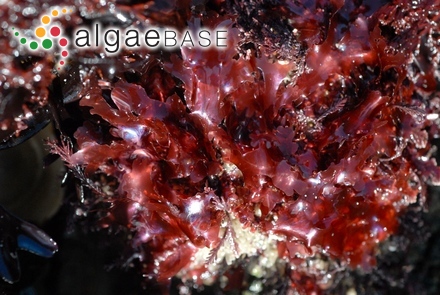
Muigh Inis, Co. Galway, Ireland; on rock. 13 Apr 2006. Michael Guiry. © Michael Guiry.


Spiddal, Co. Galway, Ireland; on Corallina officinalis


Spiddal, Co. Galway, Ireland; lower intertidal pools on Corallina officinalis. 30 Sep 2007. Michael Guiry. © Michael Guiry.


Spain, Galicia, A Coruña, Ártabra, intertidal, 2005. Ignacio Bárbara. © Ignacio Bárbara.


Spain, Galicia, Lugo, San Ciprián, 2005, lower intertidal. Ignacio Bárbara. © Ignacio Bárbara.


Spain, Galicia, A Coruña, 2005; superficial and TS microscope view. Ignacio Bárbara. © Ignacio Bárbara.


Murles Point, Co. Donegal, Ireland; to 110 mm. 27 May 1994. Michael Guiry. © Michael Guiry.


Spiddal, Co. Galway, Ireland; intertidal pools; to 100 mm. Michael Guiry. © Michael Guiry.


Spiddal, Co. Galway, Ireland; plants in pools in lower shore; gorwing epiphytically on Corallina officinalis. 26 Mar 2005. Michael Guiry. © Michael Guiry.


Spiddal, Co. Galway, Ireland; epiphytic on Corallina officinalis in a low-water pool. 22 Mar 2002. Michael Guiry. © Michael Guiry.

1  2  Next

12 Found - Displaying 1 through 10


CryramSpiddal

Cryptopleura ramosa (Hudson) L.Newton Spiddal, Co. Galway, Ireland; intertidal pools; to 100 mm

Publication details
Cryptopleura ramosa (Hudson) L.Newton 1931: 332

Original publication: Newton, L. (1931). A handbook of the British seaweeds. pp. xiii + 478, 270 figs. London: British Museum (Natural History).

Type species
The type species (holotype) of the genus Cryptopleura is Cryptopleura lacerata (S.G.Gmelin) Kützing.

Status of name
This name is of an entity that is currently accepted taxonomically.

Basionym
Ulva ramosa Hudson

Type information
Type locality: Lancaster, England (Silva, Basson & Moe 1996: 900).

Origin of species name
Adjective (Latin), branched, bearing branches (usually many) (Stearn 1973).

Homotypic Synonym(s)
Ulva ramosa Hudson 1762

Heterotypic Synonym(s)
Cryptopleura fimbriata (Greville) Kützing
Cryptopleura ramosa var. ciliifera Kützing
Cryptopleura ramosa var. lobata Kützing
Cryptopleura ramosa var. uncinatum Greville
Fucus laceratus S.G.Gmelin 1768
Fucus endiviifolius Lightfoot 1777
Fucus crispatus Hudson 1778
Fucus laceratus var. uncinatus Turner 1808
Papyracea lacerata (S.G.Gmelin) Stackhouse 1809
Hymenophylla lacerata (S.G.Gmelin) Stackhouse 1816
Chondrus laceratus (Gmelin) Lyngbye 1819
Delesseria lacerata (S.G.Gmelin) C.Agardh 1822
Nitophyllum laceratum (S.G.Gmelin) Greville 1830
Cryptopleura lacerata (S.G.Gmelin) Kützing 1843
Aglaophyllum laceratum (Gmelin) Areschoug 1847
Nitophyllum reptans P.L.Crouan & H.M.Crouan 1851
Nitophyllum uncinatum (Turner) J.Agardh 1852
Acrosorium reptans (P.L.Crouan & H.M.Crouan) Kylin 1924
Acrosorium uncinatum (Turner) Kylin 1924
Acrosorium uncinatum var. reptans (P.L.Crouan & H.M.Crouan) Ben Maiz, Boudouresque & Ouachi 1987

General environment
This is a marine species.

Description
Thin, membranous, brownish red fronds, to 200 mm long. Frond ± dichotomously divided, becoming irregular in upper parts. Frond often iridescent, with undulate, often proliferous margins, sometimes with flattened hooks or with rhizoidal attachment processes. Very variable in growth form.

Habitat
On rock and Laminaria hyperborea stipes, lower intertidal and subtidal, generally distributed, common.

Key characteristics
Gonimophyllum buffhamii, a minute parasite, occurs occasionally on subtidal plants on southern and western coasts.

Similar species
Acrosorium venulosum is less translucent and recurved branches are not as strongly recurved.

Detailed distribution with sources
(as Cryptopleura fimbriata (Greville) Kützing)
South America: Brazil (Taylor 1960), Uruguay (Taylor 1960).

(as Cryptopleura ramosa var. ciliifera Kützing)
Europe: Britain (Newton 1931).

(as Cryptopleura ramosa var. lobata Kützing)
Europe: Britain (Newton 1931).

(as Cryptopleura ramosa var. uncinatum Greville)
Europe: Britain (Newton 1931).

(as Fucus laceratus S.G.Gmelin)
Ireland: Wexford (Tighe 1803).

Europe: Ireland (Tighe 1803).

(as Nitophyllum laceratum (S.G.Gmelin) Greville)
Ireland: Antrim (Dickie 1871, Hanna 1899, Hanna 1902), Dublin (Sanders 1860), Mayo (Cotton 1912), Wexford (Cotton 1913).

Europe: Ireland (Cotton 1912, Cotton 1913), Spain (Sauvageau 1897, Miranda 1931).

South America: Brazil (Taylor 1930).

Asia: Korea (Lee & Kang 2001).

(as Nitophyllum laceratum (S.G.Gmelin) Greville)
Europe: Spain (Sauvageau 1897).

(as Cryptopleura lacerata (S.G.Gmelin) Kützing)
Europe: Spain (Miranda 1934).

South America: Brazil (Joly 1957, Taylor 1960), Uruguay (Taylor 1960).

(as Aglaophyllum laceratum (Gmelin) Areschoug)
Atlantic Islands: Canary Islands (Price, John & Lawson 1986).

(as Nitophyllum reptans P.L.Crouan & H.M.Crouan)
Ireland: Antrim (Hanna 1902), Cork (Anonymous 1896).

(as Nitophyllum uncinatum (Turner) J.Agardh)
Ireland: Antrim (Hanna 1902), Mayo (Cotton 1912).

Europe: Balearic Islands (Ardissone 1883, Rodríguez y Femenías 1889), Ireland (Cotton 1912), Spain (Sauvageau 1897, Bellón 1921, Miranda 1931).

South America: Brazil (Taylor 1930).

(as Acrosorium reptans (P.L.Crouan & H.M.Crouan) Kylin)
Ireland: Cork (Guiry 1978), Donegal (Guiry 1978, Maggs & Guiry 1982), Waterford (Guiry 1978), Wexford (Parkes & Scannell 1969, Guiry 1978).

Europe: Balearic Islands (Ribera Siguán, Gómez Garreta & Seoane Camba 1982, Ribera Siguán 1983, Ribera Siguán & Gómez Garreta 1984), Britain (Newton 1931), France (Feldmann 1943, Feldmann 1954), Ireland (Guiry 1978), Spain (Seoane-Camba 1965, Ballesteros & Romero 1982, Pérez-Cirera & Maldonado 1982, Gómez-Menor Robles & Fuertes Lasala 1982, Ballesteros 1983, Fernández, Niell & Anadón 1983, Boisset & Barceló 1984).

Atlantic Islands: Canary Islands (Gil-Rodríguez & Afonso-Carrillo 1980, Price, John & Lawson 1986).

(as Acrosorium uncinatum (Turner) Kylin)
Ireland: Clare (Guiry 1978), Cork (Guiry 1978), Donegal (Maggs & Guiry 1982), Galway (De Valéra et al. 1979), Kerry (Guiry 1978, Whelan & Cullinane 1985), Waterford (Guiry 1977, Guiry 1978), Wexford (Norton 1970, Guiry 1978).

Europe: Adriatic (Giaccone 1978), Balearic Islands (Navarro & Bellón 1945, Dao 1957, Seoane-Camba 1969, Ribera Siguán 1983, Ribera Siguán & Gómez Garreta 1984), Britain (Newton 1931), Corsica (Boudouresque & Perret 1977, Coppejans 1979, Verlaque 1984), France (Feldmann 1943, Feldmann 1954, Augier, Boudouresque & Laborel 1971, Ben Maiz, Boudouresque, Lauret & Riouall 1988, Dizerbo & Herpe 2007), Greece (Athanasiadis 1987), Ireland (Guiry 1977, Guiry 1978, De Valéra et al. 1979, Whelan & Cullinane 1985), Italy (Giaccone 1969, Feoli & Bressan 1972, Cinelli et al. 1976), Portugal (Ardré 1970), Spain (Hamel 1928, Seoane-Camba 1965, Ballesteros & Romero 1982, Ballesteros 1983, Fernández, Niell & Anadón 1983, Boisset & Barceló 1984, Pérez-Ruzafa & Honrubia 1984, Gallardo et al. 1985, Soto & Conde 1989).

Atlantic Islands: Azores (Neto 1994, Tittley & Neto 1994), Canary Islands (Børgesen 1930, Gil-Rodríguez & Afonso-Carrillo 1980, Gil-Rodriguez et al. 1985, Price, John & Lawson 1986), Cape Verde Islands (Otero-Schmitt & Sanjuan 1992), Madeira (Levring 1974).

North America: Baja California (Taylor 1945), California (Abbott & Hollenberg 1976).

South America: Brazil (Taylor 1960, Joly 1965), Chile (Ramírez & Santelices 1991), Peru (Acleto 1973, Ramírez & Santelices 1991), Venezuela (Ganesan 1990).

Africa: Egypt (Aleem 1993), Guinea (Price, John & Lawson 1986), Mauritania (Price, John & Lawson 1986), Morocco (Dangeard 1949), Senegal (Price, John & Lawson 1986), Tunisia (Meñez & Mathieson 1981, Ben Maiz, Boudouresque & Quahchi 1987), Western Sahara (Price, John & Lawson 1986).

Asia: China (Tseng 1984), Korea (Lee 2008).

Australia and New Zealand: Queensland (Lewis 1984 ).

(as Cryptopleura ramosa (Hudson) L.Newton)
Ireland: Antrim (Guiry 1978, Morton 1994), Clare (Guiry 1978, De Valéra et al. 1979, Maggs 1983, Maggs & Hommersand 1993), Cork (Cullinane 1971, Cullinane, McCarthy & Fletcher 1975, Guiry 1978, Cullinane & Whelan 1983), Derry (Morton 1994), Donegal (Maggs & Guiry 1982, Maggs & Hommersand 1993, Morton 2003), Down (Morton 1974, Guiry 1978, Maggs & Hommersand 1993, Morton 1994), Galway (Guiry 1978, Maggs 1983), Kerry (Guiry 1978, Cullinane & Whelan 1983, Cullinane & Whelan 1984, Whelan & Cullinane 1985), Mayo (Guiry 1978), Sligo (Cullinane 1970), Waterford (Guiry 1978), Wexford (Parkes & Scannell 1969, Norton 1970, Guiry 1978).

Europe: Britain (Newton 1931, Maggs & Hommersand 1993, Hardy & Guiry 2003), Faroes (Irvine 1982, Nielsen & Gunnarsson 2001), France (Feldmann 1954, Coppejans 1995, Dizerbo & Herpe 2007, Loiseaux-de Goër & Noailles 2008), Ireland (Cullinane 1971, Guiry 1978, De Valéra et al. 1979, Maggs 1983, Whelan & Cullinane 1985, Maggs & Hommersand 1993, Morton 1994), Italy (Cinelli et al. 1976, Gómez Garreta et al. 2001, Furnari et al. 2003, Furnari et al. 2003), Netherlands (Stegenga & Mol 1983), Norway (Rueness 1997), Portugal (Ardré 1970, Araujo et al. 2009, Araújo, Bárbara & Sousa-Pinto in press), Scandinavia (Athanasiadis 1996), Spain (Seoane-Camba 1965, Fernández & Niell 1982, Fernández, Niell & Anadón 1983, Gallardo et al. 1985, Anadón & Fernández 1986, Silva & Fernández 1988, Fernández & Menéndez 1991, Granja, Cremades & Barbara 1992, Bárbara & Cremades 1996, Conde et al. 1996, Veiga, Cremades & Bárbara 1998, Gómez Garreta et al. 2001, Peña & Bárbara 2002, Valenzuela Miranda 2002, Gorostiaga et al., 2004, Bárbara et al. 2004, Bárbara et al. 2005, Diaz-Tapia & Bárbara 2005).

Atlantic Islands: Azores (Neto 1994), Canary Islands (Price, John & Lawson 1986, Haroun et al. 2002, Gil-Rodríguez et al. 2003, John et al. 2004), Madeira (Levring 1974, Neto, Cravo & Haroun 2001, John et al. 2004).

South America: Brazil (Joly 1965), Uruguay (Coll & Oliveira 1999).

Africa: Algeria (Gómez Garreta et al. 2001), Morocco (Dangeard 1949, Gómez Garreta et al. 2001), Western Sahara (Price, John & Lawson 1986, John et al. 2004).

(as Acrosorium uncinatum var. reptans (P.L.Crouan & H.M.Crouan) Ben Maiz, Boudouresque & Ouachi)
Europe: Spain (Gallardo et al. 1985, Rodriguez Prieto & Polo Alberti 1988, Soto & Conde 1989).

Africa: Tunisia (Ben Maiz, Boudouresque & Quahchi 1987).

Nomenclatural notes
Newton (1931: 332) attributed the combination to Kylin without explanation, but was probably aware of a pending publication via correspondence.

Key references
Dawes, C.J. & Mathieson, A.C. (2008). The seaweeds of Florida. pp. [i]- viii, [1]-591, [592], pls I-LI. Gainesville, Florida: University Press of Florida.

Loiseaux-de Goër, S. & Noailles, M.-C. (2008). Algues de Roscoff. pp. [1]-215, col. figs. Roscoff: Editions de la Station Biologique de Roscoff.

Maggs, C.A. & Hommersand, M.H. (1993). Seaweeds of the British Isles. Volume 1. Rhodophyta. Part 3A. Ceramiales. pp. xv + 444, 129 figs, map. London: HMSO.

SAG Cultures
No records have been found on the SAG site.

NCBI Nucleotide Sequences

Created: 31 March 1996 by M.D. Guiry

Verified by: 20 November 2008 by M.D. Guiry

Accesses: This record has been accessed by users 3463 times since it was created.

References
(Please note: only references with the binomials in the title are included. The information is from the Literature database.)

Baardseth, E. (1974). Cryptopleura ramosa (Huds.) Kylin ex Newton (Rhodophyceae) and Omphalophyllum ulvaceum Rosenv. (Phaeophyceae) new to Norway. Sarsia 57: 109-112.

SITE © 1996 - 2010 M.D. Guiry. All rights reserved.

Website Design : 249 Design Studio