Gracilaria gracilis (Stackhouse) M. Steentoft, L.M. Irvine & W.F. Farnham
Classification:
Empire Eukaryota
Kingdom Plantae
Subkingdom Biliphyta
Phylum Rhodophyta
Subphylum Eurhodophytina
Class Florideophyceae
Subclass Rhodymeniophycidae
Order Gracilariales
Family Gracilariaceae
Genus Gracilaria
- Uses and Compounds
- Aquaculture Methods
- Aquaculture Data
- Taxonomy
- References
- Submit Feedback
- Submit Reference
- Links
- Genbank
- Index Nominum Algarum
Pictures:
click on thumbnail for larger version.
![]()
Cooliva Quay, Co. Clare, Ireland; plants in sand. 28 Apr 2006. M.D. Guiry.
![]()
Dog's Bay, Roundstone, Co. Galway, Ireland; plants at low water on sandy rocks. 27 Apr 2006. M.D. Guiry.
![]()
Dog's Bay, Roundstone, Co. Galway, Ireland; plants at low water on sandy rocks. 27 Apr 2006. M.D. Guiry.
![]()
Finavarra, Co. Clare, Ireland; pools at MLWN. 12 Aug 2002. M.D. Guiry.
![]()
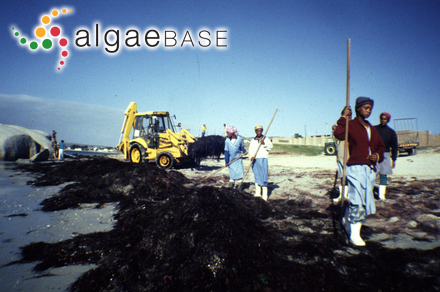
Saldanha Bay, South Africa; gathering cast weed. Rob Anderson.
![]()
Saldanha Bay, South Africa; in situ plants. Rob Anderson.
![]()
Saldanha Bay, South Africa; cultvation on ropes. Rob Anderson.
![]()
Saldanha Bay, South Africa; dried plants. Rob Anderson.
![]()
Lüderitz, Namibia; cultivation farms. Rob Anderson.
33 Found - Displaying 1 through 10
Publication details
Gracilaria gracilis (Stackhouse) M. Steentoft, L.M. Irvine & W.F. Farnham 1995: 115, figs 1-3, 5-18
Original publication: Steentoft, M., Irvine, L.M. & Farnham, W.F. (1995). Two terete species of Gracilaria and Gracilariopsis (Gracilariales, Rhodophyta) in Britain. Phycologia 34: 113-127, 37 figs.
Type species
The type species (lectotype) of the genus Gracilaria is Gracilaria compressa (C. Agardh) Greville.
Status of name
This is regarded as a current name.
Basionym
Fucus gracilis Stackhouse
Type information
Type locality: “Padstow, Cornwall, and elsewhere”, England (Athanasiadis 1996: 63). Type: Stackhouse; BM Notes: This type locality was first recorded as a lectotype without provenance by Steentoft, L.Irvine & Farnham (1995: 115, fig. 1) (Silva et al., 1996)
Origin of species name
Adjective (Latin), thin, slender (Stearn 1973).
Synonym(s)
Fucus verrucosus Hudson 1762
Fucus confervoides Linnaeus 1763
Ceramium confervoides Wiggers 1780
Sphaerococcus confervoides (Wiggers) Stackhouse 1797
Fucus procerrimus Esper 1800
Fucus gracilis Stackhouse 1801
Fucus confervoides var. gracilis (Stackhouse) Turner 1802
Gracilaria confervoides (Linnaeus) Greville 1830
Gracilaria confervoides var. procerrima (Esper) Greville 1830
Fucus gulaman M.Blanco 1837
Sphaerococcus capillaris Kützing 1863
Gracilaria confervoides f. gracilis (Stackhouse) Grunow 1874
Gracilaria confervoides var. gracilis (Stackhouse) Batters 1902
Gracilaria confervoides f. tenuissima Rosenvinge 1931
Gracilaria verrucosa (Hudson) Papenfuss 1950
Gracilariopsis verrucosa (Hudson) M. Steentoft, L.M. Irvine, & W.F. Farnham 1995
General environment
This is a marine species.
Common names used in commerce, often for edible algae
guraman {Cag}; gulaman {Ilo}; caocaoayan {Ilo}; maracaoyan {Ilo}; ogo-nori {Jap}; tou fa ts'ai {China}; "Ceylon moss, false"; "moss, false Ceylon"
Usage notes
Cultivated in Saldanha Bay, South Africa. Collected from drift in Saldanha Bay and in Namibia.
Description
Cartilaginous, cylindrical, dull purple fronds, to 500 mm long, one or several arising from small, fleshy, perennial discoid holdfast. Branching very irregular, sparse or profuse, brnches to 2 mm diam., apices pointed. Intertidal tissue of large thin-walled cells with narrow outer cortical zone of small colourless cells.
Habitat
On rocks and stones, intertidal and subtidal, especially on sandy shores, generally distributed, common.
Detailed distribution with sources
(as Fucus confervoides Linnaeus)
Ireland: Wexford (Tighe 1803).
Europe: Ireland (Tighe 1803).
(as Gracilaria confervoides (Linnaeus) Greville)
Ireland: Antrim (Adams 1907), Dublin (Sanders 1860), Mayo (Cotton 1912).
Europe: Balearic Islands (Rodríguez y Femenías 1889, Sjöstedt 1926), Britain (Newton 1931), Ireland (Adams 1907, Cotton 1912), Italy (Giaccone 1969), Spain (Miranda 1931, Miranda 1934), Sweden (Kylin 1944), Turkey (Europe) (Güven & Öztig 1971).
Atlantic Islands: Canary Islands (Haroun et al. 2002, Gil-Rodríguez et al. 2003).
North America: Gulf of California (Dawson 1944).
Central America: Islas Revillagigedo (Taylor 1945).
South America: Brazil (Taylor 1930), Ecuador (Taylor 1945).
Africa: Morocco (Dangeard 1949).
South-west Asia: Sri Lanka (Børgesen 1936).
(as Gracilaria confervoides var. procerrima (Esper) Greville)
Ireland: Derry (McMillan & Morton 1979), Mayo (Cotton 1912).
Europe: Britain (Newton 1931), Ireland (Cotton 1912).
Africa: Morocco (Dangeard 1949).
(as Gracilaria confervoides var. gracilis (Stackhouse) Batters)
Europe: Britain (Newton 1931).
(as Gracilaria verrucosa (Hudson) Papenfuss)
Ireland: Antrim (Guiry 1978, Morton 1994), Clare (De Valéra et al. 1979, Maggs 1983), Cork (Cullinane 1971, Guiry 1978), Derry (McMillan & Morton 1979, Morton 1994), Down (Guiry 1978, Morton 1994), Galway (Guiry 1978, Ottway & Mac Donnacha 1980, Maggs 1983), Kerry (Guiry 1978, Whelan & Cullinane 1985), Leitrim (Cullinane 1970, Guiry 1978), Mayo (Guiry 1978), Sligo (Cullinane 1970, Guiry 1978), Waterford (Guiry 1978), Wexford (Parkes & Scannell 1969, Norton 1970, Guiry 1978).
Europe: Adriatic (Giaccone 1978, Gargiulo, de Masi & Tripodi 1992, Curiel et al.1998), Balearic Islands (Ribera Siguán 1983, Ribera Siguán & Gómez Garreta 1984), Baltic Sea (Nielsen et al. 1995), Britain (Dixon & Irvine 1977), France (Feldmann 1954, Ben Maiz, Boudouresque, Lauret & Riouall 1988, Coppejans 1995, Dizerbo & Herpe 2007), Greece (Gerloff & Geissler 1974, Tsekos & Haritonidis 1977, Dimitrova-Konaklieva 1981, Athanasiadis 1987), Ireland (Cullinane 1971, Guiry 1978, De Valéra et al. 1979, Maggs 1983, Whelan & Cullinane 1985, Morton 1994), Isla de Alborán (Conde & Flores Moya 2000), Italy (Rindi, Sartoni & Cinelli 2002), Netherlands (Stegenga & Mol 1983), Portugal (Ardré 1970), Spain (Ballesteros & Romero 1982, Fernández & Niell 1982, Ballesteros 1983, Anadón 1983, Gallardo et al. 1985, Soto & Conde 1989, Pérez-Cirera 1989, Conde, Flores-Moya & Vera 1990, Conde Poyales 1992, Flores-Moya et al. 1994, Conde et al. 1996, Valenzuela Miranda 2002), Turkey (Europe) (Güven & Öztig 1971).
Atlantic Islands: Azores (Neto 1994), Bermuda (Taylor 1960, Schneider & Searles 1991), Canary Islands (Gil-Rodríguez & Afonso-Carrillo 1980, Ballesteros, Sansón, Reyes, Afonso-Carrillo & Gil-Rodríguez 1992, Haroun et al. 2002, Gil-Rodríguez et al. 2003, Sangil, Sansón & Afonso-Carillo 2005), Madeira (Levring 1974, Neto, Cravo & Haroun 2001), Salvage Islands (Parente et al. 2000).
North America: Alaska (Lindstrom 1977), California (Abbott & Hollenberg 1976, Silva 1979), Florida (Taylor 1960), Georgia (Schneider & Searles 1991), Gulf of California (Norris 1985), Mexico (Taylor 1960, Dawson 1961), North Carolina (Taylor 1960), South Carolina (Schneider & Searles 1991), Texas (Taylor 1960), Virginia (Humm 1979).
Central America: Belize (Taylor 1960).
Caribbean Islands: Barbados (Taylor 1960, Taylor 1969), Cuba (Taylor 1960), Hispaniola (Taylor 1960), Jamaica (Taylor 1960), Lesser Antilles (Taylor 1960, Taylor 1969), Puerto Rico (Taylor 1960), Trinidad (Taylor 1960, Richardson 1975), Virgin Islands (Taylor 1960).
South America: Brazil (Taylor 1960), Chile (Ramírez & Santelices 1991), Venezuela (Taylor 1960, Ganesan 1990).
Africa: Cameroon (Lawson & John 1987), Côte d'Ivorie (Lawson & John 1987), Egypt (Papenfuss 1968, Aleem 1993), Ghana (Lawson & John 1987), Guinea-Bissau (Welten, Audiffred & Prud'homme van Reine 2002, Welten, Audiffred & Prud'homme van Reine 2002), Kenya (Silva, Basson & Moe 1996), Morocco (Conde Poyales 1992), São Tomé & Príncipe (Lawson & John 1987), Senegal (Lawson & John 1987), Sierra Leone (Lawson & John 1987), South Africa (Silva, Basson & Moe 1996, Stegenga, Bolton & Anderson 1997), Tanzania (Silva, Basson & Moe 1996), Togo (Lawson & John 1987), Tunisia (Meñez & Mathieson 1981, Ben Maiz, Boudouresque & Quahchi 1987).
Indian Ocean Islands: Aldabra Islands (Silva, Basson & Moe 1996), Andaman Islands (Silva, Basson & Moe 1996).
South-west Asia: India (Silva, Basson & Moe 1996, Sahoo et al. 2001), Israel (Hoffman 2004), Oman (Silva, Basson & Moe 1996), Pakistan (Silva, Basson & Moe 1996), Sri Lanka (Silva, Basson & Moe 1996), Yemen (Papenfuss 1968, Silva, Basson & Moe 1996).
Asia: China (Tseng 1984), Korea (Lee & Kang 2001), Russia (Perestenko 1994, Khotimchenko 2006).
South-east Asia: Burma (Silva, Basson & Moe 1996), Indonesia (Verheij & Prud'homme van Reine 1993), Philippines (Silva, Meñez & Moe 1987), Singapore (Silva, Basson & Moe 1996), Vietnam (Pham-Hoàng 1969).
Australia and New Zealand: Auckland Islands (Adams 1994), Australia (Silva, Basson & Moe 1996), Kermadec Islands (Adams 1994), New South Wales (Millar & Kraft 1993), New Zealand (Adams 1994), Queensland (Lewis 1984, Cribb 1996, Phillips 1997, Phillips 2002), Stewart Island (Adams 1994).
Pacific Islands: French Polynesia (Payri, N'Yeurt & Orempuller 2000), Samoan Archipelago (Skelton & South 1999).
Antarctic and the subantarctic islands: Antarctica (Papenfuss 1964), Wiencke Island (Wiencke & Clayton 2002).
(as Gracilaria gracilis (Stackhouse) M. Steentoft, L.M. Irvine & W.F. Farnham)
Ireland: Donegal (Morton 2003).
Europe: Britain (Hardy & Guiry 2003, Gurgel et al. 2004, Zuccarello, Moon & Goff 2004), France (Verlaque 2001, Loiseaux-de Goër & Noailles 2008), Helgoland (Bartsch & Kuhlenkamp 2000), Netherlands (Stegenga, Kaaremans & Simons 2007), Norway (Rueness, Mathisen & Tananger 1987, Rueness 2005), Portugal (Araujo et al. 2009, Araújo, Bárbara & Sousa-Pinto in press), Scandinavia (Athanasiadis 1996), Spain (Bárbara & Cremades 1996, Veiga, Cremades & Bárbara 1998, Peña & Bárbara 2002, Gorostiaga et al., 2004, Bárbara et al. 2005, Pena & Bárbara 2008), Turkey (Europe) (Taskin et al. 2008).
Atlantic Islands: Canary Islands (John et al. 2004), Madeira (John et al. 2004), Salvage Islands (John et al. 2004).
Caribbean Islands: Trinidad & Tobago (Duncan & Lee Lum 2006).
Africa: Angola (John et al. 2004), Cameroon (John, Lawson & Ameka, 2003, John et al. 2004), Congo (John et al. 2004), Côte d'Ivoire (John, Lawson & Ameka, 2003, John et al. 2004), Ghana (John, Lawson & Ameka, 2003, John et al. 2004), Liberia (John, Lawson & Ameka, 2003, John et al. 2004), Mauritania (John et al. 2004), Namibia (Rull Lluch 2002, John et al. 2004, Iyer et al 2005), São Tomé & Príncipe (John, Lawson & Ameka, 2003, John et al. 2004), Senegal (John et al. 2004, John et al. 2004), Sierra Leone (John, Lawson & Ameka, 2003, John et al. 2004), South Africa (Iyer et al 2005), Togo (John, Lawson & Ameka, 2003, John et al. 2004), Western Sahara (John et al. 2004).
South-west Asia: India (Silva, Basson & Moe 1996, Sahoo et al. 2001), Turkey (Asia) (Taskin et al. 2008).
South-east Asia: Philippines (Tseng & Xia 1999).
Pacific Islands: Fiji (N'Yeurt, South & Keats 1996).
Key references
Braune, W. (2008). Meeresalgen. Ein Farbbildführer zu den verbreiteten benthischen Grün- Braun- und Rotalgen der Weltmeere. pp. [1]-596, 266 pls. Ruggell: A.R.G. Gantner Verlag.
Irvine, L. & Steentoft, M. (1995). Proposal to reject the name Fucus verrucosa Huds. (Rhodophyta). Taxon 44: 223-224.
Iyer, R., Tronchin, E.M., Bolton, J.J. & Coyne, V.E. (2005). Molecular systematics of the Gracilariaceae (Gracilariales, Rhodophyta) with emphasis on Southern Africa. Journal of Phycology 41: 672-684.
Loiseaux-de Goër, S. & Noailles, M.-C. (2008). Algues de Roscoff. pp. [1]-215, col. figs. Roscoff: Editions de la Station Biologique de Roscoff.
Rueness, J. (2005). Life history and molecular sequences of Gracilaria vermiculophylla (Gracilariales, Rhodophyta), a new introduction to European waters. Phycologia 44: 120-128.
Rueness, J., Mathisen, H.A. & Tananger, T. (1987). Culture and field observations on Gracilaria verrucosa (Huds.) Papenf. (Rhodophyta) from Norway. Botanica Marina 30: 267-276.
Steentoft, M. & Irvine, L.M. (1990). Proposal to conserve the type of Gracilaria, nom. cons., as G. compressa and its lectotypification (Rhodophyta: Gracilariaceae). Taxon 40: 663-666.
NCBI Nucleotide Sequences
As of 2 June 2009, nucleotide sequence data are available at http://www.ncbi.nlm.nih.gov/Genbank for 298 samples identified as Gracilaria gracilis.
Created: 30 March 1996 by M.D. Guiry
Verified by: 20 November 2008 by M.D. Guiry
Accesses: This record has been accessed by users 18693 times since it was created.
References
(Please note: only references with the binomials in the title are included. The information is from the Literature database.)
Anderson, R.J., Smit, A.J. & Levitt, G.J. (1999). Upwelling and fish-factory waste as nitrogen sources for suspended cultivation of Gracilaria gracilis in Saldanha Bay, South Africa. Proceedings of the International Seaweed Symposium 16: 455-462.
Engel, C., Wattier, R., Destombe, C. & Valero, M. (1997). Dispersal in a haplo-diploid red algal species : genetic structure and gene flow in Gracilaria gracilis. Vie et Milieu 47(4): 333-337.
Engel, C.R. & Destombe, C. (2002). Reproductive ecology of an intertidal red seaweed, Gracilaria gracilis: influence of high and low tides on fertilization success. Journal of the Marine Biological Association of the United Kingdom 82: 189-192.
Engel, C.R., Valeo, M., Lagadeuc, Y. & Destombe, C. (2002). Non-random mating in controlled multiple-donor crosses in Gracilaria gracilis (Gracilariaceae, Rhodophyta). European Journal of Phycology 37: 179-190.
Engel, C.R., Åberg, P., Gaggioti, O., Destombe, C. & Valero, M. (2001). Population dynamics and stage structure in a haploid-diploid red alga, Gracilaria gracilis. Journal of Ecology 89: 436-450.
Jaffray, A.E., Anderson, R.J. & Coyne, V.E. (1997). Investigation of bacterial epiphytes of the agar-producing red seaweed Gracilaria gracilis (Stackhouse) Steentoft, Irvine et Farnham from Saldanha Bay, South Africa and Lüderitz, Namibia. Botanica Marina 40: 569-576.
Lluisma, A.O. & Ragan, M.A. (1999). Occurence of closely spaced genes in the nuclear genome of the agarophyte Gracilaria gracilis. Proceedings of the International Seaweed Symposium 16: 613-618.
Martínez, E.A., Destombe, C., Quillet, M.C. & Valero, M. (1999). Identification of RAPD markers highly linked to sex determination in the red algae Gracilaria gracilis. Molecular Ecology 8: 1533-1538.
Molloy, F.J. & Bolton, J.J. (1996). The effect of season and depth on the growth of Gracilaria gracilis at Lüderitz, Namibia. Botanica Marina 39: 407-413.
Polifrone M.,Viera-Rodríguez M. A, Suárez-Santana J., Lazzoz G. & Pérez-Ruzafa I. (2005). Mapas de distribución de algas marinas de la Península Ibérica e Islas Baleares. XX. Gracilaria corallicola, G. gracilis, G. multipartita y Gracilariopsis longissima (Gracilariales, Rhodophyta). Botanica Complutensis 29: 77-83.
Polifrone, M., De Masi, F., Gargiulo, G.M. (2006). Alternative pathways in the life history of Gracilaria gracilis. Aquaculture 261: 1003-1013.
Rebello, J., Ohno, M., Critchley, A.T. & Sawamura, M. (1996). Growth rates and agar quality of Gracilaria gracilis (Stackhouse) Steentoft from Namibia, Southern Africa. Botanica Marina 39: 273-279.
Wattier, R., Dallas, J.F., Destombe, C., Saumitou-Laprade, P. & Valero, M. (1997). Single locus microsatellites in Gracilariales (Rhodophyta): high level of genetic variability within Gracilaria gracilis and conservation in related species. Journal of Phycology 33: 868-880, 4 figs, 6 tables.
Wilson, A.J. & Critchley, A.T. (1997). Studies on Gracilaria gracilis (Stackhouse) Steentoft, Irvine and Farnham and Gracilaria aculeata (Hering) Papenfuss from southern Africa. I. The influence of temperature, irradiance, salinity and nitogen nutrition on growth. South African Journal of Botany 63: 465-473.