125,865 species and infraspecific names are in the database, 8,150 images, 44,630 bibliographic items, 162,797 distributional records.

Capsosiphon fulvescens (C.Agardh) Setchell & N.L.Gardner

Classification:
Empire Eukaryota
Kingdom Plantae
Subkingdom Viridaeplantae
Phylum Chlorophycophyta
Class Ulvophyceae
Order Ulvales
Family Capsosiphonaceae
Genus Capsosiphon

Pictures:

click on thumbnail for larger version.


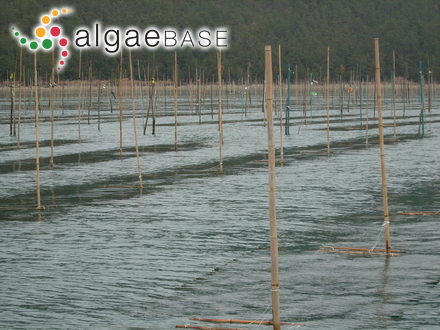
Artificial culture farm at high tide. 05 Jan 2007. Gyuhwa Chung.


Harvesting by hand. Annual production is about 1200 tons(FW) in Korea. 05 Jan 2007. Gyuhwa Chung.


Gangjin, Korea. Cultivation net closeup. 05 Jan 2007. Gyuhwa Chung.


Thalli regenerated from protoplasts. 04 Feb 2004. Gyuhwa Chung.


netcloseup

Capsosiphon fulvescens (C.Agardh) Setchell & N.L.Gardner Gangjin, Korea. Cultivation net closeup

Publication details
Capsosiphon fulvescens (C.Agardh) Setchell & N.L.Gardner 1920: 280

Original publication: Setchell, W.A. & Gardner, N.L. (1920). Phycological contributions. I. University of California Publications in Botany 7: 279-324, Plates 21 - 31.

Type species
The type species (holotype) of the genus Capsosiphon is Capsosiphon aureolus (C.Agardh) Gobi.

Status of name
This name is of an entity that is currently accepted taxonomically.

Basionym
Ulva fulvescens C.Agardh

Type information
Type locality: "In saxis portus Landscronae, atque lapillis lacunarum munimenti Gråen" [Landskrona, Sweden] (Agardh 1823: 420). Lectotype: LD herb. alg. Agardh 13358 (Brodie et al. 2007: 33).

Origin of species name
Adjective (Latin), becoming tawny, somewhat tawny [yellowish-brown] (Stearn 1973).

Homotypic Synonym(s)
Ulva fulvescens C.Agardh 1823
Solenia fulvescens (C.Agardh) C.Agardh 1824
Enteromorpha fulvescens (C.Agardh) Greville 1830
Prasiola fulvescens (C.Agardh) Trevisan 1842

Heterotypic Synonym(s)
Ulva aureola C.Agardh 1829
Prasiola aureola (C.Agardh) Trevisan 1842
Bangia aureola (C.Agardh) Endlicher 1843
Enteromorpha aureola (C.Agardh) Kützing 1849
Capsosiphon aureolus (C.Agardh) Gobi 1879

General environment
This is a marine species.

Detailed distribution with sources
(as Enteromorpha aureola (C.Agardh) Kützing)
Europe: Adriatic (Ercegović 1980), Sweden (Kylin 1907).

(as Capsosiphon aureolus (C.Agardh) Gobi)
Ireland: Mayo (Cotton 1912).

Europe: Britain (Batters 1902, Newton 1931), Ireland (Cotton 1912).

(as Capsosiphon fulvescens (C.Agardh) Setchell & N.L.Gardner)
Arctic: Canada (Arctic) (Lee 1980).

Ireland: Antrim (Morton 1994), Down (Morton 1994), Limerick (Guiry 1978).

Europe: Adriatic (Gallardo et al. 1993), Baltic Sea (Nielsen et al. 1995), Belgium (Coppejans 1995), Black Sea (Gallardo et al. 1993), Britain (Burrows 1991, Hardy & Guiry 2003, Brodie et al. 2007), Faroes (Irvine 1982, Nielsen & Gunnarsson 2001), France (Feldmann & Magne 1964, Dizerbo & Herpe 2007), Helgoland (Bartsch & Kuhlenkamp 2000), Iceland (Caram & Jónsson 1972), Ireland (Guiry 1978, Burrows 1991, Morton 1994), Italy (Gallardo et al. 1993), Netherlands (Stegenga & Mol 1983), Norway (Rueness 1997), Spain (López Rodriguez & Pérez-Cirera 1990, Bárbara et al. 2005), Sweden (Kylin 1949, Tolstoy & Österlund 2003).

North America: Alaska (Lindstrom 1977), British Columbia (Scagel et al. 1989), Maine (Mathieson et al. 2001), New Brunswick (Taylor 1957), New Hampshire (Mathieson & Hehre 1986), New Jersey (Taylor 1957).

South America: Argentina (Boraso de Zaixso 2004).

Indian Ocean Islands: St. Paul Island (Silva, Basson & Moe 1996).

Asia: Japan (Yoshida, Nakajima & Nakata 1990, Yoshida 1998), Korea (Lee & Kang 2001, Lee 2008).

Key references
Boraso de Zaixso, A. (2004). Chlorophyta marinas de la Argentina. Historia Natural, Buenos Aires, Ser. 2 3: 95-119.

Brodie, J., Maggs, C.A. & John, D.M. (2007). Green seaweeds of Britain and Ireland. pp. [i-v], vi-xii, 1-242, 101 figs. London: British Phycological Society.

Brodie, J., Maggs, C.A. & John, D.M. (2007). Green seaweeds of Britain and Ireland. pp. [i-v], vi-xii, 1-242, 101 figs. London: British Phycological Society.

Burrows, E.M. (1991). Seaweeds of the British Isles. Volume 2. Chlorophyta. pp. xi + 238, 60 figs, 9 plates. London: Natural History Museum Publications.

Zemke-White, W.L. & Ohno, M. (1999). World seaweed utilisation: an end-of-century summary. Journal of Applied Phycology 11: 369-376.

UTEX Cultures
UTEX Culture LB 759 Capsosiphon fulvescens
Go to UTEX Site

SAG Cultures
No records have been found on the SAG site.

NCBI Nucleotide Sequences

Created: 06 April 1996 by M.D. Guiry

Verified by: 01 January 2008 by M.D. Guiry

Accesses: This record has been accessed by users 9056 times since it was created.

References
(Please note: only references with the binomials in the title are included. The information is from the Literature database.)

Chihara, M. (1967). Developmental morphology and systematics of Capsosiphon fulvescens as found in Izu, Japan. Bulletin of the National Science Museum, Tokyo, Ser. B (Botany) 10: 163-170.
Garbary, D., Golden, L. & Scagel, R.F. (1982). Capsosiphon fulvescens (Capsosiphonaceae, Chlorophyta) rediscovered in the northeast Pacific. Syesis 15: 39-42.
Hwang, E.K., Yi, Y.H., Shin, W.J. & Sohn, C.H. (2003). Growth and maturation of a green alga, Capsosiphon fulvescens, as a new candidate for seaweed cultivation in Korea. Proceedings of the International Seaweed Symposium 17: 59-64.
López Rodriguez, M.C. & Pérez-Cirera, J.L. (1990). Capsosiphon fulvescens (C. Agardh) Setchell & Gardner (Chlorophyta), en la Ría de Pontevedra, Noroeste penínsular. Anal. J. Bot. Madrid 47: 496-497.
Migita, S. (1967). Life cycle of Capsosiphon fulvescens (C. Agardh) Setchell and Gardner. Bull. Fac. Fish. Nagasaki Univ. 22: 21-31.

SITE © 1996 - 2010 M.D. Guiry. All rights reserved.

Website Design : 249 Design Studio