133,478 species and infraspecific names are in the database, 16,455 images, 49,226 bibliographic items, 220,042 distributional records.

Peyssonnelia dubyi P.L.Crouan & H.M.Crouan

Publication details
Peyssonnelia dubyi P.L.Crouan & H.M.Crouan 1844: 368, pl. 11: figs 6-8 ('Peyssonelia')

Original publication: Crouan, P.L. & Crouan, H.M. (1844). Observations sur le genre Peyssonelia Dne. Annales des Sciences Naturelles, Botanique, Troisième série 2: 367-368, pl. 11: figs 6-10.
 Download PDF

Type species
The type species (lectotype) of the genus Peyssonnelia is Peyssonnelia squamaria (S.G.Gmelin) Decaisne.

Status of name
This name is of an entity that is currently accepted taxonomically.

Eponomy
Named for Jean Étienne Duby (1798-1885), Swiss botanist.

Homotypic Synonym(s)
Cruoriella dubyi (P.L.Crouan & H.M.Crouan) F.Schmitz 1889

Heterotypic Synonym(s)
Hildenbrandia dubyi P.L.Crouan & H.M.Crouan ex Kützing 1869
Cruoriella codana Rosenvinge 1917
Cruoriella armorica var. de-zwaanii Weber-van Bosse 1921
Peyssonnelia codana (Rosenvinge) Denizot 1968

General environment
This is a Marine species.

Description
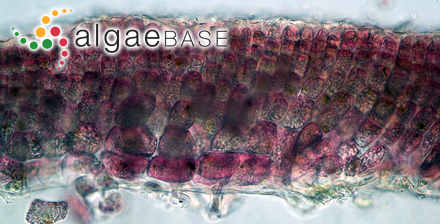
Thin, dark-red crust, to 30 mm diam.; frequently with concentric surface markings. Relatively loosely attached to the substrate with a well-developed layer of lime on lower surface.

Habitat
On calcareous encrusting algae and Laminaria hyperborea holdfasts, lower intertidal, widely distributed on western and southern coasts, not uncommon. Epilithic, epiphytic on encrusting corallines, Laminaria holdfasts and occasionally Gracilaria verrucosa etc, and on shells; in shallow pools in lower littoral, on pebbles in sheltered areas, sublittoral to 16 m tolerating a wide range of exposure to currents and wave action (Irvine & Maggs 1983: 59)

Key characteristics
Loose attachment to the substratum, presence of concentric markings on the surface of the thallus.

Similar species
Five species of Peyssonnelia are found in the British Isles and all require expert identification;P. dubyi seems to be the commonest and most widely distributed.

Distribution by country

Point data for Ireland and Britain

This map may take a minute to load. Please use an up-to-date web browser (Google Chrome 11, Firefox 4, Safari 5, Opera 11, Internet Explorer 9) for best performance.

Type information
Type locality: Rade de Brest, Brittany, France. (Athanasiadis 1996: 69). Type: CO (Womersley 1994: 164). Notes: Dawson (1953: 112) Holotype not designated but represented by the original Crouan material in the Herbarium of the Museum of Paris. According to Womersley (1994: 164) the type material comes from Brivatem (Brest, France ). France (Banc de St. Marc, Brest) is cited in Irvine & Maggs 1983: 57). Isotypes: PC, AHFH (54107, slides 1573-4) also cited in Irvine & Maggs.

Detailed distribution with sources
(as Peyssonnelia dubyi P.L.Crouan & H.M.Crouan)
Ireland: Antrim (Morton 1994), Clare (Maggs 1983), Cork (Guiry 1978), Donegal (Morton 2003), Down (Morton 1974, Guiry 1978, Morton 1994), Dublin (Fletcher & Maggs 1985), Galway (Guiry 1978, Maggs 1983), Waterford (Guiry 1977, Guiry 1978), Wexford (Norton 1970, Guiry 1978).

Europe: Adriatic (Giaccone 1978, Ercegovic 1980), Baltic Sea (Nielsen et al. 1995), Britain (Irvine 1983, Hardy & Guiry 2003), Bulgaria (Dimitrova-Konaklieva 1981), Corsica (Boudouresque & Perret 1977, Sales & Ballesteros 2011), Faroe Islands (Irvine 1982, Nielsen & Gunnarsson 2001), France (Verlaque 2001, Kato et al 2006, Dizerbo & Herpe 2007, Anon. 2012), Greece (Athanasiadis 1987), Helgoland (Bartsch & Kuhlenkamp 2000), Ireland (Guiry 1977, Guiry 1978, Maggs 1983, Irvine 1983, Morton 1994, Guiry 2012), Italy (Giaccone 1969, Cinelli et al. 1976, Cecere et al. 1996, Furnari, Cormaci & Serio 1999, Furnari et al. 2003, Furnari et al. 2003, Furnari et al. 2003, Furnari et al. 2003, Serio et al 2006), Malta (Cormaci et al. 1997), Norway (Rueness 1997), Portugal (Ardré 1970, Araujo et al. 2009), Romania (Caraus 2002, Caraus 2012), Sardinia (Furnari et al. 2003), Scandinavia (Athanasiadis 1996), Spain (Miranda 1934, Ballesteros 1983, Boisset & Barceló 1984, Pérez-Ruzafa & Honrubia 1984, Soto & Conde 1989, Ballesteros 1989, Pérez-Ruzafa et al. 1991, Granja, Cremades & Bárbara 1993, Conde et al. 1996, Bárbara & Cremades 1996, Veiga, Cremades & Bárbara 1998, Gorostiaga et al., 2004, Bárbara et al. 2004, Bárbara et al. 2005, Morais e Silva, Lavelli & Rull Lluch 2008, Peña & Bárbara 2008, Viviana Peña, Ignacio Bárbara 2010, Cires Rodriguez & Cuesta Moliner 2010), Sweden (Kylin 1944).

Atlantic Islands: Canary Islands (Viera-Rodriguez, Audiffred, Gil-Rodríguez, Prud'Homme Van Reine & Afonso-Carrillo 1987, Lawson et al. 1995, Guadalupe et al. 1995, Haroun et al. 2002, Gil-Rodríguez et al. 2003, John et al. 2004, Anon 2011), Cape Verde Islands (John et al. 2004, Prud'homme van Reine, Haroun & Kostermans 2005), Madeira (Levring 1974, Neto, Cravo & Haroun 2001, John et al. 2004), Salvage Islands (John et al. 2004).

North America: California (Miller 2012).

South America: Brazil (Taylor 1930), Galápagos Islands (Ruiz & Ziemmeck 2011).

Africa: Egypt (Aleem 1993), Ethiopia (Papenfuss 1968), Tunisia (Ben Maiz, Boudouresque & Quahchi 1987).

Indian Ocean Islands: Seychelles (Silva, Basson & Moe 1996).

South-west Asia: Turkey (Asia) (Taskin et al. 2008 ).

Asia: China (Xia 2004), Japan (Yoshida, Nakajima & Nakata 1990, Yoshida 1998), Korea (Lee & Kang 2001, Lee 2008).

South-east Asia: Indonesia (Silva, Basson & Moe 1996, Atmadja & Prud'homme van Reine 2012).

Australia and New Zealand: South Australia (Womersley 1994), Victoria (Womersley 1994).

(as Cruoriella dubyi (P.L.Crouan & H.M.Crouan) F.Schmitz)
Ireland: Antrim (Adams 1907), Mayo (Cotton 1912).

Europe: Britain (Newton 1931), France (Feldmann 1939, Feldmann 1954), Ireland (Adams 1907, Cotton 1912), Romania (Caraus 2002), Spain (Miranda 1931), Sweden (Kylin 1907).

North America: Mexico (Taylor 1945, Dawson 1953).

Central America: Islas Revillagigedo (Taylor 1945), Panama (Fernández-García et al. 2011).

Pacific Islands: Federated States of Micronesia (Lobban & Tsuda 2003).

(as Peyssonnelia codana (Rosenvinge) Denizot)
Europe: Baltic Sea (Nielsen et al. 1995).

Key references
Denizot, M. (1968). Les algues floridées encroutantes (à l'éxclusion des Corallinacées). pp. [1]-310, 227 figs. Paris: Laboratoire de Cryptogamie, Muséum National d'Histoire Naturelle.

Irvine, L.M. & Maggs, C.A. (1983). Peyssonneliaceae. In: Seaweeds of the British Isles. Volume 1, Rhodophyta. Part 2A Cryptonemiales (sensu stricto), Palmariales, Rhodymeniales. (Irvine, L.M. Eds), pp. 52-61. London: British Museum (Natural History).

Peña,V. & Bárbara, I. (2010). New records of crustose seaweeds associated with subtidal maërl beds and gravel bottoms in Galicia (NW Spain). Botanica marina 53: 41-62.

Rodríguez-Prieto, C., Ballesteros, E., Boisset, F. & Afonso-Carrillo, J. (2013). Guía de las macroalgas y fanerógamas marinas del Mediterráneo occidental. pp. [1]-656. Barcelona: Ediciones Omega, S.A..

Silva, P.C., Basson, P.W. & Moe, R.L. (1996). Catalogue of the benthic marine algae of the Indian Ocean. University of California Publications in Botany 79: 1-1259.

Womersley, H.B.S. (1994). The marine benthic flora of southern Australia - Part IIIA - Bangiophyceae and Florideophyceae (Acrochaetiales, Nemaliales, Gelidiales, Hildenbrandiales and Gigartinales sensu lato). pp. 1-508, 167 figs, 4 pls, 4 maps. Canberra: Australian Biological Resources Study.

Xia, B.M. (2004). Flora algarum marinarum sinicarum Tomus II Rhodophyta No. III Gelidiales Cryptonemiales Hildenbrandiales. pp. [i]-xxi, 1-203, pls I-XIII. Beijing: Science Press.

SAG Cultures
SAG Cultures may be viewed at http://sagdb.uni-goettingen.de/showstrains.php?genus=Peyssonnelia&species=dubyi

SCCAP Cultures
Cultures from the Scandinavian Culture Collection of Algae at the University of Copenhagen (SCCAP) and Protozoa may be viewed at http://www.sccap.dk/search/algaebase.asp?Genus=Peyssonnelia&Species=dubyi

NCBI Nucleotide Sequences

Created: 30 March 1996 by M.D. Guiry

Verified by: 07 May 2013 by M.D. Guiry

Accesses: This record has been accessed by users 1132 times since it was created.

Linking to this page: http://www.algaebase.org/search/species/detail/?species_id=29

Citing AlgaeBase
Cite this record as:
M.D. Guiry in Guiry, M.D. & Guiry, G.M. 2013. AlgaeBase. World-wide electronic publication, National University of Ireland, Galway. http://www.algaebase.org; searched on 24 May 2013.

Algaebase taxon LSID: urn:lsid:algaebase.org:taxname:77484

SITE © 1996 - 2013 M.D. Guiry. All rights reserved.

Website Design : 249 Design Studio