133,440 species and infraspecific names are in the database, 16,455 images, 49,223 bibliographic items, 220,030 distributional records.

Asterionella formosa Hassall

Classification:
Empire Eukaryota
Kingdom Chromista
Phylum Ochrophyta
Class Bacillariophyceae
Subclass Fragilariophycidae
Superorder Fragilarianae
Order Fragilariales
Family Fragilariaceae
Genus Asterionella

Pictures

click on thumbnail for larger version.

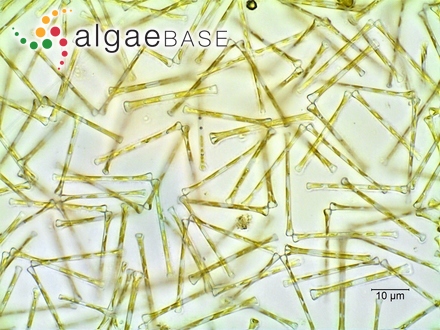
Asterionella formosa Hassall
Bainbridge Island, Washington, USA; golf couse, 1000x, DIC. 06 Oct 2008. Karl Bruun. © Karl Bruun (skogenman@earthlink.net).


Asterionella formosa Hassall Bainbridge Island, Washington, USA; golf couse, 1000x, DIC

Publication details
Asterionella formosa Hassall 1850: 10, pl.2: lower figure; fig.5

Original publication: Hassall, A.H. (1850). The Diatomaceae in the water supplied to the inhabitants of London and the suburban districts. A microscopic examination of the water. pp. 1-60, 6 pl. London: S. Highley.

Type species
This is the type species (holotype) of the genus Asterionella.

Status of name
This name is of an entity that is currently accepted taxonomically.

Origin of species name
Adjective (Latin), beautiful, handsome.

Homotypic Synonym(s)
Asterionella gracillima var. formosa (Hassall) Wislouch 1921

General environment
This is a freshwater species.

Distribution by country

Detailed distribution with sources
(as Asterionella formosa Hassall)
Europe: Britain (Whitton et al. 2003), Finland (Weckstrom & Juggins 2006), Netherlands (De Bruin et al. 2004, Dijkman & Kromkamp 2007, Gsell et al. 2012), Romania (Caraus 2002, Caraus 2012), Spain (Álvarez Cobelas 1982, Álvarez Cobelas & Estévez García 1982, Aboal, Puig & Soler 1996, Aboal, Prefasi & Asencio 1996, Pérez, Maidana & Comas 2009).

North America: Arkansas (Smith 2010), Michigan (Millie et al. 2011), Ontario (Xenopoulos & Frost, 2003), United States of America (Patrick & Reimer 1966).

South America: Brazil (Eskinazi-Leça et al. 2010).

South-west Asia: Iran (Ramzannejad Ghadi 2008).

Asia: Korea (Joh 2010), Mongolia (Edlund et al 2003).

Australia and New Zealand: New South Wales (Day et al. 1995), New Zealand (Flöder & Burns 2005), Queensland (Bostock & Holland 2010), Tasmania (Day et al. 1995), Victoria (Day et al. 1995).

Pacific Islands: Hawaiian Islands (Sherwood 2004).

Key references
Aboal, M., Alvarez Cobelas, M., Cambra, J. & Ector, L. (2003). Floristic list of non-marine diatoms (Bacillariophyceae) of Iberian Peninsula, Balearic Islands and Canary Islands. Updated taxonomy and bibliography. Diat. Monogr. 4: 1-639.

De Bruin, A., Ibelings, B.W., Rijkeboer, M., Brehm, M. & van Donk, E. (2004). Genetic variation in Asterionella formosa (Bacillariophyceae): is it linked to frequent epidemics of host-specific parasitic fungi?. Journal of Phycology 40: 823-830, 3 figs, 3 tables.

Dijkman, N.A. & Kromkamp, J.C. (2007). Photosynthetic characteristics of the phytoplankton in the Scheldt estuary: community and single-cell fluorescence measurements. European Journal of Phycology 41: 425-434.

Edlund, M.B., Williams, R.M. & Soninkhishig, N. (2003). The planktonic diatom diversity of ancient Lake Hovsgol, Mongolia. Phycologia 42: 232-260.

Flöder, S. & Burns, C.W. (2005). The influence of fluctuating light on diversity and species number of nutrient-limited phytoplankton . Journal of Phycology 41: 950-956.

Hustedt, F. (1930). Bacillariophyta (Diatomeae). In: Die Süsswasser - Flora Mitteleuropas. Heft. 10, 2. Aufl. (Pascher, A. Eds), pp. vii + 466, 875 fig. Jena:

Joh, G. (2010). Asterionella, Diatoma, Meridion, Opephora, Tabellaria. In: Algal flora of Korea. Volume 3, Number 2. Chrysophyta: Bacillariophyceae: Pennales: Araphidineae: Diatomaceae. Freshwater diatoms II. (Joh, G., Lee, J.H., Lee, K. & Yoon, S.-K. Eds), pp. 7-50. Incheon: National Institute of Biological Resources.

Weckstrom, K. & Juggins, S. (2006). Coastal diatom-environment relationships from the Gulf of Finland, Baltic Sea. Journal of Phycology 42: 21-35.

CCAP Cultures
CCAP Strain Number 1005/5 Asterionella formosa Hassall
Go to CCAP Site

SAG Cultures
SAG Cultures may be viewed at http://sagdb.uni-goettingen.de/showstrains.php?genus=Asterionella&species=formosa

SCCAP Cultures
Cultures from the Scandinavian Culture Collection of Algae at the University of Copenhagen (SCCAP) and Protozoa may be viewed at http://www.sccap.dk/search/algaebase.asp?Genus=Asterionella&Species=formosa

NCBI Nucleotide Sequences

Created: 11 April 2002 by M.D. Guiry

Verified by: 19 October 2012 by M.D. Guiry

Accesses: This record has been accessed by users 3322 times since it was created.

References
(Please note: only references with the binomials in the title are included. The information is from the Literature database.)

Belay, A. & Fogg, G.E. (1978). Photoinhibition of photosynthesis in Asterionella formosa (Bacillariophyceae). Journal of Phycology 14: 341-347, 9 figs, 1 table.
Boggetto, N., Gontero, B. & Maberly, S.C. (2007). Regulation of phosphoribulokinase and glyceraldehyde 3-phosphate dehydrogenase in a freshwater diatom, Asterionella formosa . Journal of Phycology 43: 1227-1235.
De Bruin, A., Ibelings, B.W., Rijkeboer, M., Brehm, M. & van Donk, E. (2004). Genetic variation in Asterionella formosa (Bacillariophyceae): is it linked to frequent epidemics of host-specific parasitic fungi?. Journal of Phycology 40: 823-830, 3 figs, 3 tables.
Erales, J., Gontero, B. & Maberly, S.C. (2008). Specificity and function of glyceraldehyde-3-phosphate dehydrogenase in a freshwater diatom, Asterionella formosa (Bacillariophyceae). Journal of Phycology 44: 1455-1464.
Gsell, A.S., de Senerpont Domis, L.N., Przytulska-Bartosiewicz, A., Mooij, W.M., van Donk, E. & Ibelings, B.W. (2012). Genotype-by-temperature interactions may help to maintain clonal diversity in Asterionella formosa (Bacillariophyceae). Journal of Phycology 48(5): 1197-1208.
Happey-Wood, C.M. & Hughes, D.I. (1979). Physiological and morphological distinctions in cultures of Asterionella formosa Hass. isolated from contrasting lakes. British Phycological Journal 14: 124.
Hayakawa, T., Kudoh, S., Suzuki, Y. & Takahashi, M. (1994). Temperature-dependent changes in colony size of the freshwater pennate diatom Asterionella formosa (Bacillariophyceae) and their possible ecological implications. Journal of Phycology 30: 955-964, 9 figs, 2 tables.
Holm, N.P. & Armstrong, D.E. (1981). Note: Effects of Si:P concentration ratios and nutrient limitation on the cellular composition and morphology of Asterionella formosa (Bacillariophyceae). Journal of Phycology 17: 420-424, 2 figs, 1 table.
Jaworski, G. & Lund, J.W.G. (1970). Drought resistance and dispersal of Asterionella formosa Hass.. Beih. Nova Hedw. 31: 37-48.
Jaworski, G.H.M., Wiseman, S.W. & Reynolds, C.S. (1988). Variability in sinking rate of the freshwater diatom Asterionella formosa : the influence of colony morphology. British Phycological Journal 23: 167-176.
Kilham, S.S. (1975). Kinetics of silicon-limited growth in the freshwater diatom Asterionella formosa. Journal of Phycology 11: 396-399, 2 figs, 2 tables.
Koob, D.D. (1966). Parasitism of Asterionella formosa Hass. by a chytrid in two lakes of the Rawah wild area of Colorado. Journal of Phycology 2: 41-45, 3 figs, 2 tables.
Kudoh, S. & Takahashi, M. (1990). Fungal control of population changes of the planktonic diatom Asterionella formosa in a shallow eutrophic lake. Journal of Phycology 26: 239-244, 4 figs, 2 tables.
Lund, J.W.G. (1950). Studies on Asterionella formosa Hass II. Nutrient depletion and the spring maximum. Part I. Observations on Windermere, Esthwaite Water and Blelham Tarn. Journal of Ecology 38: 1-14.
Lund, J.W.G. (1961). Asterionella formosa Hass. var. acaroides Lemm. A phycological enigma. British Phycological Bulletin 2: 63-66, 2 figs.
Lund, J.W.G. (1963). Changes in depth and time of certain physical conditions and of the standing crop of Asterionella formosa Hass. in the north basin of Windermere in 1947. Philosophical Transactions of the Royal Society 246B(731): 255-290.
Ostrofsky, M.L. & Peairs, H.J. (1981). The relative photosynthetic efficiency of Asterionella formosa Hass. (Bacillariophyta) in natural plankton assemblages. Journal of Phycology 17: 230-233, 5 figs.
Tilman, D. & Kilham, S.S. (1976). Phosphate and silicate growth and uptake kinetics of the diatoms Asterionella formosa and Cyclotella meneghiniana in batch and semicontinuous culture. Journal of Phycology 12: 375-383, 6 figs, 2 tables.
Tomkins, T. & Blinn, D.W. (1976). The effect of mercury on the growth rate of Fragilaria crotonensis Kitton and Asterionella formosa Hass.. Hydrobiologia 49: 111-116.
Wiseman, S.W. & Reynolds, C.S. (1981). Sinking rate and electrophoretic mobility of the freshwater diatom Asterionella formosa: an experimental investigation. British Phycological Journal 16: 357-361, 1 fig.
Wiseman, S.W., Jaworski, G.H.M. & Reynolds, C.S. (1984). Variability in sinking rate of the freshwater diatom Asterionella formosa Hass.: the influence of the excess density of colonies. British Phycological Journal 18: 425-432, 3 figs, 1 table.

Linking to this page: http://www.algaebase.org/search/species/detail/?species_id=31441

Citing AlgaeBase
Cite this record as:
M.D. Guiry in Guiry, M.D. & Guiry, G.M. 2013. AlgaeBase. World-wide electronic publication, National University of Ireland, Galway. http://www.algaebase.org; searched on 23 May 2013.

Algaebase taxon LSID: urn:lsid:algaebase.org:taxname:85879

SITE © 1996 - 2013 M.D. Guiry. All rights reserved.

Website Design : 249 Design Studio