Didymosphenia geminata (Lyngbye) M.Schmidt
Classification:
Empire Eukaryota
Kingdom Chromista
Phylum Ochrophyta
Class Bacillariophyceae
Subclass Bacillariophycidae
Superorder Bacillarianae
Order Cymbellales
Family Gomphonemataceae
Genus Didymosphenia
- Taxonomy
- References
- Submit Feedback
- Submit Reference
- Links
- Genbank
- Index Nominum Algarum
- Biodiversity Heritage Library
Pictures
click on thumbnail for larger version.

Winthrop, Washington, US.... 15 Jan 2011. Karl Bruun. © Karl Bruun.

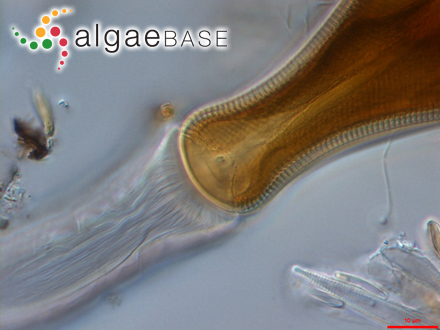
Winthrop, Washington, USA; Methow River, Lugols, 1000x DIC. 15 Jan 2011. Karl Bruun. © Karl Bruun.

600x __Dim. 43 x 117 µm. 02 Apr 2011. Robert Lavigne. © Robert Lavigne. (MicroscopyView.com).

Winthrop, Washington, USA; Methow River, 400x, DIC. 19 Jan 2010. Karl Bruun. © Karl Bruun (skogenman@earthlink.net).

Winthrop, Washington, USA; Methow River, Audubon Trail bridge, 400x DIC. 20 Jan 2009. Karl Bruun. © Karl Bruun (skogenman@earthlink.net).

Mararoa River, Southland, New Zealand; dead dry plants. © Free of copyright. From: http://en.wikipedia.org/wiki/Image:Didymo_079.jpg".

Scanning electron micrograph of the silica cell wall. The raphe is composed of the two slits that run along the apical axis of the cell. The cell secretes mucopolysaccarides through the raphe .. Sarah Sapulding. © Public domain.
Publication details
Didymosphenia geminata (Lyngbye) M.Schmidt in A. Schmidt 1899: pl. 214: figs 7-10
Original publication: Schmidt, M. (1899). Plates 213-216. In: Atlas der Diatomaceenkunde. (Schmidt, A. Eds) Leipzig: R. Reisland.
Type species
This is the type species (holotype) of the genus Didymosphenia.
Status of name
This name is of an entity that is currently accepted taxonomically.
Basionym
Echinella geminata Lyngbye
Type information
in ins. Faer. ad saxa rivulorum subalpest. prope Argehospital et rupem Skielling [Faroe Islands] (Lyngbye 1819: 219).
Homotypic Synonym(s)
Echinella geminata Lyngbye 1819
Styllaria geminata (Lyngbye) Bory 1822
Dendrella geminata (Lyngbye) Bory 1822
Gomphonema geminatum (Lyngbye) C.Agardh 1824
Lyngbyea pulvinata var. geminata (Lyngbye) Sommerfelt 1826
Heterotypic Synonym(s)
Gomphonema vulgare Brébisson 1838
General environment
This is a Freshwater species.
Distribution by country
Detailed distribution with sources
(as Gomphonema geminatum (Lyngbye) C.Agardh)
Europe: Spain (Álvarez Cobelas & Estévez García 1982).
Australia and New Zealand: Victoria (Day et al. 1995).
(as Didymosphenia geminata (Lyngbye) M.Schmidt)
Europe: Britain (Whitton et al. 2003, Kilroy 2004), Faroe Islands (Kilroy 2004), Finland (Kilroy 2004), France (Kilroy 2004, Anon. 2012), Ireland (Heuff & Horkan 1984, Kilroy 2004), Poland (Kilroy 2004
), Romania (Caraus 2002, Caraus 2012), Spain (Kilroy 2004, Flor-Arnau et al. 2009), Spitsbergen (Kilroy 2004), Switzerland (Kilroy 2004), Turkey (Europe) (Kilroy 2004).
Atlantic Islands: Iceland (Kilroy 2004
).
North America: British Columbia (Kilroy 2004), Virginia (Patrick & Reimer 1975).
South-west Asia: Iran (Jamaloo et al.. 2006, Ghelichi & Ramzannejad Ghadi & Shabani 2008, Ramzannejad Ghadi 2008).
Asia: China (Kilroy 2004, Hu & Wei 2006).
Australia and New Zealand: New Zealand (Kilroy & Bothwell 2011
, Harper et al. 2012).
Conservational notes
This species has been introduced into New Zealand, where it forms large mats on the bottom of streams, rivers and occasional lake edges where there is a wave action. Thick growths can adversely affect freshwater fish, plant and invertebrate species by reducing the number of suitable habitats. It has no human health risk. It has been confused with a number of New Zealand native alga. The main difference between it and native species is the way it feels. Native alga feels slimy and will break apart in your fingers, whereas didymo is strong and feels like wet cotton wool. Currently, there is no 'cure' for didymo, and preventing further spread relies on freshwater users cleaning aquatic equipment between use in different waterways regardless of location and perceived didymo risk. A controlled area notice, requiring cleaning of aquatic equipment when moving from the South Island to the North Island is in force. Other measures may be put in place by long-term management partners to help protect specific high-value sites, such as Fiordland National Park (Department of Conservation and Fish and Game) and Te Waikoropupu Springs in Nelson (Department of Conservation). (Extracted from http://www.biosecurity.govt.nz/didymo). - (16 Dec 2007) - Wendy Guiry
Key references
Hofmann, G., Werum, M. & Lange-Bertalot, H. (2013). Diatomeen im Süßwasser - Benthos von Mitteleuropa. Bestimmungsflora Kieselalgen für die ökologische Praxis. Über 700 der häufigsten Arten und ihre Ökologie. pp. [1]-908, 133 pls. Königstein: Koeltz Scientific Books.
Hu, H. & Wei, Y. (2006). The freshwater algae of China. Systematics, taxonomy and ecology. pp. [4 pls of 16 figs], [i-iv], i-xv, 1-1023. China: www.sciencep.com.
Hustedt, F. (1930). Bacillariophyta (Diatomeae). In: Die Süsswasser - Flora Mitteleuropas. Heft. 10, 2. Aufl. (Pascher, A. Eds), pp. vii + 466, 875 fig. Jena:
SAG Cultures
SAG Cultures may be viewed at http://sagdb.uni-goettingen.de/showstrains.php?genus=Didymosphenia&species=geminata
SCCAP Cultures
Cultures from the Scandinavian Culture Collection of Algae at the University of Copenhagen (SCCAP) and Protozoa may be viewed at http://www.sccap.dk/search/algaebase.asp?Genus=Didymosphenia&Species=geminata
Created: 11 April 2002 by M.D. Guiry
Verified by: 28 February 2013 by M.D. Guiry
Accesses: This record has been accessed by users 13107 times since it was created.
References
(Please note: only references with the binomials in the title are included. The information is from the Literature database.)
Antoine, S.E. & Benson-Evans, K. (1984). Morphological variation in six populations of Didymosphenia geminata (Lyngbye) M. Schmidt of Great Britain. Nova Hedwigia 40: 141-156.
Antoine, S.E. & Benson-Evans, K. (1983). Polymorphism and size variation in Didymosphenia geminata from Great Britain. British Phycological Journal 18: 199-200.
Blanco, S. & Ector, L. (2009). Distribution, ecology and nuisance effects of the freshwater invasive diatom Didymosphenia geminata (Lyngbye) M.Schmidt: a literature review. Nova Hedwigia 88: 347-422.
Dawson, P.A. (1973). The morphology of the siliceous components of Didymosphenia geminata (Lyngb.) M. Schm.. British Phycological Journal 8: 65-78, 40 figs.
Kawecka, B. & Sanecki, J. (2003). Didymosphenia geminata in running waters of southern Poland - symptoms of change in water quality?. Hydrobiologia 495: 193-201.
Kilroy, C. & Bothwell, M. (2011). Environmental control of stalk length in the bloom-forming, freshwater benthic diatom Didymosphenia geminata (Bacillariophyceae). Journal of Phycology 47(5): 981-989.
Kilroy, C. (2004). A new alien diatom, Didymosphenia geminata (Lyngbye) Schmidt: its biology, distribution, effects and potential risks for New Zealand fresh waters. pp. 1-40. Christchurch: National Institute of Water & Atmospheric Research Ltd. Report No.: NIWA Client Report: CHC2004-128.
Sherbot, D.M.J. & Bothwell, M.L. . (1993). Didymosphenia geminata (Gomphonemaceae). A review of the ecology of D. geminata and the physicochemical characteristics of endemic catchments on Vancouver Island. Saskatoon, Saskatchewan: National Hydrology Research Institute, Environment Canada. Report No.: NHRI Contribution No. 93005.
Spaulding, S. & Elwell, L.. (2007). Increase in nuisance blooms and geographic expansion of the freshwater diatom Didymosphenia geminata Recommendations for response. Livingston, Montana: Federation of Fly Fishers and USA Environmental Protection Agency. Report No.: White Paper.
Stoermer, E.F., Yu-Zao, Q. & Ladewski, T.B. (1986). A quantitative investigation of shape variation in Didymosphenia geminata (Lyngbye) M. Schmidt (Bacillariophyta). Phycologia 25: 494-502.
Linking to this page: http://www.algaebase.org/search/species/detail/?species_id=31545
Citing AlgaeBase
Cite this record as:
M.D. Guiry in Guiry, M.D. & Guiry, G.M. 2013.
AlgaeBase. World-wide electronic publication, National University of Ireland, Galway. http://www.algaebase.org; searched on 19 May 2013.
Algaebase taxon LSID: urn:lsid:algaebase.org:taxname:85822