Prymnesium parvum N.Carter
Classification:
Empire Eukaryota
Kingdom Chromista
Phylum Haptophyta
Class Coccolithophyceae
Subclass Prymnesiophycidae
Order Prymnesiales
Family Prymnesiaceae
Genus Prymnesium
- Taxonomy
- References
- Submit Feedback
- Submit Reference
- Links
- Genbank
- Index Nominum Algarum
- Biodiversity Heritage Library
Pictures
click on thumbnail for larger version.

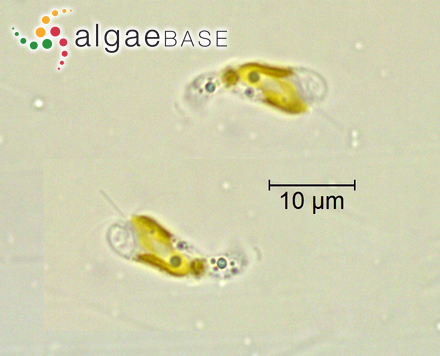
In the brackish Lake Biviere di Gela (Sicily); with Cyclotella. Rossella Barone (rossella.barone@unipa.it). © Rossella Barone (rossella.barone@unipa.it).

In the brackish Lake Biviere di Gela (Sicily). 01 Mar 2005. Rossella Barone (rossella.barone@unipa.it). © Rossella Barone (rossella.barone@unipa.it).

In the brackish Lake Biviere di Gela (Sicily). 01 Mar 2005. Rossella Barone (rossella.barone@unipa.it). © Rossella Barone (rossella.barone@unipa.it).
Publication details
Prymnesium parvum N.Carter 1937: 40, pl. 3: figs 5-16; pl. 8: fig. 16
Original publication: Carter, N. (1937). New or interesting algae from brackish water. Archiv für Protistenkunde 90: 1-68.
Type species
The type species (holotype) of the genus Prymnesium is Prymnesium saltans J.Massart.
Status of name
This name is of an entity that is currently accepted taxonomically.
Origin of species name
Adjective (Latin), little, small, puny (Stearn 1973).
Synonym(s)
No synonyms are currently included in AlgaeBase.
General environment
This is a Brackish species.
Usage notes
Harmful species
Toxic; self-toxic. - (6 Feb 2007) - Wendy Guiry
Distribution by country
Type information
type locality: Brackish water pond, Bembridge, Isle of Wight, England (Carter 1937: 40).
Detailed distribution with sources
(as Prymnesium parvum N.Carter)
England: England (Carter 1937).
Europe: Britain (Parke & Dixon 1976, Preisig 2002, Whitton et al. 2003), Denmark (Edvardsen et al. 2011), Norway (Freitag et al. 2011), Romania (Caraus 2002, Caraus 2012), Russia (Europe) (Edvardsen et al. 2011
), Spain (Alvárez Cobelas 1984).
North America: Arkansas (Smith 2010), Maine (Edvardsen et al. 2011), Massachusetts (Hulburt 1965).
South America: Brazil (Bergesh 2010).
South-west Asia: Israel (Tsarenko et al. 2000
).
Asia: China (Hu & Wei 2006).
Australia and New Zealand: New Zealand (Rhodes et al. 2012).
Source of synonymy
Throndsen, J. (1996). The planktonic marine flagellates. In: Identifying marine phytoplankton. (Tomas, C.R. Eds), pp. 591-730. San Diego: Academic Press.
Key references
Hallegraeff, G.M., Anderson, D.M. & Cembella, A.D., Eds (2003). Manual on harmful marine microalgae. Paris: UNESCO.
Hu, H. & Wei, Y. (2006). The freshwater algae of China. Systematics, taxonomy and ecology. pp. [4 pls of 16 figs], [i-iv], i-xv, 1-1023. China: www.sciencep.com.
Hulburt, E.M. (1965). Flagellates from brackish waters in the vicinity of Woods Hole, Massachusettes. Journal of Phycology 1(2): 87-94.
Nakayama, T., Yoshida, M., Noël, M.-H., Kawachi, M. & Inouye, I. (2005). Ultrastructure and phylogenetic position of Chrysoculter rhomhoideus gen. et sp. nov. (Prymnesiophyceae), a new flagellate haptophyte from Japanese coastal waters. Phycologia 44: 369-383.
Olli, K. & Trunov, K. (2007). Self-toxicity of Prynmesium parvum (Prymnesiophyceae). Phycologia 46: 109-112.
Parke, M. & Dixon, P.S. (1976). Check-list of British marine algae - third revision. Journal of the Marine Biological Association of the United Kingdom 56: 527-594.
Toepel, J., Langner, U. & Wilhelm, C. (2005). Combination of flow cytometry and single cell absorption spectroscopy to study the phytoplankton structure and to calculate the chl a specific absorption coefficients at the taxon level. Journal of Phycology 41(6): 1099-1109.
UTEX Cultures
UTEX Culture LB 995 Prymnesium parvum
Go to UTEX Site
CCAP Cultures
CCAP Strain Number 946/1B Prymnesium parvum N.Carter
Go to CCAP Site
SAG Cultures
SAG Cultures may be viewed at http://sagdb.uni-goettingen.de/showstrains.php?genus=Prymnesium&species=parvum
SCCAP Cultures
Cultures from the Scandinavian Culture Collection of Algae at the University of Copenhagen (SCCAP) and Protozoa may be viewed at http://www.sccap.dk/search/algaebase.asp?Genus=Prymnesium&Species=parvum
Created: 11 April 2002 by M.D. Guiry
Verified by: 20 March 2013 by Wendy Guiry
Accesses: This record has been accessed by users 3200 times since it was created.
References
(Please note: only references with the binomials in the title are included. The information is from the Literature database.)
Baker, J.W., Grover, J.P., Brooks, B.W., Ureña-Boeck, F., Roelke, D.L., Errera, R. & Kiesling, R.L. (2007). Growth and toxicity of Prymnesium parvum (Haptophyta) as a function of salinity, light and temperature. Journal of Phycology 43(2): 219-227, 2 figs, 2 tables.
Barone, R. (2005). Il fitoplankton delle zone umide siciliane d'importanza internazionale: presenza dell'aptofita ittiotossica Prymnesium parvum Carter. Informatore Botanico Italiano 37: 556-557.
Billard, C. (1983). Prymnesium zebrinum sp. nov. et P. annuliferum sp. nov. deux nouvelles espèces apparentées à P. parvum Carter (Prymnesiophyceae). Phycologia 22: 141-151.
Dafni, Z., Ulitzur, S. & Dhilo, M. (1972). Influence of light and phosphate on toxin production and growth of Prymnesium parvum. Journal of General Microbiology 70: 199-207.
Freitag, M., Beszteri, S., Vogel H. & John, U. (2011). Effects of physiological shock treatments on toxicity and polyketide synthase gene expression in Prymnesium parvum (Prymnesiophyceae). European Journal of Phycology 46(3): 193-201.
Holdway, P.A. & Watson, R.A. (1978). Growth and ichthyotoxicity in two strains of Prymnesium parvum Carter (Haptophyta) as affected by phosphorus concentration. British Phycological Journal 13: 201-202.
Holdway, P.A., Watson, R.A. & Moss, B. (1978). Aspects of the ecology of Prymnesium parvum (Haptophyta) and water chemistry in the Norfolk Broads, England. Freshwater Biology 8: 295-311.
Johnsen, T.M. & Lein, T.E. (1989). Prymnesium parvum Carter (Prymnesiophyceae) in association with macroalgae in Ryfylke, southwestern Norway. Sarsia 74: 277-281.
Larsen, A. & Edvardsen, B. (1999 '1998' ). Relative ploidy levels in Prymnesium parvum and P. patelliferum (Haptophyta) analyzed by flow cytometry. Phycologia 37: 412-424, 15 figs, 4 tables.
Larsen, A. (1999). Prymnesium parvum and P. patelliferum (Haptophyta) - one species. Phycologia 38: 541-543.
Moon, R.E. & Martin, D.F. (1981). The cytolytic substance aponin on Prymnesium parvum and Ptychodiscus brevis, a comparative study. Botanica Marina 24: 591-593.
Neisch, M.T., Roelke, D.L., Brooks, B.W., Grover, J.P. & Masser, M.P. (2012). Stimulating effect of Anabaena sp. (Cyanobacteria) exudate on Prymnesium parvum (Haptophyta) (Note). Journal of Phycology 48(4): 1045-1049.
Ricketts, T.R. (1964). The localization of enzymes in hydrolysing adenosine phosphates in Prymnesium parvum Carter. J. R. Micros. Soc. 83: 459-465.
Ricketts, T.R. (1965). Inorganic pyrophosphatase in Prymnesium parvum Carter. Arch. Biochem. Biophys. 110: 184-190.
Shilo, M. & Shilo, M. (1955). Control of the phytoflagellate Prymnesium parvum. Proceedings of the International Association of theoretical and applied Limnology 12: 233-240.
Linking to this page: http://www.algaebase.org/search/species/detail/?species_id=32781
Citing AlgaeBase
Cite this record as:
Wendy Guiry in Guiry, M.D. & Guiry, G.M. 2013.
AlgaeBase. World-wide electronic publication, National University of Ireland, Galway. http://www.algaebase.org; searched on 26 May 2013.
Algaebase taxon LSID: urn:lsid:algaebase.org:taxname:53982