125,865 species and infraspecific names are in the database, 8,150 images, 44,630 bibliographic items, 162,797 distributional records.

Ecklonia maxima (Osbeck) Papenfuss

Classification:
Empire Eukaryota
Kingdom Chromista
Subkingdom Chromobiota
Infrakingdom Heterokonta
Phylum Heterokontophycophyta
Class Phaeophyceae
Order Laminariales
Family Lessoniaceae
Genus Ecklonia

Pictures:

click on thumbnail for larger version.


South Africa; fronds collection for abalone food. Robert Anderson. © Robert Anderson.


South Africa; fronds collected for abalone food. Robert Anderson. © Robert Anderson.


South Africa; beds at low water. Robert Anderson. © Robert Anderson.


South Africa; stipe collection. Robert Anderson. © Robert Anderson.


South Africa; isopods on decaying plants. Robert Anderson. © Robert Anderson.


South Africa; kayak used for kelp mapping. Robert Anderson. © Robert Anderson.


South Africa; milled kelp. Robert Anderson. © Robert Anderson.


South Africa; milled kelp. Robert Anderson. © Robert Anderson.


Kommetjie, Cape Peninsula, South Africa; strip-harvested beds. Robert Anderson. © Robert Anderson.


South Africa; assessment by quadrat. Robert Anderson. © Robert Anderson.

1  2  3  4  5  6  7  8  9  Next

87 Found - Displaying 1 through 10


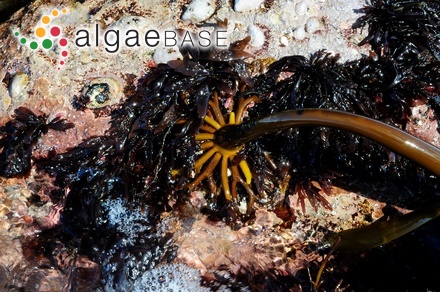
DSC_1288

Ecklonia maxima (Osbeck) Papenfuss Platboom, Cape Peninsula, South Africa; beds in surf with Egyptiasn Geese

Publication details
Ecklonia maxima (Osbeck) Papenfuss 1940: 7

Original publication: Papenfuss, G.F. (1940). A revision of the South African marine algae in herbarium Thunberg. Symbolae Botanicae Upsalensis 4(3): 1-17.

Type species
The type species (holotype) of the genus Ecklonia is Ecklonia buccinalis (Linnaeus) Hornemann.

Status of name
This name is of an entity that is currently accepted taxonomically.

Basionym
Fucus maximus Osbeck

Type information
Type locality: Cape of Good Hope, South Africa (Silva, Basson & Moe 1996: 639).

Origin of species name
Adjective (Latin), largest.

Homotypic Synonym(s)
Fucus maximus Osbeck 1757

Heterotypic Synonym(s)
Fucus buccinalis Linnaeus 1771
Laminaria buccinalis (Linnaeus) J.V.Lamouroux 1813
Laminaria flabellum Bory de Saint-Vincent 1826
Laminaria buccinalis var. macloviana Bory de Saint-Vincent 1828
Ecklonia buccinalis (Linnaeus) Hornemann 1828

General environment
This is a Marine species.

Detailed distribution with sources
(as Ecklonia buccinalis (Linnaeus) Hornemann)
Atlantic Islands: St Helena (Price, John & Lawson 1978).

Africa: South Africa (Price, John & Lawson 1978).

(as Ecklonia maxima (Osbeck) Papenfuss)
Atlantic Islands: St Helena (John et al. 2004).

South America: Falkland Islands (Papenfuss 1964).

Africa: Namibia (Rull Lluch 2002, John et al. 2004), South Africa (Price, John & Lawson 1978, Chapman & Chapman 1980, Silva, Basson & Moe 1996, Stegenga, Bolton & Anderson 1997).

Indian Ocean Islands: St. Paul Island (Silva, Basson & Moe 1996).

Australia and New Zealand: Auckland Islands (Papenfuss 1964).

Taxonomic notes
According to Silva et al. (1996: 639) the name Lessonia nigrescens has been misapplied to this species by Hohenacker (1854 [1852-1862]: no. 162) and Barton (1893: 112).

Key references
Braune, W. (2008). Meeresalgen. Ein Farbbildführer zu den verbreiteten benthischen Grün- Braun- und Rotalgen der Weltmeere. pp. [1]-596, 266 pls. Ruggell: A.R.G. Gantner Verlag.

SAG Cultures
No records have been found on the SAG site.

NCBI Nucleotide Sequences

KU-MACC Cultures
Strain Numbers: KU-1116, KU-1125, Ecklonia maxima
Go to KU-MACC Site

Created: 07 February 1998 by M.D. Guiry

Verified by: 02 January 2010 by M.D. Guiry

Accesses: This record has been accessed by users 27901 times since it was created.

References
(Please note: only references with the binomials in the title are included. The information is from the Literature database.)


Anderson, R.J., Rothman, M.D., Share, A. & Drummond, H. (2007). Harvesting of the kelp Ecklonia maxima in South Africa affects its three obligate, red algal epiphytes. Proceedings of the International Seaweed Symposium 18: 117-123.
Bolton, J.J. & Levitt, G.L. (1985). Light and temperature requirements for growth and reproduction in gametophytes of Ecklonia maxima (Alariaceae: Laminariales). Marine Biology, Berlin 87: 131-135.
Crouch, I.J. & Vanstaden, J. (1991). Evidence for rooting factors in a seaweed concentrate prepared from Ecklonia maxima. Journal of Plant Physiology 137(3): 319-322.
Featonby-Smith, B.C. & van Staden, J. (1984). Identification and seasonal variation of endogenous cytokinins in Ecklonia maxima (Osbeck) Papenf.. Botanica Marina 27: 524-531.
Hofman, P.J., Featonby-Smith, B.C. & van Staden, J. (1986). The development of ELISA and IRA for cytokinin estimation and their application to a study of lunar periodicity in Ecklonia maxima (Osbeck) Papenf.. J. Pl. Physiol. 122: 455-466.
Joska, M.A.P. & Bolton, J.J. (1987). In situ measurement of zoospore release and seasonality of reproduction in Ecklonia maxima (Alariaceae, Laminariales). British Phycological Journal 22: 209-214.
Mann, K.H., Jarman, N. & Dieckmann, G. (1979). Development of a method for measuring the productivity of the kelp Ecklonia maxima (Osbeck) Papenf.. Trans. Roy. Soc. S. Afr. 44: 27-41.
Papenfuss, G.F. (1942). Studies of South African Phaeophyceae. I. Ecklonia maxima, Laminaria pallida, Macrocystis pyrifera. American Journal of Botany 29: 15-24.
Rothman, M.D., Anderson, R.J. & Smit, A.J. (2007). The effects of harvesting of the South African kelp (Ecklonia maxima) on kelp population structure, growth rate and recruitment. Proceedings of the International Seaweed Symposium 18: 109-115.
Rotmann, K.W.G, Ruscoe, W.M. & Rotman, H.G. (2003). The economic importance of Ecklonia maxima and other kelps in the southern Cape region of South Africa. Proceedings of the International Seaweed Symposium 17: 131-136.
Tugwell, S. & Branch, G.M. (1989). Differential polyphenolic distribution among tissues in the kelps Ecklonia maxima, Laminaria pallida and Macrocystis angustifolia in relation to plant-defense theory. Journal of Experimental Marine Biology and Ecology 129: 219-230.
Weiersbye, I.M., Otter, L.B., Eccles, N.S., Critchley, A.T. & Pfab, M.F. (2001). Benefits and constraints of using beach-strewn kelp (Ecklonia maxima) to improve crop growth in degraded soils. In: Breakthrough opportunities from the world's bioresources. (Mshigeni, K.E. & Bisanda, E. Eds), pp. 149-165. University of Namibia.

SITE © 1996 - 2010 M.D. Guiry. All rights reserved.

Website Design : 249 Design Studio