133,440 species and infraspecific names are in the database, 16,455 images, 49,223 bibliographic items, 220,030 distributional records.

Prorocentrum micans Ehrenberg

Classification:
Empire Eukaryota
Kingdom Chromista
Phylum Dinophyta
Class Dinophyceae
Order Prorocentrales
Family Prorocentraceae
Genus Prorocentrum

Pictures

click on thumbnail for larger version.

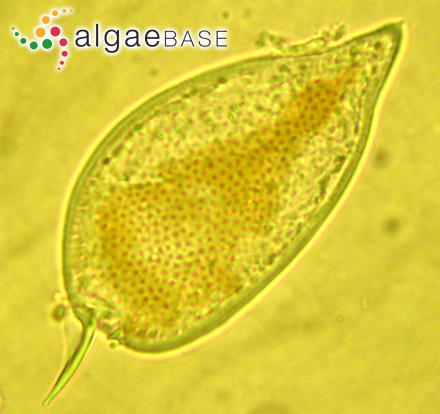
Prorocentrum micans Ehrenberg
Bahía de Santiago de Cuba, Cuba. 13 Jul 2011. Liliana Gomez Luna. © Liliana Gomez Luna (lilianag@cnea.uo.edu.cu) .

Prorocentrum micans Ehrenberg
© Robin Raine (Robin.Raine@nuigalway.ie).


Fucus vesiculosus var. laterifructus Greville

Prorocentrum micans Ehrenberg Bahía de Santiago de Cuba, Cuba

Publication details
Prorocentrum micans Ehrenberg 1834: 307

Original publication: Ehrenberg, C.G. (1834). Beiträge zur physiologischen Kenntniss der Corallenthiere im allgemeinen, und besonders des rothen Meeres, nebst einem Versuche zur physiolo- gischen Systematik derselben. 1.. Abhandlungen der Königlichen Akademie Wissenschaften zu Berlin, Physikalische Klasse 1832(1): 225-380.
 Download PDF

Type species
This is the type species (holotype) of the genus Prorocentrum.

Status of name
This name is of an entity that is currently accepted taxonomically.

Heterotypic Synonym(s)
Prorocentrum schillerii Böhrn 1933
Prorocentrum levantinoides Bursa 1959
Prorocentrum pacificum Wood 1963

General environment
This is a marine species.

Usage notes
Faust & Gulledge (2002: 64) notes this species is capable of forming blooms, it is usually considered harmless. It may excrete substances that inhibit diatom growth. Recent incidents involving shellfish mortality have been attributed to oxygen depletion. Please consult original reference for further details.

Distribution by country

Type information
Type locality: North Sea: near Kiel, Berlin, Germany (Faust & Gulledge 2002: 64). Holotype: (Faust & Gulledge 2002: 64).

Detailed distribution with sources
(as Prorocentrum micans Ehrenberg)
Europe: Britain (Parke & Dixon 1976), Croatia (Vilicic et al. 2009), Greece (Ignatiades 2012), Norway (Naustvoll 2001), Romania (Caraus 2002, Caraus 2012), Spain (Pérez, Maidana & Comas 2009).

Atlantic Islands: Canary Islands (Gil-Rodríguez et al. 2003, Anon 2011).

North America: Nova Scotia (Kim, Garbary & McLachlan 2004), Rhode Island (Lin et al 2006, Haywood et al. 2007, Chomérat et al. 2011).

Caribbean Islands: Cuba (Moreira et al. 2009).

South America: Brazil (Odebrecht 2010).

Africa: Morocco (Gottschling et al. 2005).

Australia and New Zealand: New Zealand (Chang et al. 2012), South Australia (Harlow et al 2007).

Source of synonymy
Steidinger, K.A. & Tangen, K. (1996). Dinoflagellates. In: Identifying Marine Phytoplankton. (Tomas, C.R. Eds), pp. 387-584. San Diego: Academic Press.

Key references
Daugbjerg, N., Hansen, G., Larsen, J. & Moestrup, Ø. (2000). Phylogeny of some of the major genera of dinoflagellates based on ultrastructure and partial LSU rDNA sequence data, including the erection of three new genera of unarmoured dinoflagellates. Phycologia 39: 302-317.

Dodge, J.D. (1982). Marine dinoflagellates of the British Isles. pp. 1-303. London: Her Majesty's Stationery Office.

Faust, M.A. & Gulledge, R.A. (2002). Identifying harmful marine dinoflagellates. Contributions from the United States National Herbarium 42: 1-144.

Gottschling, M., Knop, R., Plötner, J., Kirsch, M., Willems, H. & Keupp, H. (2005). A molecular phylogeny of Scrippsiella sensu lato (Calciodinellaceae, Dinophyta) with interpretations on morphology and distribution. European Journal of Phycology 40: 207-220.

Harlow, L.D., Koutoulis, A. & Hallegraeff, G.M. (2007). S-adenosylmethionine synthetase genes from eleven marine dinoflagellates. Phycologia 46: 46-53.

Jeong, H.J., Kim, H.R., Kim, K.L., Kim, K.Y., Park, K.H., Kim, S.T., Yoo, Y.D., Song, J.Y., Kim, J.S., Seong, K.A., Yih, W.H., Pae, S.J., Lee, C.H., Huh, M.D. & Lee, S.H. (2002). NaOCl produced by electrolysis of natural seawater as a potential method to control marine red-tide dinoflagellates. Phycologia 41: 643-656.

Jin, Q., Dong, S. & Wang, C. 2005 (2005). Allelopathic growth inhibition of Prorocentrum micans (Dinophyta) by Ulva pertusa and Ulva linza (Chlorophyta) in laboratory cultures. European Journal of Phycology 40: 31-37.

Kim, K.Y., Garbary D.J. & McLachlan, J.L. (2004). Phytoplankton dynamics in Pomquet Harbour, Nova Scotia: a lagoon in the southern Gulf of St. Lawrence. Phycologia 43: 311-328.

Kim, S. (2006). Patterns in host range for two strains of Amoebophyra (Dinophyta) infecting thecate dinoflagellates: Amoebophyra spp. ex ,i>Alexandrium affine and ex Gonyaulax polygramma (Note). Journal of Phycology 42: 1170-1173.

Leaw, C.P., Lim, P.T., Ng, B.K., Cheah, M.Y., Ahmad, A. & Usup, G. (2005). Phylogenetic analysis of Alexandrium species and Pyrodinium bahamense (Dinophyceae) based on theca morphology and nuclear ribosomal gene sequence. Phycologia 44: 550-565.

Lin, S., Zhang, H. & Jiao, N. (2006). Potential utility of mitochondrial cytochrome b and its mRNA editing in resolving closely related dinoflagellates: a case study of Prorocentrum (Dinophyceae). Journal of Phycology 42: 646-654.

Lindberg, K., Moestrup, Ø & Daugbjerg, N. (2005). Studies on woloszynskioid dinoflagellates I: Woloszynskia coronata re-examined using light and electron microscopy and partial LSU rDNA sequences, with description of Tovellia gen. nov. and Jadwigia gen. nov. (Tovelliaceae fam. nov.). Phycologia 44: 416-440.

Parke, M. & Dixon, P.S. (1976). Check-list of British marine algae - third revision. Journal of the Marine Biological Association of the United Kingdom 56: 527-594.

Zhang, H., Bhattacharya, D. & Lin, S. (2005). Phylogeny of dinoflagellates based on mitochondrial cytochrome b and nuclear small subunit rDNA sequence comparisons. Journal of Phycology 41: 411-420.

UTEX Cultures
UTEX Culture LB 1003 Prorocentrum micans
Go to UTEX Site

CCAP Cultures
CCAP Strain Number 1136/1 Prorocentrum micans Ehrenberg
Go to CCAP Site

SAG Cultures
SAG Cultures may be viewed at http://sagdb.uni-goettingen.de/showstrains.php?genus=Prorocentrum&species=micans

SCCAP Cultures
Cultures from the Scandinavian Culture Collection of Algae at the University of Copenhagen (SCCAP) and Protozoa may be viewed at http://www.sccap.dk/search/algaebase.asp?Genus=Prorocentrum&Species=micans

NCBI Nucleotide Sequences

Created: 02 May 2002 by M.D. Guiry

Verified by: 19 August 2011 by Wendy Guiry

Accesses: This record has been accessed by users 3496 times since it was created.

References
(Please note: only references with the binomials in the title are included. The information is from the Literature database.)

Braarud, T. & Rossavik, E. (1951). Observations on the marine dinoflagellate Prorocentrum micans Ehrenb. in culture. Det Norske Videnskaps-Akademi I Oslo I. Mat.-Naturv. Klasse 1951 1951(1): 1-18.
Cohen-Fernandez, E.J., Del Castillo, E.M., Ugarte, I.H.S. & Pedroche, F.F. (2006). Contribution of external morphology in solving a species complex: The case of Prorocentrum micans, Prorocentrum gracile and Prorocentrum sigmoides (Dinoflagellata) from the Mexican Pacific Coast. Phycological Research 54(4): 330-340.
Heimann, K., Roberts, K.R. & Wetherbee, R. (1995). Flagellar apparatus transformation and development in Prorocentrum micans and P. minimum (Dinophyceae). Phycologia 34: 323-335, 52 figs.
Jin, Q., Dong, S. & Wang, C. 2005 (2005). Allelopathic growth inhibition of Prorocentrum micans (Dinophyta) by Ulva pertusa and Ulva linza (Chlorophyta) in laboratory cultures. European Journal of Phycology 40: 31-37.
Lage, O.M., Parente, A.M., Soares, H.M.V.M., Vasconcelos, M.T.S.D. & Salema, R. (1994). Some effects of copper on the dinoflagellates Amphidinium carterae and Prorocentrum micans in batch culture. European Journal of Phycology 29: 253-260, 6 figs, 3 tables.
Lage, O.M., Parente, A.M., Vasconcelos, M.T.S.D., Gomes, C.A.R. & Salema, R. (1996). Potential tolerance mechanisms of Prorocentrum micans (Dinophyceae) to sublethal levels of copper. Journal of Phycology 32: 416-423, 6 figs, 1 table.
Lembeye, G. & Campodonico, I. (1984). First recorded bloom of the dinoflagellate Prorocentrum micans Ehr. in South -Central Chile. Botanica Marina 27: 491-493.
Minier, C., Galgani, F. & Robert, J.M. (1993). In vivo characterization of esterase activity in Calothrix PCC 7601, Haslea ostrearia and Prorocentrum micans. Botanica Marina 36: 245-252, 5 figs, 1 table.
Pybus, C. (1990). Blooms of Prorocentrum micans (Dinophyta) in the Galway Bay area. Journal of the Marine Biological Association of the United Kingdom 70(4): 697-705.
Roberts, K.R., Heimann, K. & Wetherbee, R. (1995). The flagellar apparatus and canal structure in Prorocentrum micans (Dinophyceae). Phycologia 34: 313-322, 34 figs.
Shankle, A.M., Mayali, X. & Franks, P.J.S. (2004). Temporal patterns in population genetic diversity of Prorocentrum micans (Dinophyceae). Journal of Phycology 40: 239-247.
Uchida, T. (1981). The relationships between Prorocentrum micans-growth and its ecological environment. Scientific Papers of the Institute of Algological Research, Faculty of Science, Hokkaido Imperial University 7(1): 17-79.

Linking to this page: http://www.algaebase.org/search/species/detail/?species_id=51818

Citing AlgaeBase
Cite this record as:
Wendy Guiry in Guiry, M.D. & Guiry, G.M. 2013. AlgaeBase. World-wide electronic publication, National University of Ireland, Galway. http://www.algaebase.org; searched on 23 May 2013.

Algaebase taxon LSID: urn:lsid:algaebase.org:taxname:47384

SITE © 1996 - 2013 M.D. Guiry. All rights reserved.

Website Design : 249 Design Studio