125,097 species and infraspecific names are in the database, 8,056 images, 43,558 bibliographic items, 160,228 distributional records.

Asparagopsis armata Harvey

Classification:
Empire Eukaryota
Kingdom Plantae
Subkingdom Biliphyta
Phylum Rhodophyta
Subphylum Eurhodophytina
Class Florideophyceae
Subclass Rhodymeniophycidae
Order Bonnemaisoniales
Family Bonnemaisoniaceae
Genus Asparagopsis

Pictures:

click on thumbnail for larger version.

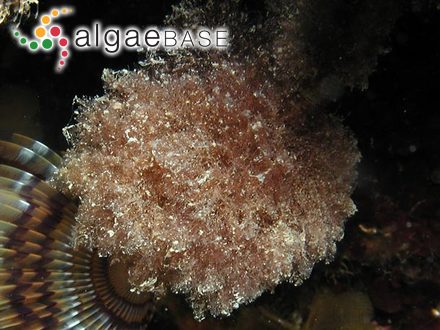
Asparagopsis armata (1)
Finavarra, Co. Clare, Ireland; Falkenbergia-phase plants epiphytic on Corallina with Dictyota. 08 Aug 2004. M.D. Guiry.

Asparagopsis armata (2)
Finavarra, Co. Clare, Ireland; lower-shore pools epiphytic on Corallina; Falkenbergia-phase plant. 12 Aug 2002. M.D. Guiry.

Asparagopsis armata (3)
Finavarra, Co. Clare, Ireland; MLWN lagoon; note harpoon branches. 08 Aug 2002. M.D. Guiry.

Asparagopsis armata (4)
Finavarra, Co. Clare, Ireland; epiphytic plants at MLWN. 29 Mar 2002. M.D. Guiry.

Asparagopsis armata (5)
Houtman Abrolhos, Western Australia. John Huisman.

Asparagopsis armata (6)
Madeira. Peter Wirtz.

Asparagopsis armata (7)
From Harvey, W.H. (1858-1863). Phycologia australica. Vols 1-5. Plates I-CCC. London: Lovell Reeve & Co. Available on CD from http://www.phycology.ugent.be/harvey.

Asparagopsis armata (8)
Falkenbergia rufolanosa-phase grwoing on Cystoseira baccata, Spain, Galicia, Lugo, Ría de Vivero, subtidal, 2004. Ignacio Bárbara.

Asparagopsis armata (9)
lower intertidial, Spain, Galicia, Lugo, Castro point, 2003. Ignacio Bárbara.

Asparagopsis armata (10)
lower intertidial, Spain, Galicia, Lugo, San Ciprián, 1994. Ignacio Bárbara.

1  2  Next

18 Found - Displaying 1 through 10


Publication details
Asparagopsis armata Harvey 1855: 544

Original publication: Harvey, W.H. (1855). Some account of the marine botany of the colony of western Australia. Transactions of the Royal Irish Academy 22: 525-566.
 Download PDF

Type species
The type species (holotype) of the genus Asparagopsis is Asparagopsis delilei Montagne.

Status of name
This is regarded as a current name.

Origin of species name
Adjective (Latin), equipped, armed (Stearn 1973).

Synonym(s)
Polysiphonia rufolanosa Harvey 1855
Polysiphonia vagabunda Harvey 1859
Falkenbergia rufolanosa (Harvey) F. Schmitz 1897
Falkenbergia vagabunda (Harvey) Falkenberg 1901
Falkenbergia olens A.H.S. Lucas 1919

General environment
This is a Marine species.

Description
In north-eastern Europe, gametophyte plants occurring from June or July - August or September (sometimes overwintering), pale purplish-red, quickly degenerating when removed from the water and becoming distinctly orange; fronds bushy, with a cylindrical axis to1 mm wide and 200 mm long, arising from bare, creeping stolons; irregularly branched, with 4 rows of branchlets, simple, short, branchlets alternating with longer ones with 4 rows of simple filamentous ramuli. Lower branchlets unbranched, long, tapered, with harpoon-like barbs. Tetrapsorophyte (“Falkenbergia-phase”) occurring all year round, but most obvious in October-March, brownish-red, much branched, filamentous, in dense cotton-wool-like tufts to 15 mm in diameter.

Habitat
Both phases readily reproduce vegetatively. Drift specimens of gametophyte readily attach to other algae by barbed branchlets, and produce new shoots. Introduced from Southern Hemisphere, the gametophyte was first recorded in Europe in 1925 (Cherbourg and Biarritz), arriving in the Ireland and Britain at Galway in 1941, and is now well established in open sandy pools of lower intertidal and subtidal, on rock or epiphytic (mainly on Ulva spp.)in the Channel Is, S England (Swanage to Scilly Is.) and S and W Ireland (Carnsore Pt, Co. Wexford; Magharees Lagoon, Co. Kerry; and from Finavarra, Co. Clare north to Clare I., Co. Mayo). Tetrasporophyte epiphytic, especially on Corallina, in similar habitats to gametophyte, but more widely distributed on western and southern coast N to Shetland Is.

Key characteristics
The harpoon-like hooks and bushy habit are unmistakable; association with Ulva.

Similar species
Bonnemaisonia hamifera occurs in similar habitats but has crozier-shaped attachment branchlets rather than recurved barbs.

Type information
Type locality: Garden Island, Western Australia (Womersley 1996: 329). Lectotype: Harvey; Herb. Harvey, TCD Trav. Set 193 (Womersley 1996: 329). Notes: Syntype localities: Garden Island and King George Sound, Western Australia; Tasmania (Silva et al. 1996: 182).

Detailed distribution with sources
(as Asparagopsis armata Harvey)
Ireland: Cork (Christensen 1957, Dixon & Irvine 1977, Guiry 1978), Donegal (Guiry 1978, Morton 2003), Galway (De Valéra 1957, Dixon & Irvine 1977, Guiry 1978, De Valéra et al. 1979), Kerry (Guiry 1978, Whelan & Cullinane 1985), Mayo (Dixon & Irvine 1977, Guiry 1978), Wexford (Guiry 1978, Cullinane & Whelan 1979, Guiry, Cullinane & Whelan 1979).

Europe: Adriatic (Giaccone 1978), Britain (Dixon & Irvine 1977, Guiry 1997, Hardy & Guiry 2003, Ní Chualáin et al. 2004), Channel Islands (Ní Chualáin et al. 2004), Croatia (Cormaci et al. 2004), France (Feldmann 1939, Feldmann 1954, Cormaci et al. 2004, Ní Chualáin et al. 2004, Dizerbo & Herpe 2007, Loiseaux-de Goër & Noailles 2008), Greece (Athanasiadis 1987, Cormaci et al. 2004), Ireland (De Valéra 1957, Guiry 1978, De Valéra et al. 1979, Whelan & Cullinane 1985, Ní Chualáin et al. 2004, Stokes, O'Neill & McDonald 2004, Kraan & Barrington 2005, Sekimoto et al. 2009), Isla de Alborán (Conde & Flores Moya 2000), Italy (Cinelli 1971, Cinelli et al. 1976, Cecere et al. 1996, Furnari, Cormaci & Serio 1999, Furnari et al. 2003, Cormaci et al. 2004, Ní Chualáin et al. 2004, Serio et al 2006), Malta (Cormaci et al. 1997, Cormaci et al. 2004), Monaco (Cormaci et al. 2004), Netherlands (Stegenga & Mol 1983), Portugal (Ardré 1970, Araújo et al., 2003, Araujo et al. 2009, Araújo, Bárbara & Sousa-Pinto in press), Sardinia (Furnari et al. 2003), Spain (Miranda 1934, Miranda 1936, Ardré 1957, Seoane-Camba 1965, Polo 1978, Varo, Ramirez & Renteria 1979, Ballesteros 1981, Ballesteros & Romero 1982, Aranda, Niell & Fernández 1984, Conde 1984, García Raso & Salas 1984, Gallardo et al. 1985, Anadón & Fernández 1986, Soto Moreno 1987, Rodriguez Prieto & Polo Alberti 1988, Soto & Conde 1989, Navarro & Gallardo 1989, Granja, Cremades & Barbara 1992, Flores-Moya & Conde 1992, Bárbara & Cremades 1996, Conde et al. 1996, Rodríguez-Prieto & Polo, L. 1996, Veiga, Cremades & Bárbara 1998, Rodriguez-Prieto & Polo Albertí 1998, Peña & Bárbara 2002, Valenzuela Miranda 2002, Sánchez, Fernández & Rico 2003, Cormaci et al. 2004, Gorostiaga et al., 2004, Ní Chualáin et al. 2004, Bárbara et al. 2005, de los Santos, Pérez-Lloréns & Vergara 2009, Mercado et al. 2009), Turkey (Europe) (Güven & Öztig 1971, Cormaci et al. 2004, Taskin et al. 2008).

Atlantic Islands: Azores (Neto 1994, Tittley & Neto 1994), Canary Islands (Gil-Rodríguez & Afonso-Carrillo 1980, Viera-Rodriguez et al. 1985, Price, John & Lawson 1986, Viera-Rodriguez et al. 1987, Ballesteros, Sansón, Reyes, Afonso-Carrillo & Gil-Rodríguez 1992, Guadalupe et al. 1995, Haroun et al. 2002, Gil-Rodríguez et al. 2003, John et al. 2004), Madeira (Levring 1974, Neto, Cravo & Haroun 2001, Haroun et al. 2002, John et al. 2004), Salvage Islands (Audiffred & Weisscher 1984, Price, John & Lawson 1986, Parente et al. 2000, John et al. 2004).

North America: California (Ní Chualáin et al. 2004).

Caribbean Islands: Cuba (Cabrera, Moreira & Suárez 2004).

South America: Chile (Santelices 1989, Ramírez & Santelices 1991, Hoffmann & Santelices 1997, Ní Chualáin et al. 2004, Silva & Chacana 2005).

Africa: Algeria (Cormaci et al. 2004), Morocco (Dangeard 1949, Gil-Rodriguez & Socorro Hernández 1986, Cormaci et al. 2004), Senegal (John et al. 2004), South Africa (Silva, Basson & Moe 1996), Tunisia (Meñez & Mathieson 1981, Ben Maiz, Boudouresque & Quahchi 1987, Cormaci et al. 2004).

South-west Asia: India (Silva, Basson & Moe 1996, Sahoo et al. 2001), Red Sea (Papenfuss 1968), Turkey (Asia) (Taskin et al. 2008).

Asia: Korea (Lee & Kang 2001).

South-east Asia: Burma (Silva, Basson & Moe 1996).

Australia and New Zealand: Australia (Silva, Basson & Moe 1996), New South Wales (Millar & Kraft 1993, Womersley 1996, Huisman 2000, Paul et al 2006), New Zealand (Bonin & Hawkes 1987, Adams 1994, Womersley 1996, Adams 1997, Huisman 2000), Queensland (Lewis 1984), South Australia (Womersley 1996, Huisman 2000, Copertino et al. 2005), Tasmania (Womersley 1996, Huisman 2000), Victoria (Womersley 1996, Huisman 2000, Ní Chualáin et al. 2004), Western Australia (Harvey 1855, Huisman & Walker 1990, Womersley 1996, Huisman 2000).

(as Polysiphonia rufolanosa Harvey)
Europe: Italy (Giaccone 1969).

(as Falkenbergia rufolanosa (Harvey) F. Schmitz)
Ireland: Clare (Maggs 1983), Donegal (De Valéra 1957), Galway (De Valéra 1957, Maggs 1983).

Europe: Balearic Islands (Ribera Siguán 1983, Ribera Siguán & Gómez Garreta 1984), Corsica (Boudouresque & Perret 1977, Coppejans 1979, Demoulin, Janssen & Licot 1980, Verlaque 1984), France (Feldmann 1943, Feldmann 1954, Augier, Boudouresque & Laborel 1971, Coppejans 1972), Greece (Tsirika & Haritonidis 2005), Ireland (De Valéra 1957, Maggs 1983), Italy (Cinelli 1971), Portugal (Ardré 1970, Araújo, Bárbara & Sousa-Pinto in press), Spain (Miranda 1934, Fischer-Piette, C. & Seoane Camba, J. (1962), Seoane-Camba 1965, Polo 1978, Varo, Ramirez & Renteria 1979, Gómez, Ribera & Romero 1981, Ballesteros & Romero 1982, Boisset & Barceló 1984, Aranda, Niell & Fernández 1984, Conde 1984, Ribera Siguán & Gómez Garreta 1984, Gallardo et al. 1985, Soto Moreno 1987, Boisset Lopez 1987, Barceló 1987, Rodriguez Prieto & Polo Alberti 1988, Soto & Conde 1989, Navarro & Gallardo 1989, Granja, Cremades & Barbara 1992, Flores-Moya & Conde 1992, Bárbara & Cremades 1996, Rodríguez-Prieto & Polo, L. 1996, Rodriguez-Prieto et al. 1997, Veiga, Cremades & Bárbara 1998, Rodriguez-Prieto & Polo Albertí 1998, Diaz-Tapia & Bárbara 2005, Morais e Silva, Lavelli & Rull Lluch 2008, Pena & Bárbara 2008, Pérez-Ruzafa et al. 2008), Turkey (Europe) (Güven & Öztig 1971, Cirik, Zeybeck, Aysel & Cirik 1990).

Atlantic Islands: Canary Islands (Price, John & Lawson 1986, Viera-Rodriguez et al. 1987, Gil-Rodriguez, Afonso-Carrillo & Wildpret de la Torre 1987), Madeira (Haroun et al. 2002), Salvage Islands (Parente et al. 2000).

Africa: Morocco (Dangeard 1949), Senegal (Price, John & Lawson 1986), South Africa (Stegenga, Bolton & Anderson 1997), Tunisia (Ben Maiz, Boudouresque & Quahchi 1987).

Pacific Islands: Easter Island (Børgesen 1924, Santelices & Abbott 1987).

(as Falkenbergia olens A.H.S. Lucas)
Australia and New Zealand: New South Wales (Millar & Kraft 1993).

Taxonomic notes
test 1 - (17 Aug 2009) - Pier Kuipers

test 2 - (17 Aug 2009) - Pier Kuipers

Key references
Bonin, D.R. & Hawkes, M.W. (1987). Systematics and life histories of New Zealand Bonnemaisoniaceae (Bonnemaisoniales, Rhodophyta): I. The genus Asparagopsis. New Zealand Journal of Botany 25: 577-590.

Braune, W. (2008). Meeresalgen. Ein Farbbildführer zu den verbreiteten benthischen Grün- Braun- und Rotalgen der Weltmeere. pp. [1]-596, 266 pls. Ruggell: A.R.G. Gantner Verlag.

Loiseaux-de Goër, S. & Noailles, M.-C. (2008). Algues de Roscoff. pp. [1]-215, col. figs. Roscoff: Editions de la Station Biologique de Roscoff.

Ní Chualáin, F., Maggs, C.A., Saunders, G.W. & Guiry, M.D. (2004). The invasive genus Asparagopsis (Bonnemaisoniaceae, Rhodophyta): molecular systematics, morphology, and ecophysiology of Falkenbergia isolates. Journal of Phycology 40: 1112-1126.

Silva, P.C., Basson, P.W. & Moe, R.L. (1996). Catalogue of the benthic marine algae of the Indian Ocean. University of California Publications in Botany 79: 1-1259.

Womersley, H.B.S. (1996). The marine benthic flora of southern Australia - Part IIIB - Gracilariales, Rhodymeniales, Corallinales and Bonnemaisoniales. Vol. 5 pp. 1-392, 160 figs. Canberra & Adelaide: Australian Biological Resources Study & the State Herbarium of South Australia.

NCBI Nucleotide Sequences
As of 2 June 2009, nucleotide sequence data are available at http://www.ncbi.nlm.nih.gov/Genbank for 29 samples identified as Asparagopsis armata.

Created: 30 March 1996 by M.D. Guiry

Verified by: 17 August 2009 by Pier Kuipers

Accesses: This record has been accessed by users 11194 times since it was created.

References
(Please note: only references with the binomials in the title are included. The information is from the Literature database.)

Andreakis, N., Procaccini, G. & Kooistra, W.H.C.F. (2004). Asparagopis taxiformis and Asparagopsis armata (Bonnemaisoniales, Rhodophyta): genetic and morphological identification of Mediterranean populations. European Journal of Phycology 39: 273-284.
Aranda, J., Niell, F.X. & Fernández, J.A. (1984). Production of Asparagopsis armata (Harvey) in a thermally-stressed intertidal system of low tidal amplitude. Journal of Experimental Marine Biology and Ecology 84: 285-295.
Bruneau, Y., Codomier, L., Combaut, G. & Teste, J. (1978). Étude compatative des composés halogénés du Falkenbergia rufolanosa (Harv.) Schmitz et de l'Asparagopsis armata (Harv.): Rhodophycées bonnemaisoniales. Compte Rendu Hebdomadaire des Séances de l’Académie des Sciences. Paris. Série D 286: 603-605.
Chemin, E. (1937). Répartition géographique et mode de dissémination d'Asparagopsis armata, Harv.. : 43-44.
Codomier, L., Bruneau, Y., Combaut, G. & Teste, J. (1977). Étude biologie et chimique d'Asparagopsis armata et de Falkenbergia rufolanosa (Rhodophycées bonnemaisoniales). Compte Rendu Hebdomadaire des Séances de l’Académie des Sciences. Paris. Série D 284: 1163-1165.
Codomier, L., Segot, M. & Combaut, G. (1979). Effets de l'iode sur la croissance des frondes d'Asparagopsis armata (Rhodophycées, Bonnemaisoniales) obtenues en culture à partir de rameaux à harpons. Giornale Botanico Italiano 113: 387-393.
Codomier, L., Segot, M. & Combaut, G. (1981). Influence de composés organiques haligénés sur la croissance d'Asparagopsis armata (Rhjodophycée, Bonnemaisoniale). Botanica Marina 24: 509-513.
Codomier, L., Segot, M. & Teste, J. (1979). Sur le developpement d'Asparagopsis armata (Rhodophycée, Bonnemaisoniale) en culture. Botanica Marina 22: 153-157.
Codomier, L., Segot, M., Combaut, G. & Teste, J. (1981). Sur le développemement d'Asparagopsis armata (Rhodophycée, Bonnemaisoniale) en culture. Effets de certaines substances azotées ou phosphorées inorganiques ou organiques. Botanica Marina 24: 43-49.
Codomier, L., Segot, M., Teste, J. & Jeanty, G. (1978). Sur la croissance et le développement des frondes d'Asparagopsis armata Harv. (Rhodophycée, Bonnemaisoniale) à pratir de rameaux à harpons mis en culture dans un milieu enrichi en brome. Bulletin de la Société Phycologique de France 23: 29-37.
Combaut, G., Bruneau, Y., Codomier, L. & Teste, J. (1979). Comparative sterols composition of the red alga Asparagopsis armata and its tetrasporophyte Falkenbergia rufolanosa. Journal of Natural Products 42: 150-151.
Combaut, G., Bruneau, Y., Teste, J. & Codomier, L. (1978). Composes halogens d'une algue rouge, Falkenbergia rufolanosa tetrasporophyte d'Asparagopsis armata. Phytochemistry 17: 1661-1663.
De Valéra, M. & Folan, A. (1964). Germination in situ of carpospores in Irish material of Asparagopsis armata Harv. and Bonnemaisonia asparagoides (Woodw.) Ag.. British Phycological Bulletin 2: 332-338.
De Valéra, M. (1942). A red alga new to Ireland: Asparagopsis armata Harv. on the west coast. Irish Naturalists' Journal 8: 30-33.
De Valéra, M. (1957). A note on the distribution of Asparagopsis armata and Falkenbergia rufolanosa in Ireland as compared with Spain. Collectanea Botanica 5: 377-380.
Dizerbo, A.H. (1964). L'écologie d'Asparagopsis armata Harv. et de Falkenbergia rufolanosa (Harv.) Schmitz dans le Massif Armoricain. Proceedings of the International Seaweed Symposium 4: 179-185.
Drew, K.M. (1950). Occurrence of Asparagopsis armata Harv. on the coast of Cornwall. Nature, London 161: 223.
Feldmann, J. & Feldmann, G. (1939). Sur le développement des carpospores et l'alternance de générations de l'Asparagopsis armata Harvey. Compte Rendu Hebdomadaire des Séances de l'Académie des Sciences, Paris 208: 1240-1242, Figs. A-E.
Flores-Moya, A. & Conde, F. (1992). Fenología y corología de Asparagopsis armata (Bonnemaisoniaceae, Rhodophyta) en el Mediterráneo. Acta Botanica Malacitana 17: 245-249.
Guiry, M.D. & Dawes, C.J. (1992). Daylength, temperature and nutrient control of tetrasporogenesis in Asparagopsis armata (Rhodophyta). Journal of Experimental Marine Biology and Ecology 158: 197-219.
Haslin, C. & Pellegrini, M. (2001). Culture medium composition for optimal thallus regeneration in the red alga Asparagopsis armata Harvey (Rhodophyta, Bonnemaisoniaceae). Botanica Marina 44: 23-30.
Haslin, C., Lahaye, M. & Pellegrini, M. (2000). Chemical composition and structure of sulphated water-soluble cell-wall polysaccharides from the gametic, carposporic and tetrasporic stages of Asparagopsis armata Harvey (Rhodophyta, Bonnemaisoniaceae). Botanica Marina 43: 475-482.
Horridge, G.A. (1951). Occurrence of Asparagopsis armata Harv. on the Scilly Isles. Nature, London 167: 732-733.
Kraan, S. & Barrington, K. (2005). Commercial farming of Asparagopsis armata (Bonnemaisoniaceae, Rhodophyta) in Ireland, maintenance of an introduced species. Journal of Applied Phycology 17: 103-110.
Mata, L., Silva, J., Schuenhoff, A. & Santos R. (2007). Is the tetrasporophyte of Asparagopsis armata (Bonnemaisoniales) limted by inorganic carbon in integrated aquaculture?. Journal of Phycology 43: 1252-1258.
McLachlan, J. (1967). Tetrasporangia in Asparagopsis armata. British Phycological Bulletin 3: 251-252.
Paul, N.A., Cole, L., de Nys, R. & Steinberg, P.D. (2006). Ultrastructure of the gland cells of the red alga Asparagopsis armata (Bonnemaisoniaceae). Journal of Phycology 42: 637-645.
Sauvageau, C. (1925). Sur la naturalisation en France d'une Floridée australasienne de l'iode (Asparagopsis armata Harv.) et sur ses ioduques. Compte Rendu Hebdomadaire des Séances de l’Académie des Sciences. Paris. 180???-???: .
Segot, M. & Codomier, L. (1981). Culture media with enriched seawater: Optimal and inhibitory concentrations of some chemical compounds added to seawater for the culture of Asparagopsis armata (Rhodophyceae, Bonnemaisoniales). Botanica Marina 24: 63-67.
Segot, M. & Codomier, L. (1981). Milieu de culture á eau de mer enrichie: Concentrations maximales et inhibitrices de certains composés chimiques ajoutés á l'eau de mer pour la culture d'Asparagopsis armata (Rhodophycée, Bonnemaisoniale). Botanica Marina 24: 63-67.
Svedelius, N. (1933). On the development of Asparagopsis armata Harv. and Bonnemaisonia asparagoides (Woodw.) Ag. A contribution to the cytology of the haplobiontic Rhodophyceae. Nova Acta Reg. Soc. sci. Ups. 9(1): 1-61.
Thomas, L. (1955). Observaciones sobre la ecología de las formas Asparagopsis armata-Falkenbergia rufolanosa y un nuevo órgano de reproduccíon. Collectanea Botanica 4(3): 399-407.

SITE © 1996 - 2010 M.D. Guiry. All rights reserved.

Website Design : 249 Design Studio