Rhodothamniella floridula (Dillwyn) Feldmann
Classification:
Empire Eukaryota
Kingdom Plantae
Subkingdom Biliphyta
Phylum Rhodophycophyta
Subphylum Eurhodophytina
Class Florideophyceae
Subclass Rhodymeniophycidae
Order Palmariales
Family Rhodothamniellaceae
Genus Rhodothamniella
Pictures:
click on thumbnail for larger version.

Spain, Galicia, San Antóns Castle, 2005, lower intertidal at the base of Fucus serratus. Ignacio Bárbara. © Ignacio Bárbara.

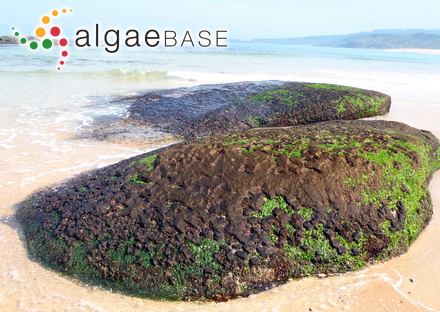
New Quay, Co. Clare, Ireland; binding sand into banks; 16-mm lens. 29 Mar 2002. Michael Guiry. © Michael Guiry.

microscope, North of Portugal, Aguçadoura, 2000. Ignacio Bárbara. © Ignacio Bárbara.

microscope, North of Portugal, Aguçadoura, 2000. Ignacio Bárbara. © Ignacio Bárbara.

with Mastocarpus stellatus, Ártabra, A Coruña, Spain, 2009. Ignacio Bárbara. © Ignacio Bárbara.

Rhodothamniella floridula Clougher Strand, Co. Kerry, Ireland. 11 Aug 2010. M.D. Guiry. © M.D. Guiry.

Rhodothamniella floridula Curragh, Co. Waterford, Ireland. 27 Aug 2010. M.D. Guiry. © M.D. Guiry.
Rhodothamniella floridula (Dillwyn) Feldmann Rhodothamniella floridula Clougher Strand, Co. Kerry, Ireland
Publication details
Rhodothamniella floridula (Dillwyn) Feldmann in T. Christensen 1978: 67
Original publication: Christensen, T. (1978). Annotations to a textbook of phycology. Botanisk Tidsskrift 73: 65-70.
Type species
This is the type species (holotype) of the genus Rhodothamniella.
Status of name
This name is of an entity that is currently accepted taxonomically.
Basionym
Conferva floridula Dillwyn
Type information
Syntype localities: "Rocks on the Sea shore. On the Galway Coast; Dr. Scott. On the Antrim Coast; Mr. Mackay." [Ireland] (Dillwyn 1809: 73). Lectotype: BM (Womersley 1994: 45). Notes: A type locality of Galway Bay was first selected by Woelkerling (1971: 31) (Silva et al., 1996).
Origin of species name
(Latin), a diminutive of floridus meaning, somewhat blooming.
Homotypic Synonym(s)
Conferva floridula Dillwyn 1809
Ceramium floridulum (Dillwyn) Agardh 1817
Callithamnion floridulum (Dillwyn) Lyngbye 1819
Trentepohlia floridula (Dillwyn) Harvey 1836
Rhodochorton floridulum (Dillwyn) Nägeli 1862
Thamnidium floridulum (Dillwyn) Thuret 1863
Chromastrum floridulum (Dillwyn) Papenfuss 1945
Kylinia floridula (Dillwyn) Papenfuss 1947
Audouinella floridula (Dillwyn) Woelkerling 1971
Heterotypic Synonym(s)
Ceramium repens var. saxitale Bonnemaison 1828
Rhodochorton rothii f. globosum Kjellman 1883
General environment
This is a Marine species.
Description
Forming a dense, brown- or purplish-red turf of sparingly branched erect, uniseriate hair-like filaments. Cells oblong, 3-4 times as long as broad. Several plastids, each with a pyrenoid, against cell wall. Reproducing by tetrasporangia, mostly in winter. Monosporangia absent.
Habitat
Turf-forming on sand-covered rocks, mid- and lower intertidal, often under Fucus serratus; widely distributed, very common.
Key characteristics
Turf-forming habit and association with sand-coved rocks. Absence of monosporangia.
Similar species
Rhodochorton purpureum forms less extensive turfs. Microscopic examination (for the presence of pyrenoids in plastids) is required to be certain of the identity of this species.
Detailed distribution with sources
(as Callithamnion floridulum (Dillwyn) Lyngbye)
Europe: Ireland (Sanders 1860, McMillan & Morton 1979).
(as Rhodochorton floridulum (Dillwyn) Nägeli)
Ireland: Cork (Cullinane 1971), Louth (Synnott 1969), Mayo (Cotton 1912), Wexford (Parkes & Scannell 1969, Norton 1970).
Europe: Belgium (Coppejans 1995), Britain (Newton 1931), France (Coppejans 1995), Ireland (Cotton 1912, Cullinane 1971), Netherlands (Stegenga & Mol 1983), Scandinavia (Athanasiadis 1996), Spain (Miranda 1931).
Atlantic Islands: Madeira (Levring 1974), Tristan da Cunha (Baardseth 1941).
(as Audouinella floridula (Dillwyn) Woelkerling)
Ireland: Antrim (McMillan & Morton 1979, Morton 1994), Clare (De Valéra et al. 1979, Maggs 1983), Derry (Morton 1994), Down (Morton 1994), Galway (Dixon & Irvine 1977, Guiry 1978, Maggs 1983), Kerry (Whelan & Cullinane 1985).
Europe: Britain (Dixon & Irvine 1977), France (Dizerbo & Herpe 2007), Ireland (Dixon & Irvine 1977, Guiry 1978, De Valéra et al. 1979, Maggs 1983, Whelan & Cullinane 1985, Morton 1994), Italy (Báez et al 2005a, Báez et al. 2005b), Norway (Rueness 1997), Spain (Pérez-Cirera & Maldonado 1982, Fernández & Niell 1982, Fernández, Niell & Anadón 1983).
Australia and New Zealand: New South Wales (Womersley 1994), South Australia (Womersley 1994), Victoria (Womersley 1994).
(as Rhodothamniella floridula (Dillwyn) Feldmann)
Ireland: Donegal (Morton 2003).
Europe: Britain (Guiry 1997, Hardy & Guiry 2003), France (Feldmann 1954), Helgoland (Bartsch & Kuhlenkamp 2000), Portugal (Ardré 1970, Araujo et al. 2009, Araújo, Bárbara & Sousa-Pinto in press), Spain (Granja, Cremades & Barbara 1992, Bárbara & Cremades 1996, Veiga, Cremades & Bárbara 1998, Calvo, Bárbara & Cremades 1999, Calvo & Bárbara 2002, Peña & Bárbara 2002, Valenzuela Miranda 2002, Bárbara et al., 2003, Gorostiaga et al., 2004, Bárbara et al. 2005, Diaz-Tapia & Bárbara 2005, Pena & Bárbara 2008).
Atlantic Islands: Madeira (Neto, Cravo & Haroun 2001, John et al. 2004).
Africa: Namibia (Rull Lluch 2002, Rull Lluch & Gómez Garreta 2002, John et al. 2004), South Africa (Bolton & Stegenga 1987, Silva, Basson & Moe 1996, Stegenga, Bolton & Anderson 1997).
Key references
Garbary, D.J. (1987). The Acrochaetiaceae (Rhodophyta): an annotated bibliography. Bibliotheca Phycologica 77: 1-267, 2 tables.
Silva, P.C., Basson, P.W. & Moe, R.L. (1996). Catalogue of the benthic marine algae of the Indian Ocean. University of California Publications in Botany 79: 1-1259.
Stegenga, H. (1978). Life histories of Rhodochorton purpureum and Rhodochorton floridulum (Rhodophyta, Nemaliales) in culture. British Phycological Journal 13: 279-289.
Womersley, H.B.S. (1994). The marine benthic flora of southern Australia - Part IIIA - Bangiophyceae and Florideophyceae (Acrochaetiales, Nemaliales, Gelidiales, Hildenbrandiales and Gigartinales sensu lato). pp. 1-508, 167 figs, 4 pls, 4 maps. Canberra: Australian Biological Resources Study.
SAG Cultures
No records have been found on the SAG site.
NCBI Nucleotide Sequences
Created: 30 March 1996 by M.D. Guiry
Verified by: 13 August 2009 by Pier Kuipers
Accesses: This record has been accessed by users 8095 times since it was created.
References
(Please note: only references with the binomials in the title are included. The information is from the Literature database.)
Hommeril, P. & Rioult, M. (1962). Phenomenes d'erosion et de sedimentation marines entre Sainte-Honorine-des-Pertes et Port-en-Bessin (Calvados). Role de Rhodothamniella floridula dans la retenue des sediments fins. Cah. Oceanogr. 14: 25-45.
Hommeril, P. & Rioult, M. (1965). Étude de la fixation de sédiments meubles par deux algues marines: Rhodothamniella floridula (Dillwyn) J. Feldmn. et Microcoleus chtonoplastes Thur.. Mar. Geol. 3: 131-155.
Lichtlé, C. (1973). Ultrastructure du plaste de deux Rhodophycées: Rhodochorton purpureum (Lighft.) Rosenvinge et Rhodothamniella floridula (Dillwyn) J. Feldmann. Compte Rendu Hebdomadaire des Séances de lAcadémie des Sciences. Paris. Série D 277: 1865-1868.
Pérez-Ruzafa, I., Lazzo, G. & Conde Poyales, F. (2005). Mapas de distribución de algas marinas de la Península Ibérica e Islas Baleares. XIX. Palmaria palmata y Rhodothamniella floridula (Palmariales, Rhodophyta). Botanica Complutensis 29: 71-75.