125,865 species and infraspecific names are in the database, 8,150 images, 44,630 bibliographic items, 162,797 distributional records.

Alaria esculenta (Linnaeus) Greville

Classification:
Empire Eukaryota
Kingdom Chromista
Subkingdom Chromobiota
Infrakingdom Heterokonta
Phylum Heterokontophycophyta
Class Phaeophyceae
Order Laminariales
Family Alariaceae
Genus Alaria

Pictures:

click on thumbnail for larger version.


Spiddal, Co. Galway; fronds at low water. 01 Mar 2002. Michael Guiry. © Michael Guiry.


Blue Lagoo, Co. Sligo, Ireland; plants on a rock platform at low water with Palmaria palmata. Michael Guiry. © Michael Guiry.


Cultures of gametophytes under red light. 01 Oct 1996. Michael Guiry. © Michael Guiry.


From: Hand-painted illustration.


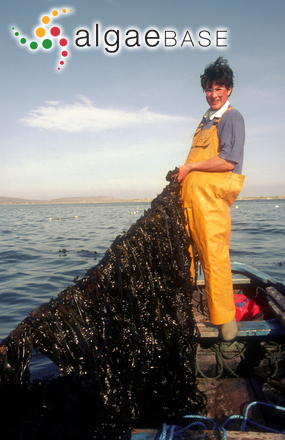
Connemara, Co. Galway, Ireland; cultivation on ropes. Stefan Kraan. © Stefan Kraan.


Bay of Fundy, New Brunswick, Canada. Colin Bates. © Coastal Imageworks.


Spiddal, Co. Galway, Ireland; fronds exposed at low water. 18 Apr 2003. Michael Guiry. © Michael Guiry.


Spiddal, Co. Galway, Ireland; fronds exposed at low water; note the fertile sporophylls. 18 Apr 2003. Michael Guiry. © Michael Guiry.


Spiddal, Co. Galway, Ireland; fertile sporophylls. 18 Apr 2003. Michael Guiry. © Michael Guiry.


Spiddal, Co. Galway, Ireland; fronds exposed at low water; note the fertile sporophylls; 16-mm lens. 18 Apr 2003. Michael Guiry. © Michael Guiry.

1  2  3  Next

21 Found - Displaying 1 through 10


DSC_0460

Alaria esculenta (Linnaeus) Greville Spiddal, Co. Galway, Ireland; fronds exposed at low water

Publication details
Alaria esculenta (Linnaeus) Greville 1830: xxxix, 25

Original publication: Greville, R.K. (1830). Algae britannicae, or descriptions of the marine and other inarticulated plants of the British islands, belonging to the order Algae; with plates illustrative of the genera. pp. [i*-iii*], [i]-lxxxviii, [1]-218, pl. 1-19. Edinburgh & London: McLachlan & Stewart; Baldwin & Cradock.
 Download PDF

Type species
This is the type species (lectotype) of the genus Alaria.

Status of name
This name is of an entity that is currently accepted taxonomically.

Basionym
Fucus esculentus Linnaeus

Type information
Type locality: Atlantic Ocean (Widdowson 1971: 31). Lectotype: LINN 1274.63 (Widdowson 1971: 31).

Origin of species name
Adjective (Latin), edible (Stearn 1973).

Homotypic Synonym(s)
Fucus esculentus Linnaeus 1767
Ceramium esculentum (Linnaeus) Stackhouse 1801
Musaefolia esculenta (Linnaeus) Stackhouse 1809
Orgyia esculenta (Linnaeus) Stackhouse 1816
Laminaria esculenta (Linnaeus) C.Agardh 1817
Phasgonon esculentum (Linnaeus) S.F.Gray 1821
Agarum esculentum (Linnaeus) Bory de Saint-Vincent 1826
Podopteris esculentum (Linnaeus) De la Pylaie 1830

Heterotypic Synonym(s)
Fucus pinnatus Gunnerus 1766
Fucus teres Goodenough & Woodward 1797
Fucus esculentus var. ß minor Turner 1802
Phasgonon esculentum var. minus S.F.Gray 1821
Agarum delisei Bory de Saint-Vincent 1826
Laminaria musaefolia Bachelot de la Pylaie 1830
Alaria delisii (Bory) Greville 1830
Laminaria musaefolia var. ß remotifolia Bachelot de la Pylaie 1830
Orgyia delisii (Bory de Saint-Vincent) Trevisan 1845
Phasganon macropterum Ruprecht 1850
Alaria grandifolia J.Agardh 1872
Alaria musaefolia (Bachelot de la Pylaie) J.Agardh 1872
Orgyia pinnata Gobi 1878
Alaria esculenta f. australis Kjellman 1883
Alaria esculenta f. musaefolia (Pylaie) Kjellman 1883
Alaria dolichorhachis Kjellman 1883
Alaria esculenta f. fasciculata Strömfelt 1886
Alaria esculenta f. pinnata (Gobi) Foslie 1886
Alaria linearis Strömfelt 1886
Alaria esculenta var. ß pinnata (Gobi) Kjellman 1890
Alaria platyrhiza Kjellman 1906
Alaria macroptera (Ruprecht) Yendo 1919

General environment
This is a Marine species.

Common names

(as Alaria esculenta (Linnaeus) Greville)
English: Dabberlocks (Dickinson 1963), Edible Kelp (Madlener 1977), Honeyware (Madlener 1977), Wing Kelp (Madlener 1977), Bladderlochs (Madlener 1977), Tangle (Madlener 1977, Madlener 1977), Murlins (Madlener 1977), Henware (Madlener 1977).

Icelandic: Marinkjarni (Madlener 1977).

Common names used in commerce, often for edible algae
babberlocks {Eng}; bladder locks {Eng}; essbarer riementang {Ger}; alimentaire varech {Fr}; edible fucus {Eng}; "locks, bladder"; "fucus, edible"

Usage notes
Irish common names are also often used for Laminaria saccharina.

Description
Plants with olive or yellow-brown fronds to 4 m long and 25 cm wide. Attached by a root-like holdfast at the base from which a narrow flexible stipe arises which continues into the leafy part of the plant as a distinct mid-rib. The reproductive structures, apparent as dark-brown areas, are confined to unbranched leafy appendages borne on the stipe, usually in two rows. This is the only kelp-like plant in Ireland and Britain with a distinct midrib and is the only one with sporangia borne at the base of the frond in special leaflets called sporophylls.

Habitat
Generally growing on rock in very exposed places, often forming a band at low water and in the shallow subtidal, but also occurring in tidal pools in the lower shore.

Detailed distribution with sources
(as Fucus esculentus Linnaeus)
Ireland: Wexford (Tighe 1803).

Europe: Ireland (Tighe 1803).

(as Fucus teres Goodenough & Woodward)
Ireland: Wexford (Tighe 1803).

Europe: Ireland (Tighe 1803).

(as Alaria esculenta (Linnaeus) Greville)
Arctic: Canada (Arctic) (Taylor 1957, Widdowson 1971, Lee 1980), Russia (Arctic) (Widdowson 1971).

Ireland: Antrim (Drummond 1837, Dickie 1871, Hanna 1902, Adams 1907, Guiry 1978, Morton 1994), Clare (Pybus 1977, Guiry 1978, De Valéra et al. 1979), Cork (Cullinane 1971, Guiry 1978), Derry (Morton 1994), Donegal (Guiry 1978, Maggs & Guiry 1982, Morton 2003), Down (Morton 1974, Guiry 1978, Morton 1994), Galway (Guiry 1978, De Valéra et al. 1979), Kerry (Guiry 1978), Mayo (Cotton 1912, Guiry 1978), Sligo (Cullinane 1970), Waterford (Guiry 1977, Guiry 1978), Wexford (Cotton 1913, Parkes & Scannell 1969, Norton 1970, Guiry 1978).

Europe: Britain (Newton 1931, Widdowson 1971, Hardy & Guiry 2003), E. Greenland (Pedersen 1976), Faroes (Widdowson 1971, Irvine 1982, Nielsen & Gunnarsson 2001), France (Feldmann 1954, Widdowson 1971, Dizerbo & Herpe 2007, Loiseaux-de Goër & Noailles 2008), Greenland (Widdowson 1971), Helgoland (Bartsch & Kuhlenkamp 2000), Iceland (Widdowson 1971, Caram & Jónsson 1972), Ireland (Adams 1907, Cotton 1912, Cotton 1913, Cullinane 1971, Guiry 1977, Pybus 1977, Guiry 1978, De Valéra et al. 1979, Morton 1994), Netherlands (Stegenga & Mol 1983, Gittenberger et al. 2010 ), Norway (Widdowson 1971, Rueness 1997), Scandinavia (Athanasiadis 1996), Spitsbergen (Vinogradova 1995).

North America: Alaska (Lindstrom 1977), Labrador (Taylor 1957), Maine (Mathieson et al. 2001), Maritime Provinces (Widdowson 1971), Massachusetts (Taylor 1957), New Hampshire (Mathieson & Hehre 1986), New York (Taylor 1957), Newfoundland (Taylor 1957), Northwest Territory (Lane & Saunders 2005), Quebec (Taylor 1957), Rhode Island (Taylor 1957).

Asia: Kurile Islands (Widdowson 1971), Sakhalin Island (Widdowson 1971), Sea of Okhotsk (Widdowson 1971).

(as Alaria grandifolia J.Agardh)
Arctic: Canada (Arctic) (Lee 1980).

Europe: Greenland (Widdowson 1971), Scandinavia (Athanasiadis 1996), Spitsbergen (Widdowson 1971, Vinogradova 1995).

North America: Labrador (Widdowson 1971), Massachusetts (Taylor 1957).

Asia: Kurile Islands (Widdowson 1971), Sakhalin Island (Widdowson 1971).

(as Alaria musaefolia (Bachelot de la Pylaie) J.Agardh)
North America: Maine (Taylor 1957), Newfoundland (Taylor 1957), Quebec (Taylor 1957).

(as Alaria dolichorhachis Kjellman)
Arctic: Russia (Arctic) (Athanasiadis 1996).

(as Alaria linearis Strömfelt)
Europe: Iceland (Athanasiadis 1996).

(as Alaria macroptera (Ruprecht) Yendo)
Asia: Korea (Lee & Kang 2001).

Key references
Braune, W. (2008). Meeresalgen. Ein Farbbildführer zu den verbreiteten benthischen Grün- Braun- und Rotalgen der Weltmeere. pp. [1]-596, 266 pls. Ruggell: A.R.G. Gantner Verlag.

Gittenberger, A., Rensing, M., Stegenga, H. & Hoeksema, B. (2010). Native and non-native species of hard substrata in the Dutch Wadden Sea. Nederlandse faunistische Mededelingen No. 33: 21-75.

Lane, C.E. & Saunders, G.W. (2005). Molecular investigation reveals epi/endophytic extrageneric kelp (Laminariales, Phaeophyceae) gametophytes colonizing Lessoniopsis littoralis thalli. Botanica Marina 48: 426-436.

Loiseaux-de Goër, S. & Noailles, M.-C. (2008). Algues de Roscoff. pp. [1]-215, col. figs. Roscoff: Editions de la Station Biologique de Roscoff.

Widdowson, T.B. (1971). A taxonomic revision of the genus Alaria Greville. Syesis 4: 11-49.

SAG Cultures
No records have been found on the SAG site.

NCBI Nucleotide Sequences
As of 2 June 2009, nucleotide sequence data are available at http://www.ncbi.nlm.nih.gov/Genbank for 61 samples identified as Alaria esculenta.

KU-MACC Cultures
Strain Number: KU-1166, Alaria esculenta
Go to KU-MACC Site

Created: 31 March 1996 by M.D. Guiry

Verified by: 03 August 2010 by M.D. Guiry

Accesses: This record has been accessed by users 7620 times since it was created.

References
(Please note: only references with the binomials in the title are included. The information is from the Literature database.)


Buggeln, R.G. & Varangu, L.K. (1983). The cross-wing translocation pathway in the blade of Alaria esculenta (Laminariales, Phaeophyta). Phycologia 22: 205-209, 6 figs.
Buggeln, R.G. (1974). Negative phototropism of the haptera of Alaria esculenta (Laminariales). Journal of Phycology 10: 80-82, 2 figs, 1 table.
Buggeln, R.G. (1974). Physiological investigations on Alaria esculenta (L.) Grev. (Laminariales) I. Elongation of the blade. Journal of Phycology 10: 283-288.
Buggeln, R.G. (1976). The rate of translocation in Alaria esculenta (Laminariales, Phaeophyceae). Journal of Phycology 12: 439-442.
Buggeln, R.G. (1977). Physiological investigations on Alaria esculenta (Lamniariales, Phaeophyceae) II. Role of translocation in blade growth. Journal of Phycology 13: 212-218.
Buggeln, R.G. (1978). Physiological investigations on Alaria esculenta (Laminariales, Phaeophyceae). IV. Inorganic and organic nitrogen in the blade. Journal of Phycology 14: 156-160, 5 figs.
Buggeln, R.G. (1978). Physiological investigations on Alaria esculenta (Laminariales, Phaeophyceae) III. Exudation by the blade. Journal of Phycology 14: 54-56.
Buggeln, R.G. (1981). Note: Source-sink relationship in the blade of Alaria esculenta (Laminariales, Phaeophyceae). Journal of Phycology 17: 102-104, 2 figs, 1 table.
Garbary, D.J. & Clarke, B. (2002). Intraplant variation in nuclear DNA content in Laminaria saccharina and Alaria esculenta (Phaeophyceae). Botanica Marina 45: 211-216.
Han, T. & Kain (Jones), J.M. (1993). Note: Blue light photoreactivation in ultraviolet-irradiated young sporophytes of Alaria esculenta and Laminaria saccharina (Phaeophyta). Journal of Phycology 29: 79 -81, 3 figs, 1 table.
Kraan, S. & Guiry, M.D. (2000). Molecular and morphological character inheritance in hybrids of Alaria esculenta and A. praelonga (Alariaceae, Phaeophyceae). Phycologia 39: 554-559.
Kraan, S. & Guiry, M.D. (2001). Phase II: Strain hybridisation field experiments and genetic fingerprinting of the edible brown seaweed Alaria esculenta. Marine Resource Series 18: [i]-vi, 1-33.
Kraan, S., Rueness, J. & Guiry, M.D. (2001). Are North Atlantic Alaria esculenta and A. grandifolia (Alariaceae, Phaeophyceae) conspecific?. European Journal of Phycology 39: 35-42.
Kraan, S., Tramullas, A.V. & Guiry, M.D. (2000). The edible brown seaweed Alaria esculenta (Phaeophyceae, Laminariales): hybridization, growth and genetic comparisons of six Irish populations. Journal of Applied Phycology 12: 577-583.
Laycock, M.V. (1975). The amino acid sequence of cytochrome f from the brown alga Alaria esculenta (L.) Grev.. Biochem. J. 149: 271-279.
Minchin, D. (1992). Extensive grazing of the prosobranch Lacuna vincta (Montagu) on the kelp Alaria esculenta (L.) Grev.. Irish Naturalists' Journal 24: 171.
Munda, I.M. & Lüning, K. (1977). Growth performance of Alaria esculenta off Helgoland. Helgoländer Wissenschaftliche Meeresuntersuchungen 29: 311-314.
Sundene, O. (1962). The implications of transplant and culture experiments on the growth and distribution of Alaria esculenta. Nytt Magasin for Botanikk 9: 155-174.
Walton, A.J. (1986). Maturation of gametophytes of Alaria esculenta. British Phycological Journal 21: 338.

SITE © 1996 - 2010 M.D. Guiry. All rights reserved.

Website Design : 249 Design Studio