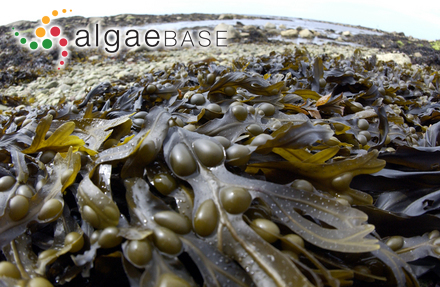
Fucus vesiculosus Linnaeus
Classification:
Empire Eukaryota
Kingdom Chromista
Subkingdom Chromobiota
Infrakingdom Heterokonta
Phylum Heterokontophyta
Class Phaeophyceae
Order Fucales
Family Fucaceae
Genus Fucus
- Uses and Compounds
- Taxonomy
- References
- Submit Feedback
- Submit Reference
- Links
- Genbank
- Index Nominum Algarum
Pictures:
click on thumbnail for larger version.
![]()
Trá na Reilige, an Cheathrú Rua, Co. na Gaillimhe; 10.5-mm lens. 21 Aug 2008. M.D. Guiry.
![]()
Céibh an tSrutháin, an Cheathrú Rua, Co. na Gaillimhe; 10.5-mm lens. 28 Jun 2008. M.D. Guiry.
![]()
Céibh an tSrutháin, an Cheathrú Rua, Co. na Gaillimhe; 10.5-mm lens. 28 Jun 2008. M.D. Guiry.
![]()
Trá na Reilige, An Cheathrú Rua, Co. na Gaillimhe. 28 Jun 2008. M.D. Guiry.
![]()
Trá na Reilige, an Cheathrú Rua, Co. na Gaillimhe. 28 Jun 2008. M.D. Guiry.
![]()
Spiddal, Co. Galway, Ireland; old plants on barnacle-covered rocks in the mid-intertidal. 29 Sep 2007. M.D. Guiry.
![]()
Silver Strand, Co. Galway, Ireland; fisheye lens; paired vesicles. 01 Sep 2007. M.D. Guiry.
![]()
Silver Strand, Co. Galway, Ireland; fisheye lens; paired vesicles; obvious midrib; dichotomous branching. 01 Sep 2007. M.D. Guiry.
![]()
Silver Strand, Co. Galway, Ireland; fisheye lens; vesicles. 01 Sep 2007. M.D. Guiry.
![]()
Silver Strand, Co. Galway, Ireland; fisheye lens. 01 Sep 2007. M.D. Guiry.
27 Found - Displaying 1 through 10
Publication details
Fucus vesiculosus Linnaeus 1753: 1158
Original publication: Linnaeus, C. (1753). Species plantarum, exhibentes plantas rite cognitas, ad genera
relatas, cum differentiis specificis, nominibus trivialibus, synonymis selectis, locis natalibus, secundum systema sexuale digestas. Vol. 2 pp. [i], 561-1200, [1-30, index], [i, err.]. Holmiae [Stockholm]: Impensis Laurentii Salvii.
Download PDF
Original description:
Download PDF
Type species
This is the type species (lectotype) of the genus Fucus.
Status of name
This is regarded as a current name.
Origin of species name
Adjective (Latin), covered with little bladders or blisters (Stearn 1973).
Synonym(s)
Fucus inflatus Linnaeus 1753
Fucus divaricatus Linnaeus 1753
Fucus excisus Forsskål 1775
Fucus vesiculosus var. divaricatus (Linnaeus) Goodenough & Woodward 1797
Halidrys vesiculosus (Linnaeus) Stackhouse 1809
Fucus vesiculosus var. rigidus Wahlenberg 1812
Fucus balticus C. Agardh 1814
Fucus vesiculosus var. angustifolius C. Agardh 1817
Fucus vesiculosus var. nanus C. Agardh 1817
Fucus vesiculosus var. subecostatus C. Agardh 1817
Fucus vesiculosus f. acutus Lyngbye 1819
Fucus vesiculosus var. filiformis C. Agardh 1819
Fucus vesiculosus var. alternans C. Agardh 1820
Fucus vesiculosus var. grandifrons C. Agardh 1821
Fucus vesiculosus var. ceratiformis Wahlenberg 1826
Fucus vesiculosus var. laterifructus Greville 1828
Fucus vesiculosus var. chondriformis J. Agardh 1836
Fucus vesiculosus var. balticus (C. Agardh) Areschoug 1847
Fucus ceranoides Areschoug 1847
Fucus axillaris var. subecostatus J. Agardh 1868
Fucus vesiculosus subsp. pseudoceranoides Areschoug 1868
Fucus vesiculosus var. sphaerocarpus J. Agardh 1872
Fucus vesiculosus f. vadorum (Areschoug) Kleen 1874
Fucus vesiculosus f. pseudoceranoides (Areschoug) Kleen 1874
Fucus vesiculosus f. sphaerocarpus (J.Agardh) Kleen 1874
Fucus vesiculosus f. angustifrons Gobi 1878
Fucus axillaris f. balticus (C.Agardh) Kjellman 1880
Fucus vesiculosus var. spiralis Farlow 1881
Fucus vesiculosus f. turgidus Kjellman 1883
Fucus vesiculosus f. angustifolius (C. Agardh) Kjellman 1890
Fucus vesiculosus f. filiformis (C.Agardh) Kjellman 1890
Fucus vesiculosus f. nanus (C.Agardh) Kjellman 1890
Fucus vesiculosus f. plicatus Kjellman 1890
Fucus vesiculosus f. subecostatus (C.Agardh) Kjellman 1890
Fucus vesiculosus f. racemosus Kjellman 1890
Fucus vesiculosus f. tenuis Kjellman 1890
Fucus vesiculosus var. rotundatus Kjellman 1890
Fucus vesiculosus f. crispus Kjellman 1890
Fucus vesiculosus f. flabellatus Kjellman 1890
Fucus vesiculosus f. robustus Kjellman 1890
Fucus vesiculosus f. subglobosus Kjellman 1890
Fucus vesiculosus f. terminalis Kjellman 1890
Fucus vesiculosus f. turgidus (Kjellman) Kjellman 1890
Fucus vesiculosus f. vadorum (Areschoug) Kjellman 1890
Fucus vesiculosus f. lanceolatus Kjellman 1890
Fucus vesiculosus f. angustifrons (Gobi) Kjellman 1890
Fucus vesiculosus f. fluviatilis Kjellman 1890
Fucus vesiculosus f. abbreviatus Kjellman 1890
Fucus vesiculosus f. latus Kjellman 1890
Fucus vesiculosus f. subfusiformis Kjellman 1890
Fucus vesiculosus f. elongatus Kjellman 1890
Virsodes vesiculosum (Linnaeus) Kuntze 1891
Fucus vesiculosus f. limicola F.S. Collins 1906
Fucus vesiculosus f. balticus (C. Agardh) Dannenberg 1927
Fucus vesiculosus var. aestuarii Lami 1938
Fucus vesiculosus f. balticus Levring 1940
General environment
This is a Marine species.
Common names
(as Fucus vesiculosus Linnaeus)
English: Bladder Wrack (Dickinson 1963).
Common names used in commerce, often for edible algae
lady wrack {Eng}; sea ware {Eng}; black tang {Eng}; bladder fucus {Eng}; chOne marin {Fr}; bladder wrack rockweed {Eng}; fucus {Sp & Mex}; "fucus, bladder"; "tang, black"; "ware, sea"; "wrack, lady"; "rockweed, bladder wrack"
Type information
Type locality: "Habitat in Mari Atlantico" (Atlantic Ocean) (Linnaeus 1753: 1158).
Detailed distribution with sources
(as Fucus vesiculosus Linnaeus)
Arctic: Canada (Arctic) (Taylor 1957, Lee 1980).
Ireland: Antrim (Drummond 1837, Adams 1907, Guiry 1978, Morton 1994), Clare (Guiry 1978, De Valéra & Cooke 1979), Cork (Renouf 1931, Cullinane 1971, Cullinane, McCarthy & Fletcher 1975, Guiry 1978), Derry (Guiry 1978, Morton 1994), Donegal (Guiry 1978, Morton 2003), Down (Morton 1974, Guiry 1978, Morton 1994), Dublin (Guiry 1978), Galway (Guiry 1978), Kerry (Guiry 1978), Leitrim (Cullinane 1970, Guiry 1978), Limerick (Cullinane 1969, Guiry 1978), Louth (Synnott 1969, Guiry 1978), Mayo (Cotton 1912, Guiry 1978), Sligo (Cullinane 1970), Waterford (Guiry 1978), Wexford (Tighe 1803, Cotton 1913, Parkes & Scannell 1969, Norton 1970, Guiry 1978), Wicklow (Guiry 1978).
Europe: Baltic Sea (Nielsen et al. 1995), Belgium (Coppejans 1995), Britain (Newton 1931, Hardy & Guiry 2003), Denmark (Larsen & Sand-Jensen 2006), E. Greenland (Pedersen 1976), Faroes (Irvine 1982, Nielsen & Gunnarsson 2001), France (Feldmann 1954, Coppejans 1995, Billard et al. 2005, Billard et al 2006, Dizerbo & Herpe 2007, Loiseaux-de Goër & Noailles 2008), Helgoland (Bartsch & Kuhlenkamp 2000), Ireland (Adams 1907, Cotton 1912, Cotton 1913, Cullinane 1969, Cullinane 1971, Guiry 1978, De Valéra et al. 1979, Morton 1994, Nygard & Dring 2008), Netherlands (Stegenga & Mol 1983, Stegenga, Kaaremans & Simons 2007), Norway (Rueness 1997), Portugal (De Mesquita Rodrigues 1963, Ardré 1970, Billard et al 2006, Araujo et al. 2009, Araújo, Bárbara & Sousa-Pinto in press), Scandinavia (Athanasiadis 1996), Spain (Roxas Clemente y Rubio 1807, Lázaro Ibiza 1889, Sauvageau 1897, Sauvageau 1913, Hamel 1928, Miranda 1931, Fischer-Piette 1955, González Guerrero 1957, Seoane-Camba 1957, Ardré 1957, Fischer-Piette, C. & Seoane Camba, J. (1962), Seoane-Camba 1965, Pérez-Cirera & Maldonado 1982, Fernández & Niell 1982, Fernández, Niell & Anadón 1983, Anadón 1983, Gallardo et al. 1985, Fernández 1985, Pérez-Cirera 1989, Ribera et al. 1992, Granja, Cremades & Barbara 1992, Conde Poyales 1992, Flores-Moya et al. 1994, Flores-Moya et al. 1995, Bárbara & Cremades 1996, Veiga, Cremades & Bárbara 1998, López-Rodríguez & Pérez-Cirera 1998, Calvo, Bárbara & Cremades 1999, Veiga Villar 1999, López-Rodríguez, Bárbara & Pérez-Cirera 1999, Calvo & Bárbara 2002, Peña & Bárbara 2002, Gorostiaga et al., 2004, Bárbara et al. 2005, Lobón et al. 2008, Viejo et al. 2008, Mercado et al. 2009), Spitsbergen (Vinogradova 1995), Sweden (Kylin 1947, Tolstoy & Österlund 2003, Malm, Kautsky & Claesson 2003, Bergström et al 2005, Pearson et al 2006, Nygard & Dring 2008).
Atlantic Islands: Azores (Neto 1994), Bermuda (Taylor 1960), Canary Islands (Price, John & Lawson 1978, Gil-Rodríguez & Afonso-Carrillo 1980, Haroun et al. 2002, Gil-Rodríguez et al. 2003, John et al. 2004), Madeira (John et al. 2004).
North America: Maine (Mathieson et al. 2001, Wallace et al. 2004, Mathieson et al 2006), Massachusetts (Mathieson et al 2006), New Hampshire (Mathieson & Hehre 1986, Mathieson & Dawes 2002), North Carolina (Taylor 1957, Schneider & Searles 1991), Nova Scotia (Garbary et al 2006), Virginia (Humm 1979).
Caribbean Islands: West Indies (Taylor 1960).
South America: Brazil (Taylor 1930, Taylor 1960).
Africa: Morocco (Dangeard 1949).
(as Fucus inflatus Linnaeus)
Europe: E. Greenland (Lund 1959), Sweden (Kylin 1947).
North America: Alaska (Lindstrom 1977).
(as Fucus vesiculosus var. divaricatus (Linnaeus) Goodenough & Woodward)
Europe: Britain (Newton 1931).
(as Fucus balticus C. Agardh)
Europe: France (Dizerbo & Herpe 2007).
(as Fucus vesiculosus var. angustifolius C. Agardh)
Ireland: Derry (Morton 1994).
Europe: Ireland (Morton 1994), Portugal (De Mesquita Rodrigues 1963, Ardré 1970).
(as Fucus vesiculosus var. laterifructus Greville)
Ireland: Mayo (Cotton 1912).
Europe: Britain (Newton 1931), Ireland (Cotton 1912).
North America: Connecticut (Taylor 1957), Maine (Taylor 1957), Massachusetts (Taylor 1957), New Jersey (Taylor 1957).
(as Fucus vesiculosus var. balticus (C. Agardh) Areschoug)
Ireland: Mayo (Cotton 1912).
Europe: Britain (Newton 1931), Ireland (Cotton 1912).
(as Fucus vesiculosus subsp. pseudoceranoides Areschoug)
Europe: Scandinavia (Athanasiadis 1996).
(as Fucus vesiculosus var. sphaerocarpus J. Agardh)
Europe: Britain (Newton 1931).
North America: Connecticut (Taylor 1957), Maine (Taylor 1957), Massachusetts (Taylor 1957), Quebec (Taylor 1957).
(as Fucus vesiculosus var. aestuarii Lami)
Europe: Portugal (De Mesquita Rodrigues 1963, Ardré 1970).
Taxonomic notes
John et al. (2004) cite Fucus lutarius (Kütz.) Sidi-Moussa as a synonym of this species.
Key references
Braune, W. (2008). Meeresalgen. Ein Farbbildführer zu den verbreiteten benthischen Grün- Braun- und Rotalgen der Weltmeere. pp. [1]-596, 266 pls. Ruggell: A.R.G. Gantner Verlag.
Cho, G.Y, Rousseau, F., Reviers, B. de & Boo, S.M. (2006). Phylogenetic relationships within the Fucales (Phaeophyceae) assessed by the photosystem I coding psaA sequences. Phycologia 45: 512-519.
Garbary, D.J., Brackenbury, A., McLean, A.M. & Morrison, D. (2006). Structure and development of air bladders in Fucus and Ascophyllum (Fucales, Phaeophyceae). Phycologia 45: 557-566.
Larsen, A. & Sand-Jensen, K. (2005). Salt tolerance and distribution of estuarine benthic macroalgae in the Kattegat-Baltic Sea area. Phycologia 45: 13-23.
Loiseaux-de Goër, S. & Noailles, M.-C. (2008). Algues de Roscoff. pp. [1]-215, col. figs. Roscoff: Editions de la Station Biologique de Roscoff.
Mathieson, A.C., Dawes, C.J., Wallace, A.L. & Klein, A.S. (2006). Distribution, morphology, and genetic affinities of dwarf embedded Fucus populations from the Northwest Atlantic Ocean.. Botanica Marina 49: 283-303.
Moss, B.L. (1950). Studies in the genus Fucus III. Structure and development of the attaching discs of Fucus vesiculosus. Annals of Botany 14: 411-419.
Moss, B.L. (1950). Studies in the Genus Fucus. II. The anatomical structure and chemical composition of receptacles of Fucus vesiculosus from three contrasting habitats. Annals of Botany 14(55): 395-410.
Nägeli, C. (1849). Gattungen einzelliger Algen, physiologisch und systematisch bearbeitet. Neue Denkschriften der Allg. Schweizerischen Gesellschaft für die Gesammten Naturwissenschaften 10(7): i-viii, 1-139, pls I-VIII.
Pearson, G., Lago-Leston, A., Valente, M. & Serrao, E. (2006). Simple and rapid RNA extraction from freeze-dried tissue of brown algae and seagrasses. European Journal of Phycology 41: 97-104.
Perrin, C., Daguin, C., Van de Vliet, M., Engel, C.R., Pearson, G.A., & Serráo,E.A. (2007). Implications of mating system for genetic diversity of sister algal species: Fucus spiralis and Fucus vesiculosus (Heterokontophyta, Phaeophyceae). European Journal of Phycology 42: 219-230.
Peters, A.F., Marie, D., Scornet, D., Kloareg, B. & Cock, J.M. (2004). Proposal of Ectocarpus siliculosus (Ectocarpales, Phaeophyceae) as a model organism for brown algal genetics and genomics. Journal of Phycology 40: 1079-1088.
Wallace, A.L., Klein, A.S. & Mathieson, A.C. (2004). Determining the affinities of salt marsh fucoids using microsatellite markers: evidence of hybridization and introgression between two species of Fucus (Phaeophyta) in a Maine estuary . Journal of Phycology 40: 1013-1027.
NCBI Nucleotide Sequences
As of 2 June 2009, nucleotide sequence data are available at http://www.ncbi.nlm.nih.gov/Genbank for 4,631 samples identified as Fucus vesiculosus.
Created: 31 March 1996 by M.D. Guiry
Verified by: 22 August 2009 by M.D. Guiry
Accesses: This record has been accessed by users 49274 times since it was created.
References
(Please note: only references with the binomials in the title are included. The information is from the Literature database.)
Alam, M., Chakravarti, A. & Ikawa, M. (1971). Lipid composition of the brown alga Fucus vesiculosus. Journal of Phycology 7: 267-268, 1 fig, 1 table.
Arnold, T.M., Targett, N.M., Tanner, C.E., Hatch, W.I. & Ferrari, K.E. (2001). Evidence for methyl jasmonate-induced phlorotannin production in Fucus vesiculosus (Phaeophyceae) (Note). Journal of Phycology 37: 1026-1029.
Baardseth, E. & Cuesta, M.A. (1983). Relationship between the diatom Navicula endophytica Hasle and the brown alga Fucus vesiculosus L., a statistical study. Sarsia 68: 165-169.
Berger, R., Malm, T. & Kautsky, L. (2001). Two reproductive strategies in Baltic Fucus vesiculosus (Phaeophyceae). European Journal of Phycology 36: 265-274.
Billard, E., Daguin, C., Pearson, G., Serrao, E., Engel C. & Valero M. (2005). Genetic isolation between three closely related taxa: Fucus vesiculosus, F. spiralis and F. ceranoides (Phaeophyceae). Journal of Phycology 41(4): 900-905.
Billard, E., Serrao, E.A., Pearson, G.A., Engel, C.R., Destombe, C. & Valero, M. (2006). Analysis of sexual phenotype and prezygotic fertility in natural populations of Fucus spiralis, F. vesiculosus (Fucaceae, Phaeophyceae) and their putative hybrids. European Journal of Phycology 40(4): 397-407.
Bonsdorff, E. & Nelson, W.G. (1996). Apical growth-measurements of Fucus vesiculosus L.: Limited value in monitoring. Botanica Marina 39: 129-132.
Borowczak, E., Kentzer, T. & Potulska-Klein, B. (1977). Effect of gibberellin and kinetin on the regeneration ability of Fucus vesiculosus L.. Biol. Plant. (Praha) 19: 405-412.
Bäck, S., Collins, J.C. & Russell, G. (1991). Effects of salinity on growth of Baltic and Atlantic Fucus vesiculosus. British Phycological Journal 26: 81-82.
Bäck, S., Collins, J.C. & Russell, G. (1992). Comparative ecophysiology of Baltic and Atlantic Fucus vesiculosus. Marine Ecology Progress Series 84: 71-82.
Bäck, S., Collins, J.C. & Russell, G. (1992). Effects of salinity on growth of Baltic and Atlantic Fucus vesiculosus. British Phycological Journal 27: 39-47.
Bäck, S., Collins, J.C.C. & Russell, G. (1990). Reproductive biology of Baltic Fucus vesiculosus. British Phycological Journal 25: 84.
Carlson, L. (1991). Seasonal variation in growth, reproduction and nitrogen content of Fucus vesiculosus L. in the Öresund, Southern Sweden. Botanica Marina 34: 447-453, 7 figs.
Chambers, J. A. & Burnett, J. H. (1958). Metabolic studies on Fucus vesiculosus. Proceedings of the International Seaweed Symposium 3: 22.
Chapman, A. R. O. (1990). Competitive interactions between Fucus spiralis L. and Fucus vesiculosus L. (Fucales, Phaeophyta). Proceedings of the International Seaweed Symposium 13: 205-209.
Collén, J. & Davison, I.R. (2001). Seasonality and thermal acclimation of reactive oxygen metabolism in Fucus vesiculosus (Phaeophyceae). Journal of Phycology 37: 474-481.
Coudret, A., Feron, F. & Giraud, G. (1985). Effets d'une émersion prolongée sur le métabolisme photosynthétique de Fucus vesiculosus en culture expérimentale. Physiol. Vég. 23: 155-161.
Craigie, J.S., McInnes, A.G., Ragan, M.A. & Walter, J.A. (1977). Chemical constituents of the physodes of brown algae. Characterization by 1H and 13C nuclear magnetic resonance spectroscopy of oligomers of phloroglucinol from Fucus vesiculosus (L.). Can. J. Chem. 55: 1575-1582.
Creed, J.C., Kain (Jones), J.M. & Norton, T.A. (1992). The importance of density and self-thinning in a population of Fucus vesiculosus. British Phycological Journal 27: 87.
Derenbach, J.B. & Gereck, M.V. (1980). Interference of petroleum hydrocarbons with the sex pheromone reaction of Fucus vesiculosus. Journal of Experimental Marine Biology and Ecology 44: 61-65.
Ekelund, N.G.A., Nygård, C.A., Nordström, R. & Gylle, A.M. (2009). In situ study of relative electron transport rates in the marine macroalga Fucus vesiculosus in the Baltic Sea at different depths and times of year. Proceedings of the International Seaweed Symposium 19: 301-306, 1 fig, 3 tables.
Eriksson, B.K. & Johansson, G. (2003). Sedimentation reduces recruitment success of Fucus vesiculosus (Phaeophyceae) in the Baltic Sea. European Journal of Phycology 38: 217-222.
Fischer-Piette, E. (1961). Sur l'ecologie de la non-vesiculisation de Fucus vesiculosus L.. Rev Gen Bot. 68: 302-316.
Floc'h, J.-Y. & Penot, M. (1981). Translocation of 32p and 86Rb in some brown algae (Laminaria digitata and Fucus vesiculosus): influence of metabolism and sinks. Proceedings of the International Seaweed Symposium 8: 176-187.
Fulcher, R.G. & McCully, M.E. (1969). Laboratory culture of the intertidal brown alga Fucus vesiculosus. Canadian Journal of Botany 47: 219-222.
Gledhill, M., Nimmo, M., Hill, S.J. & Brown, M.T. (1999). The release of copper-complexing ligands by the brown alga Fucus vesiculosus (Phaeophyceae) in response to increasing total copper levels. Journal of Phycology 35: 501-509, 6 figs, 4 tables.
Gylle, A.M., Isaksson, D., Ekelund, N.G.A. (2009). Ecotype differentiation in qualitative content of water soluble organic compounds between marine and brackish Fucus vesiculosus L. (Phaeophyceae). Phycological Research 57(2): 127-130.
Gylle, A.M., Nygård, C.A. & Ekelund, N.G.A. (2009). Desiccation and salinity effects on marine and brackish Fucus vesiculosus L. (Phaeophyceae). Phycologia 48(3): 156-164, 4 figs, 2 tables.
Ikawa, M., Alam, M. & Chakravarti, A. (1971). Lipid composition of the brown alga Fucus vesiculosus. Journal of Phycology 7: 267-268.
Jensen, A. (1964). Ascorbic acid in Ascophyllum nodosum, Fucus serratus and Fucus vesiculosus. Proceedings of the International Seaweed Symposium 4: 319-325.
Johnson, S.C. & Scheibling, R.E. (1987). Reproductive patterns of harpacticoid copepods on intertidal macroalgae (Ascophyllum nodosum and Fucus vesiculosus) in Nova Scotia, Canada. Can. J. Zool. 65: 129-141.
Johnson, S.C. & Scheibling, R.E. (1987). Structure and dynamics of epifaunal assemblages on intertidal macroalgae Ascophyllum nodosum and Fucus vesiculosus in Nova Scotia, Canada. Marine Ecology Progress Series 37: 209-227.
Jordan, A.J. & Vadas, R.L. (1972). Influence of environmental parameters on infraspecific variation in Fucus vesiculosus. Marine Biology, Berlin 14: 248-252.
Kalvas, A. & Kautsky, L. (1993). Geographical variation in Fucus vesiculosus morphology in the Baltic and North Seas. European Journal of Phycology 28: 85-91, 7 figs.
Kalvas, A. & Kautsky, L. (1998). Morphological variation in Fucus vesiculosus populations along temperate and salinity gradients in Iceland. J. Mar. Biol. Ass. UK 78: 985-1001, 7 figs, 3 tables.
Kangas, P., Autio, H., Hällfors, G., Luther, H., Niemi, Å. & Salemaa, H. (1982). A general model of the decline of Fucus vesiculosus at Tvärmine, south coast of Finland in 1977-81. Acta Bot. Fen. 118: 1-27.
Kautsky, H., Kautsky, L., Kautsky, N., Kautsky, U. & Lindblad, C. (1992). Studies on the Fucus vesiculosus community in the Baltic Sea. In: Phycological studies of Nordic coastal waters - a festschrift dedicated to Prof. Mats Wærn on his 80th birthday. (Sjögren, E., Wallentinus, I. & Snoeijs, P. Eds) Vol.78, pp. 33-48. Uppsala: Opulus Press AB.
Kautsky, N., Kautsky, H., Kautsky, U. & Waern, M. (1986). Decreased depth penetration of Fucus vesiculosus (L.) since the 1940's indicates eutrophication of the Baltic Sea. Marine Ecology Progress Series 28: 1-8.
Keser, M., Vadas, R.L. & Larson, B.R. (1981). Regrowth of Ascophyllum nodosum and Fucus vesiculosus under various harvesting regimes in Maine, U. S. A.. Botanica Marina 24: 29-38, 2 figs, 6 tables.
Khailov, K.M., Kholodov, V.I., Firsov, Y.K. & Prazulin, A.V. (1978). Thalli of Fucus vesiculosus in ontogenesis: changes in morpho-physiological parameters. Botanica Marina 21: 289-311.
Kiirikki, M. & Ruuskanen, A. (1996). How does Fucus vesiculosus survive ice scraping?. Botanica Marina 39: 133-139.
Kiirikki, M. (1996). Experimental evidence that Fucus vesiculosus (Phaeophyta) controls filamentous algae by means of the whiplash effect. European Journal of Phycology 31: 61-66, 6 figs.
Kim, K.Y., O'Leary, S.J. & Garbary, D.J. (1997). Artificial hybridization between Ascophyllum nodosum and Fucus vesiculosus (Phaeophyceae) from Nova Sotia, Canada. Canadian Journal of Botany 75: 1133-1136.
King, R.J. & Schramm, W. (1976). Determination of photosynthetic rates for the marine algae Fucus vesiculosus and Laminaria digitata. Marine Biology, Berlin 37: 209-213.
Knight, M. & Parke, M. (1950). A biological study of Fucus vesiculosus L. and F. serratus L.. Journal of the Marine Biological Association of the United Kingdom 26: 439-514.
Lehvo, A., Bäck, S. & Kiirikki, M. (2001). Growth of Fucus vesiculosus L. (Phaeophyta) in the Northern Baltic Proper: Energy and Nitrogen storage in seasonal environment. Botanica Marina 44: 345-350.
Liaaen, S. & Sørensen, N. A. (1956). Postmortal changes in the carotenoids of Fucus vesiculosus. Proceedings of the International Seaweed Symposium 2: 25-32.
López Rodríguez, Mª.C. & Pérez-Cirera, J.L. (1995). Aportación al conocimiento de la influencia de la contaminación industrial en Fucus vesiculosus y Fucus spiralis en el N.O. de la Península Ibérica. Studia Botanica 13: 21-29.
López-Rodríguez, M.C. & Pérez-Cirera, J.L. (1998). The effects of different environmental conditions on colonization and succession in the Fucus vesiculosus community on the Galician coasts (Northwestern Iberian Peninsula). Botanica Marina 41: 581-592.
López-Rodríguez, M.C., Bárbara, I. & Pérez-Cirera, J.L. (1999). Effects of pollution on Fucus vesiculosus communities on the northwest Iberian Atlantic coast. Ophelia 51(2): 129-141.
Luther, H. (1981). Occurrence and ecological requirements of Fucus vesiculosus in semi-enclosed inlets of the Archipelago Sea, SW Finland. Ann. Bot. Fen. 18: 187-200.
Müller-Stoll, W. R. (1958). Fucus vesiculosus in der westlichen Ostsee, Okologische und Biochemische verhaltnisse. Proceedings of the International Seaweed Symposium 3: 14-15.
MacDonald, M.A., Fensom, D.S. & Taylor, A.R.A. (1974). Electrical impedance in Ascophyllum nodosum and Fucus vesiculosus in relation to cooling, freezing, and desiccation. Journal of Phycology 10: 462-469.
Malm, T. & Kautsky, L. (2003). Differences in life-history characteristics are consistent with the vertical distribution pattern of Fucus serratus and Fucus vesiculosus (Fucales, Phaeophyceae) in the Central Baltic Sea. Journal of Phycology 39: 880-887.
Malm, T., Kautsky, L. & Claesson, T. (2003). The density and survival of Fucus vesiculosus L. (Fucales, Phaeophyta) on different bedrock types on a Baltic Sea moraine coast. Botanica Marina 46: 256-262.
Manga, N. & Hughes, G. (1981). Heavy metal concentrations in Fucus vesiculosus, Mytilus edulis and Littorina littorea from Carlingford Lough. Irish Naturalists' Journal 20: 302-304.
Margalet, J.L., Almaraz, T., Navarro, M.J. & Pérez-Ruzafa, I.M. (1993). Mapas de distribución de algas marinas de la Península Ibérica. III. Fucus ceranoides L., F. serratus L., F. spiralis L. y F. vesiculosus L. (Fucales, Fucophyceae). Bot. Complutensis 18: 267-290.
Marsden, W.J.N., Evans, L.V., Callow, J.A. & Keen, J.N. (1984). A preliminary electrophoretic comparison of Fucus serratus and Fucus vesiculosus. Botanica Marina 27: 79-83.
McInnes, A.G., Ragan, M.A., Smith, D.G. & Walter, J.A. (1985). The high molecular weight polyphloroglucinols of the marine brown alga Fucus vesiculosus L. 1H and 13C nuclear magnetic resonance spectroscopy. Can. J. Chem. 63: 304-313.
McLachlan, J. & Craigie, J.S. (1964). Algal inhibition by yellow ultraviolet-absorbing substances from Fucus vesiculosus. Canadian Journal of Botany 42: 287-292.
Moss, B. (1958). Growth substances and the regeneration of adventitious branches of Fucus vesiculosus. Proceedings of the International Seaweed Symposium 3: 21.
Moss, B. (1964). Growth and regeneration of Fucus vesiculosus in culture. British Phycological Bulletin 2: 377-380.
Moss, B. (1964). Wound healing and regeneration in Fucus vesiculosus L. Proceedings of the International Seaweed Symposium 4: 117-122.
Moss, B. (1965). Apical dominance in Fucus vesiculosus. New Phytologist 64: 387-392.
Moss, B. (1966). Apical dominance in Fucus vesiculosus. British Phycological Bulletin 3: 154 only.
Moss, B. (1966). Apical dominance in Fucus vesiculosus. Proceedings of the International Seaweed Symposium 5: 179 only.
Moss, B. (1966). Polarity and apical dominance in Fucus vesiculosus. British Phycological Bulletin 3: 31-35, 2 figs, 2 tables.
Moss, B. (1967). The culture of fertile tissue of Fucus vesiculosus. British Phycological Bulletin 3: 209-212.
Moss, B. (1968). The transition from vegetative to fertile tissue in Fucus vesiculosus. British Phycological Bulletin 3: 567-573.
Moss, B.L. (1950). Studies in the genus Fucus III. Structure and development of the attaching discs of Fucus vesiculosus. Annals of Botany 14: 411-419.
Moss, B.L. (1950). Studies in the Genus Fucus. II. The anatomical structure and chemical composition of receptacles of Fucus vesiculosus from three contrasting habitats. Annals of Botany 14(55): 395-410.
Muhlin, J.F. & Brawley, S.H. (2009). Recent versus relic: discerning the genetic signature of Fucus vesiculosus (Heterokontophyta; Phaeophyceae) in the northwestern Atlantic. Journal of Phycology 45(4): 828-837.
Munda, I.M. & Hudnik, V. (1986). Growth responses of Fucus vesiculosus to heavy metals, singly and in dual combinations, as related to accumulation. Botanica Marina 29: 401-412.
Munda, I.M. & Hudnik, V. (1988). The effects of Zn, Mn, and Co accumulation on growth and chemical composition of Fucus vesiculosus L. under different temperatue and salinity conditions.. PSZNI Marine Ecology, 9: 213-225.
Munda, I.M. & Hudnik, V. (1988). The effects of Zn, Mn, and Co accumulation on growth and chemical composition of Fucus vesiculosus L. under different temperature and salinity conditions. Marine Ecology 9: 213-225.
Müller, D.G. & Gassmann, G. (1978). Identification of the sex attractant in the marine brown alga Fucus vesiculosus. Naturwissenschaften 65: 389.
Müller, D.G. & Seferiadis, K. (1977). Specificity of sexual chemotaxis in Fucus serratus and Fucus vesiculosus (Phaeophyceae). Zeit. Pflazenphysiol. 84: 85-94.
Niell, F.X., Miranda, A. & Pazó, J.P. (1980). Studies on the morphology of the Megaecade limicola of Fucus vesiculosus L. with taxonomical comments. Botanica Marina 23: 303-307.
Nyberg, M., Nygård, C.A. & Ekelund, N.G.A. (2002). Impacts of UV radiation on photosynthesis of Fucus vesiculosus at low temperature and different salinities. Verh. Internat. Verein. Limnol. 28: 242-245.
Nygard, C.A. & Dring, M.J. (2008). Influence of salinity, temperature, dissolved inorganic carbon and nutrient concentration on the photosynthesis and growth of Fucus vesiculosus from the Baltic and Irish Seas. European Journal of Phycology 43(3): 253-262.
Nygard, C.A. & Ekelund, N.G.A. (2007). Photosynthesis and UV-B tolerance of the marine alga Fucus vesiculosus at different sea water salinities. Proceedings of the International Seaweed Symposium 18: 235-241.
Parusel, E.S. (1991). Brown algae (Fucus vesiculosus f. mytili) entangled by blue mussels (Mytilus edulis) - a beneficial status of nutrient supply?. British Phycological Journal 26: 93.
Pazó, J.P. & Romaris, X.M. (1979). Estado actual de las poblaciones de Fucus vesiculosus L. (Algae Phaeophyta) en la Ria de Vigo. Acta Bot Malacitana 5: 67-78.
Pearson, G.A. & Evans, L.V. (1990). Settlement and survival of Polysiphonia lanosa (Ceramiales) spores on Ascophyllum nodosum and Fucus vesiculosus (Fucales).. Journal of Phycology 26: 597-603.
Percival, E., Bourne, E. J. & Brush, P. (1969). The active carbohydrate metabolites of Fucus vesiculosus. Proceedings of the International Seaweed Symposium 6: 575-577.
Perrin, C., Daguin, C., Van de Vliet, M., Engel, C.R., Pearson, G.A., & Serráo,E.A. (2007). Implications of mating system for genetic diversity of sister algal species: Fucus spiralis and Fucus vesiculosus (Heterokontophyta, Phaeophyceae). European Journal of Phycology 42: 219-230.
Printz, H. (1959). Phenological studies of marine algae along the Norwegian Coast. I. Ascophyllum nodosum (L.) Le Jol. II. Fucus vesiculosus L.. Det Norske Vid.-Akad. Oslo I. Mat.-Naturv. Klasse 4: 3-28.
Ragan, M.A. & Craigie, J.S. (1976). Physodes and the phenolic compounds of brown algae. Isolation and characterization of phloroglucinol polymers from Fucus vesiculosus (L.). Can. J. Biochem. 54: 66-73.
Ragan, M.A. & Jamieson, W.D. (1982). Oligomeric polyphloroglucinols from Fucus vesiculosus: photoplate mass spectrometric investigation. Phytochemistry 21: 2709-2711.
Ragan, M.A. & Jensen, A. (1978). Quantitative studies in brown algal phenols. II. Seasonal variation in polyphenol content of Ascophyllum nodosum (L.) Le Jol. and Fucus vesiculosus (L.). Journal of Experimental Marine Biology and Ecology 34: 245-258.
Ragan, M.A. (1985). The high molecular weight polyphloroglucinols of the marine brown alga Fucus vesiculosus L.: degradative analysis. Can. J. Chem. 63: 294-303.
Raven, J.A. & Samuelsson, G. (1988). Ecophysiology of Fucus vesiculosus L. at its northern limit in the Gulf of Bothnia. British Phycological Journal 23: 295.
Rindi, F. & Guiry, M.D. (2004). Composition and spatio temporal variability of the epiphytic macroalgal assemblage of Fucus vesiculosus Linnaeus at Clare Island, Mayo, western Ireland. Journal of Experimental Marine Biology and Ecology 311: 233-252.
Rintz, H. (1959). Phenological studies of marine algae along the Norwegian coast. I. Ascophyllum nodosum (L.) Le Jol. II. Fucus vesiculosus L.. Det Norske Vid.-Akad. Oslo, I, Mat.-Naturv. Klasse 1959(4): 1-28.
Rohde, S., Hiebenthal, C., Wahl, M., Karez, R. & Bischof, K. (2008). Decreased depth distribution of Fucus vesiculosus (Phaeophyceae) in Western Baltic: effects of light deficiency and epibionts on growth and photosynthesis. European Journal of Phycology 43(2): 143-150, 6 figs.
Ronnberg, O., Kajadjers., Ruokolahti, C. & Bondestam, M. (1990). Fucus vesiculosus as an indicator of heavy metal availability in a fish farm recipient in the Northern Baltic Sea. Marine Pollution Bulletin 21: 388-392.
Russell, G. (1979). Heavy receptacles in estuarine Fucus vesiculosus L.. Est. Coast. Mar. Sci. 9: 659-661.
Russell, G. (1987). Spatial and environmental components of evolutionary change: interactive effects of salinity and temperature on Fucus vesiculosus as an example. Helgoländer Meeresuntersuchungen 41(3): 371-376.
Rüffer, U., Nultsch, W. & Pfau, J. (1978). Untersuchungen zur lichyinduzierten Chromatophorenverlagerung bei Fucus vesiculosus. Helgoländer Wissenschaftliche Meeresuntersuchungen 31: 333-346.
Rönnberg, O. & Ruokolahti, C. (1986). Seasonal variation of algal epiphytes and phenolic content of Fucus vesiculosus in a northern Baltic archipelago. Ann. Bot. Fen. 23: 317-323.
Rönnberg, O., Adjers, K., Ruokolahti, C. & Bondestam, M. (1990). Fucus vesiculosus as an indicator of heavy metal availability in a fish farm recipient in the northern Baltic Sea. Marine Pollution Bulletin 21: 388-392.
Rönnberg, O., Lehto, J. & Haahtela, I. (1985). Recent changes in the occurrence of Fucus vesiculosus in the Archipelago Sea, SW Finland. Ann. Bot. Fen. 22: 231-244.
Rönnberg, O., Ådjers, K., Ruokolahti, C. & Bondestam, M. (1992). Effects of fish farming on gowth, epiphytes and nutrient content of Fucus vesiculosus L. in the Åland Archipelago, northern Baltic Sea. Aquatic Botany 42: 109-120.
Rönnberg, O., Östman, T. & Ådjers, K. (1992). Effects of ferry traffic on the metal content of Fucus vesiculosus in the Åland archipelago, northern Baltic Sea. In: Phycological studies of Nordic coastal waters - a festschrift dedicated to Prof. Mats Wærn on his 80th birthday. (Sjögren, E., Wallentinus, I. & Snoeijs, P. Eds) Vol.78, pp. 95-99. Uppsala: Opulus Press AB.
Sauvageau, C. (1909). Sur l'hybride des Fucus vesiculosus et F. serratus. Compte Rendu Hebdomadaire des Séances de l'Académie des Sciences, Paris 62: 833-834.
Seoane-Camba, J. (1966). Sobre la variabiliad morfógica de Fucus vesiculosus en las rías gallegas. Investigacion Pesquera 30: 561-576.
Serrão, E.A., Brawley, S.H., Hedman, J., Kautsky, L. & Samuelsson, G. (1999). Reproductive success of Fucus vesiculosus (Phaeophyceae) in the Baltic Sea. Journal of Phycology 35: 254-269, 17 figs, 1 table.
Sieburth, J.M. & Tootle, J.L. (1981). Seasonality of microbial fouling on Ascophyllum nodosum (L.) Lejol., Fucus vesiculosus L., Polysiphonia lanosa (L.) Tandy and Chondrus crispus Stackh. Journal of Phycology 17: 57-64.
Speransky, V.V., Speransky, S.R. & Brawley, S.H. (1999). Cryoanalytical studies of freezing damage and recovery in Fucus vesiculosus (Phaeophyceae). Journal of Phycology 35: 1264-1275.
Tatarenkov, A., Jonsson, R.B., Kautsky, L. & Johanneson, K. (2007). Genetic structure in populations of Fucus vesiculosus (Phaeophyceae) over spatial scales from 10 m to 800 km. Journal of Phycology 43: 675-685.
Tuomi, J., LIvessalo, H., Niemelä, P., Sirén, S. & Jormalainen, V. (1989). Within-plant variation in phenolic content and toughness of the brown alga Fucus vesiculosus L.. Botanica Marina 32: 505-509.
Wright, P.J. & Weber, J.H. (1990). Biosorption of inorganic and methyltin compounds by Enteromorpha spp. and Fucus vesiculosus. British Phycological Journal 25: 100.